2025 Recap: AI-Driven Insights and the Product Team Assessment Beta Launch
By Team Lean Agile Intelligence
As 2026 begins, we’re taking a moment to reflect on a year of focused progress at Lean Agile Intelligence. The past year wasn’t about chasing trends or adding noise. It was about strengthening what matters most: giving organizations clarity on where they stand and enabling them to turn insight into action aligned with real business outcomes.
A More Intentional Experience for Insight and Action
In 2025, we delivered capabilities that polished and refined the Lean Agile Intelligence platform end-to-end. Our focus was simple but critical.
-
Make it easier to capture meaningful insights from teams.
-
Make it easier to navigate those insights.
-
Make it easier to turn data into decisions that actually move the organization forward.
We improved how insights are captured across teams so leaders can see patterns without losing context. We streamlined navigation so users spend less time hunting for answers and more time understanding what the data is telling them. We strengthened the link between assessment results and organizational business outcomes, ensuring improvement efforts are intentional rather than reactive.
The result is a clearer, more usable experience that supports evidence-based decision-making rather than opinion-driven debates.
To build on this momentum, we followed up quickly with a January release that further refined the experience and addressed additional opportunities for improvement. You can read more details in the release announcement here.
Solving the “Now What” Problem With AI and more learnings

One of the most consistent challenges we hear from clients is this.
“We have the insights. Now what do we do with them?”
In 2025, we addressed that gap directly by introducing AI-powered recommendations into the platform. These recommendations are designed to help teams and leaders move from insight to action with clarity and confidence.
This was not a simple feature to build.
As we researched, tested, and deployed this capability, new AI models were being launched constantly. We quickly learned that not all models behave the same, and not all are suited to this type of work. We tested different approaches, evaluated output quality, and learned where certain models excel and where they fall short.
One of our biggest learnings was prompt design.
Useful recommendations do not come from generic prompts. They require deep domain expertise. We invested heavily in translating our experience in product, agility, and organizational change into prompts that guide AI toward practical, context-aware recommendations that leaders can actually use.
The result is AI that does not replace expertise, but amplifies it. AI that helps teams focus on the most meaningful next steps rather than overwhelming them with generic advice.
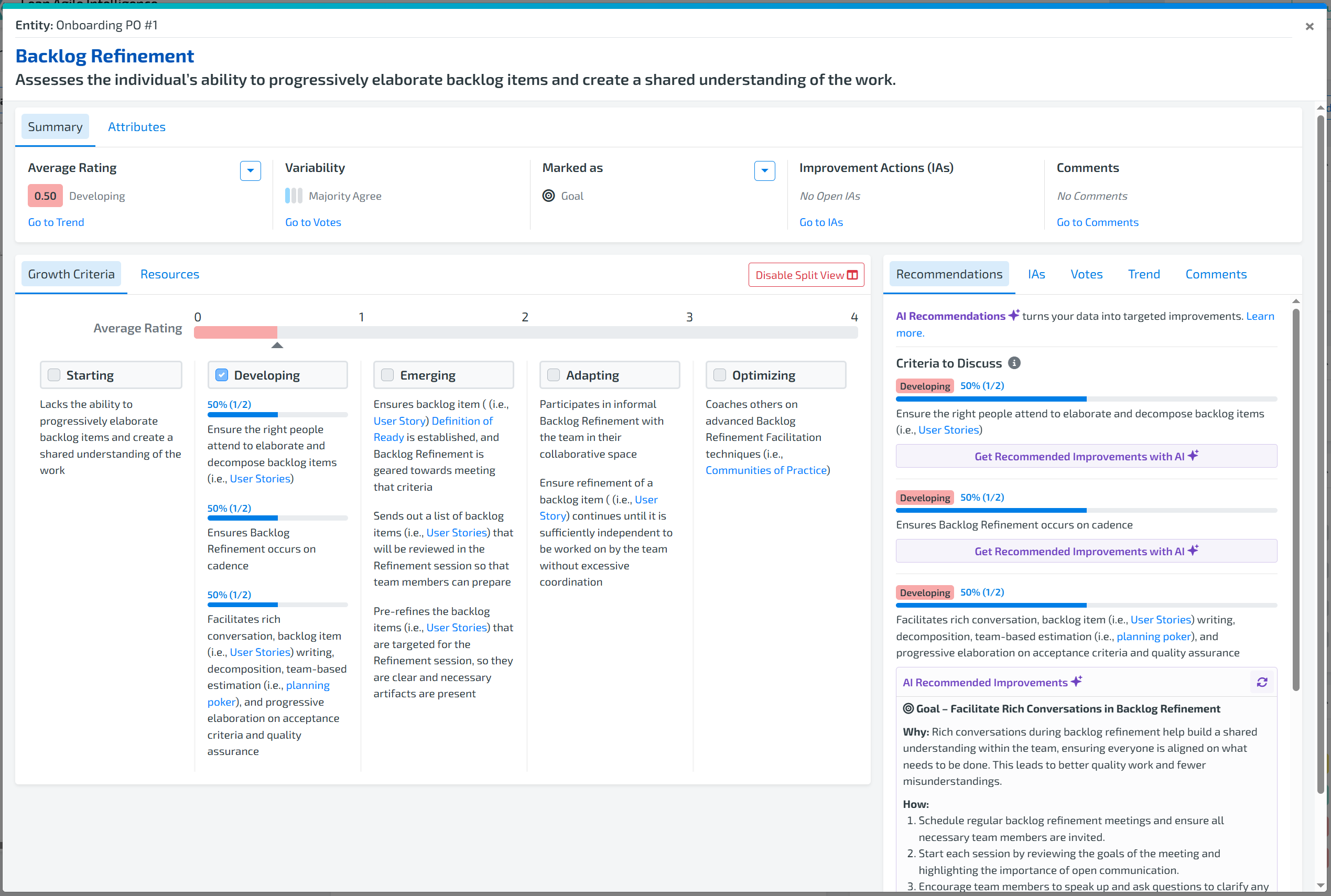
Check out this feature here.
Listening to the Market where Product Operating Model Is the Focus
In 2025, we also took action based on consistent client feedback.
Organizations want visibility into what is really happening at the product team level.
As more companies move toward Product Operating Models, leaders are realizing that implementation alone is not enough. Structures may change. Roles may be renamed. Ceremonies may be in place. Yet the outcomes that matter, faster delivery, adaptability, and customer impact, often stall.
This is where the industry is heading, and we responded.
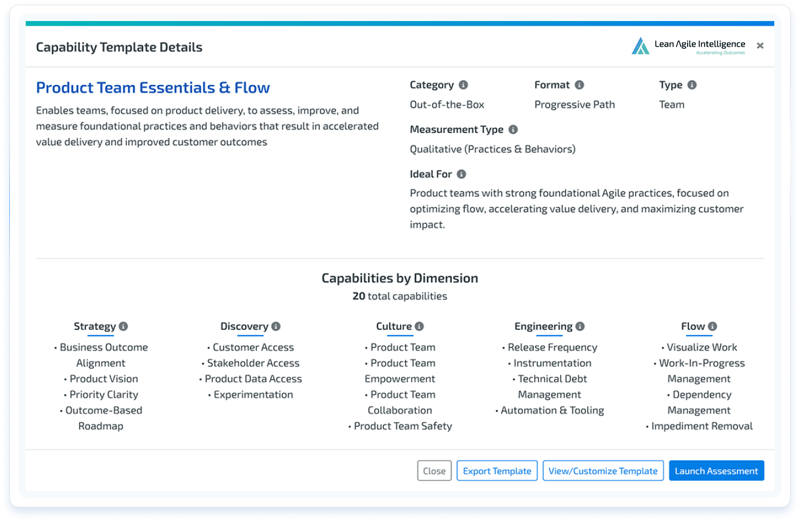
Our new Beta Program: Product Team Essentials & Flow Assessment
To support organizations navigating this shift, we created the Product Team Essentials & Flow Assessment, now available through our beta program.
Why Adoption Stalls
Many Product Operating Model transformations begin with energy and investment but lose momentum over time. Leaders often struggle to answer basic questions:
-
What progress have we actually made?
-
Where are the real gaps holding teams back?
-
What should we focus on next to improve results?
-
How do we scale what is working and fix what is not?
The core challenge is adoption and making the change sustainable.
Product Operating Models are designed to enable specific behaviors that drive speed and customer impact. But those outcomes only happen when teams consistently demonstrate those behaviors in their everyday work, not just in planning documents or org charts. High-performing organizations deliver value faster because their product teams make better decisions, adapt quickly, and learn continuously.
That is why product teams must be the center of adoption efforts.
A Quantified, Evidence-Based Approach
The Product Team Essentials & Flow Assessment clearly defines what effective product teams do. It focuses on observable, behavior-based practices rather than abstract ideas or opinions.
The assessment then measures the current state using a quantified, evidence-based approach. It does not check whether teams are following a process. It assesses whether the intended behaviors are present in actual work.
Each practice is evaluated using clear criteria that show whether it is established, emerging, or limiting performance. This gives teams and leaders a shared understanding of where they are and where focused action is needed.
What Organizations Gain
-
A shared definition of what good product practices look like.
-
Clear visibility into real team behaviors.
-
Early signals of systemic issues slowing delivery.
-
Aligned insights leaders can act on together.
-
Better focus for coaching and enablement efforts.
👉 Join our Beta Program and take the Product Team Essentials & Flow Assessment for a spin
Looking Ahead
2025 was a year of learning, refinement, and intentional progress at Lean Agile Intelligence.
-
We strengthened the platform.
-
We focused on helping organizations act on insights, not just collect them.
-
We listened to our clients and responded with a product designed for where the industry is going.
As we move into 2026, our focus remains the same: helping organizations move beyond surface-level change and achieve measurable, lasting impact.
👉 Join our Beta Program to explore what is possible with Lean Agile Intelligence