I worry that the DX and AI movements may be unintentionally setting collaboration back.
Maybe it’s because I spent years of blood, sweat, and tears trying to make collaboration a first-class citizen in organizations.
Trying to shift the mindset of traditional organizations away from individual functions, silos, and handoffs, and toward people banding together around common goals to deliver meaningful value to customers.
And I gained tremendous satisfaction from seeing the progress made. Not everywhere, of course, but in many places: happier employees, better collaboration, and better customer outcomes.
So when I look at the current wave of Developer Experience (DX) and AI adoption, I notice something that worries me: we may be quietly re-drawing the lines we spent a decade erasing.

First, for the record: I am not saying either the DX movement or the AI movement is bad. That is not the case at all.
On the DX side, improving the experience of the people who create value is absolutely necessary. We need better feedback loops. We need to understand friction. We need to remove unnecessary obstacles and create environments where people can do their best work.
AI may be an even bigger opportunity. We now have access to a once-in-a-generation technology with the potential to dramatically increase organizational capability and productivity.
But I worry that we are looking at both too locally.
Too often, the focus seems to be on the individual, particularly for developers.
But what happens when that individual improvement gets dropped back into the same slow, fragmented system surrounding it?
It gets absorbed. The queue is still the queue. The handoff is still the handoff. And the needle doesn’t move nearly as much as we expected.
There is growing evidence of this in recent AI ROI reports. Many organizations are reporting individual productivity gains but little to no bottom-line impact.

Why? Because, thanks in large part to the Agile movement, organizations increasingly deliver value through cross-functional groups of people working together to address a shared customer need. These teams typically bring together engineering, testing, product, design, and other necessary areas of expertise.
Their work is coordinated through shared practices such as sprints, planning sessions, product discovery, working agreements, team syncs, and a common definition of done.
Therefore, if organizations want to translate individual AI & DX productivity into measurable business impact, the next step must be team enablement.
Teams need to learn how to apply AI collectively across their end-to-end workflows, not simply as individuals using AI to complete isolated tasks more quickly.
I'll say the quiet part: none of this is groundbreaking. It's just worth repeating — again — because we seem to keep forgetting it
We made real, hard-earned progress during the Agile era making collaboration and teamwork first-class citizens, for the good of both people and customers.
And I think we've quietly given some of that ground back as DX and AI took the spotlight, because both movements, as currently practiced in a lot of organizations, default to optimizing the individual, not the system the individual works inside of.
The real opportunity isn't AI. It isn't DX. It's bringing all three together: AI, DX, and collaborative ways of working, viewed through a systems lens, not an individual one.
The next logical step for productivity gains with AI & DX is the team level, where people collaborate to deliver value.
If this perspective resonates with you, we're diving much deeper into exactly this challenge in an upcoming webinar.
Organizations are deploying AI at an unprecedented pace, yet very few are seeing measurable business impact. The reason isn't a lack of AI tools. It's that AI adoption often stops at the individual instead of becoming part of how teams work together.
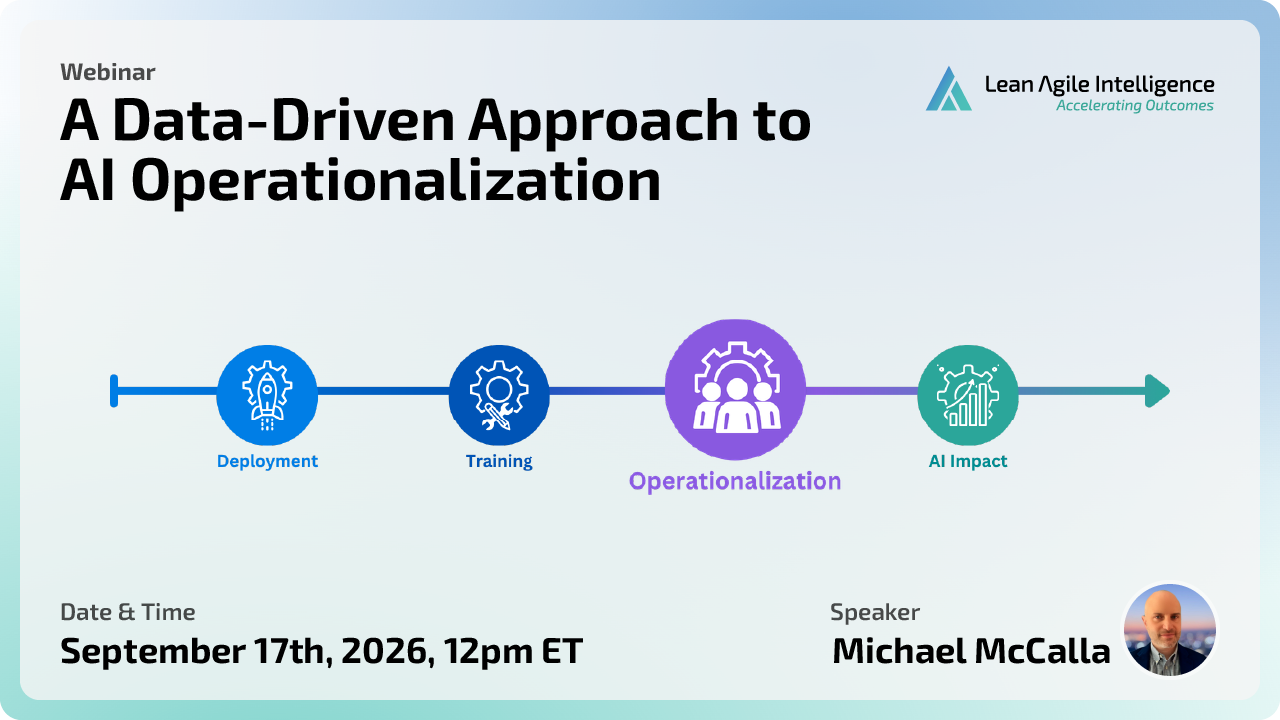
In this session, we'll explore a practical, data-driven approach to accelerating AI operationalization by moving beyond individual AI use toward shared practices that scale across teams and workflows.
You'll learn how to:
- Understand the AI Productivity Paradox and what causes it
- Define AI operationalization and how it differs from adoption
- View AI operationalization through an organizational change lens
- Identify practical ways to accelerate operationalization at the team and organizational levels
If you've been asking, "How do we turn individual AI productivity into organizational performance?" this webinar is for you.
🗓 September 17th | 12:00 PM ET
Hope to see you there. I think it will be a valuable discussion for anyone trying to move AI from isolated productivity gains to measurable business outcomes.