A few weeks ago, we hosted a webinar on how organizations can move from AI access to AI effectiveness, specifically through the lens of AI-assisted productivity. It was our most-attended webinar, reinforcing that this is a real pain point and one worth discussing more broadly.
AI-assisted productivity has become a major focus for organizations. With AI tools already deployed across most enterprises, the immediate question is no longer whether teams have access to AI, but whether they are building the capabilities needed to use it effectively. While AI has the potential to drive revenue growth, innovation, and entirely new business models, this article focuses on developing the AI-assisted capabilities that make teams measurably more productive.
The Supporting Data
Recent research from MIT, DORA, and Atlassian paints a consistent picture.
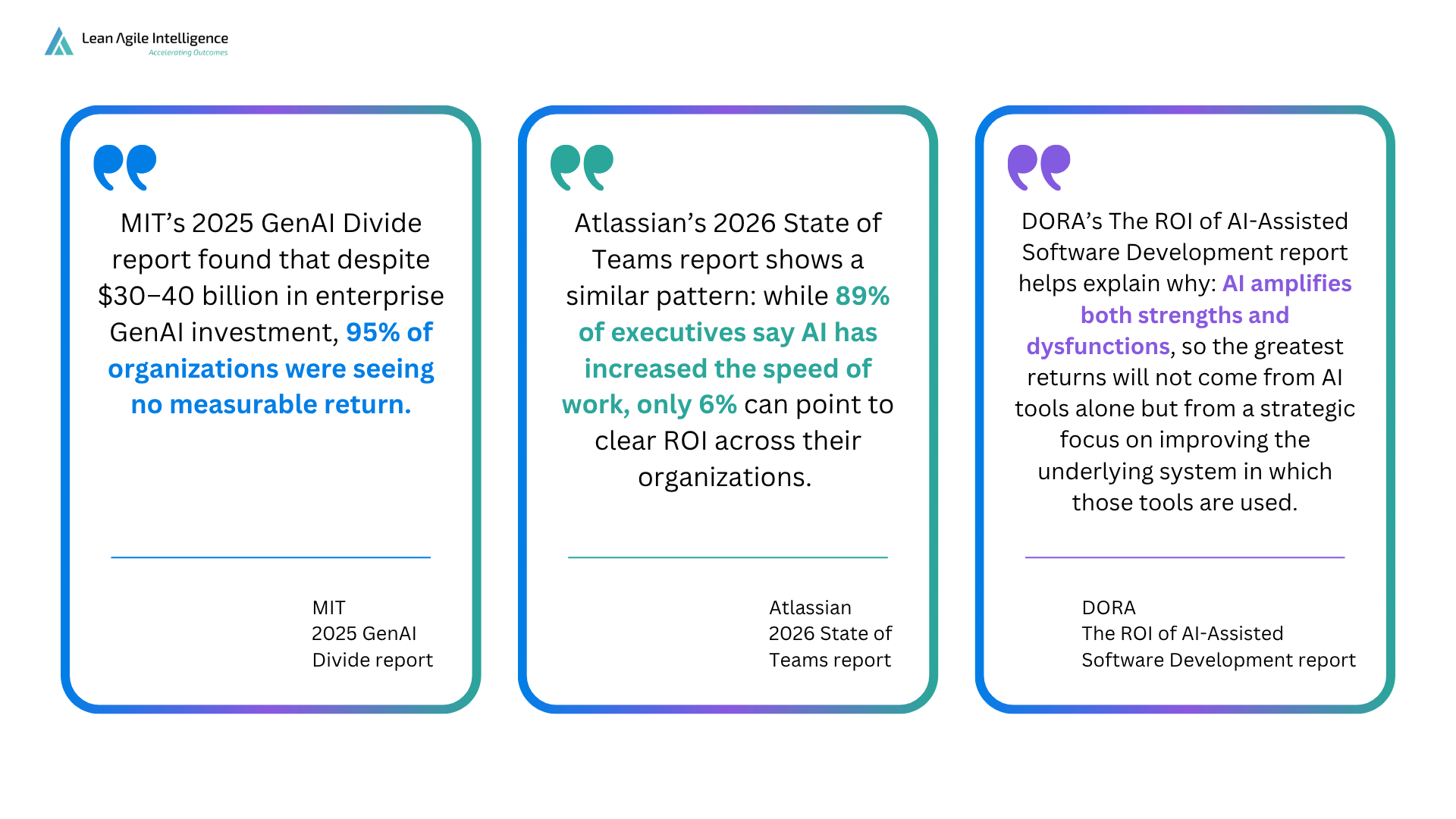
MIT’s 2025 GenAI Divide report found that despite $30–40 billion in enterprise GenAI investment, 95% of organizations were seeing no measurable return. Atlassian’s 2026 State of Teams report shows a similar pattern: while 89% of executives say AI has increased the speed of work, only 6% can point to clear ROI across their organizations. DORA’s The ROI of AI-Assisted Software Development report helps explain why: AI amplifies both strengths and dysfunctions, so the greatest returns will not come from AI tools alone but from a strategic focus on improving the underlying system in which those tools are used.
The pattern is hard to ignore. AI rollout is happening at scale, yet most organizations are still struggling to connect activity to outcomes.
What Past Movements Can Teach Us About AI
I am not an AI architect. I won’t tell you which model to deploy or how to design your RAG strategy.
What I understand is organizational change. For more than 20 years, I have helped organizations adopt new ways of working and realize business outcomes from transformation efforts. That is the lens through which I view AI — specifically, how organizations can turn adoption of new tools and ways of working into measurable productivity gains.
The pattern of failure is remarkably consistent across movements. Organizations race toward the new shiny object that promises to help them produce more, faster. They activate the change by communicating the vision, rolling out training, implementing tools, changing the terminology, and expecting the benefits to appear automatically.
When those benefits don’t materialize, disappointment sets in. Leaders blame the technology, the framework, or the people responsible for implementation. Then, because the underlying value is still too compelling to ignore, many organizations restart the journey under a new name.
Transformation 2.0, anyone?
AI is no different. The opportunity is real. The potential is significant. But here we are again:
Significant Deployment. Minimal Impact.
Deployment Creates Potential, Not Impact
In my experience, nine times out of ten, it is not a tool or framework problem. It is an operationalization problem.
By operationalization, I mean moving beyond awareness, training, and access to ensure that a change, including the new ways of working and tools it introduces, is applied effectively, consistently, and at scale to achieve desired outcomes.
Downloading a fitness app does not automatically help someone lose 20 pounds. The app only creates the potential to achieve the desired outcomes. Desired outcomes come from incorporating it into daily routines, changing behaviors, and sustaining those behaviors over time.
Organizational change works the same way. Deploying a new technology does not create an impact on its own. Value is realized when people integrate it into daily work, change their behaviors, and sustain those behaviors long enough to produce better outcomes.
Deployment introduces change. Operationalization turns that change into impact.
The Operationalization Gap
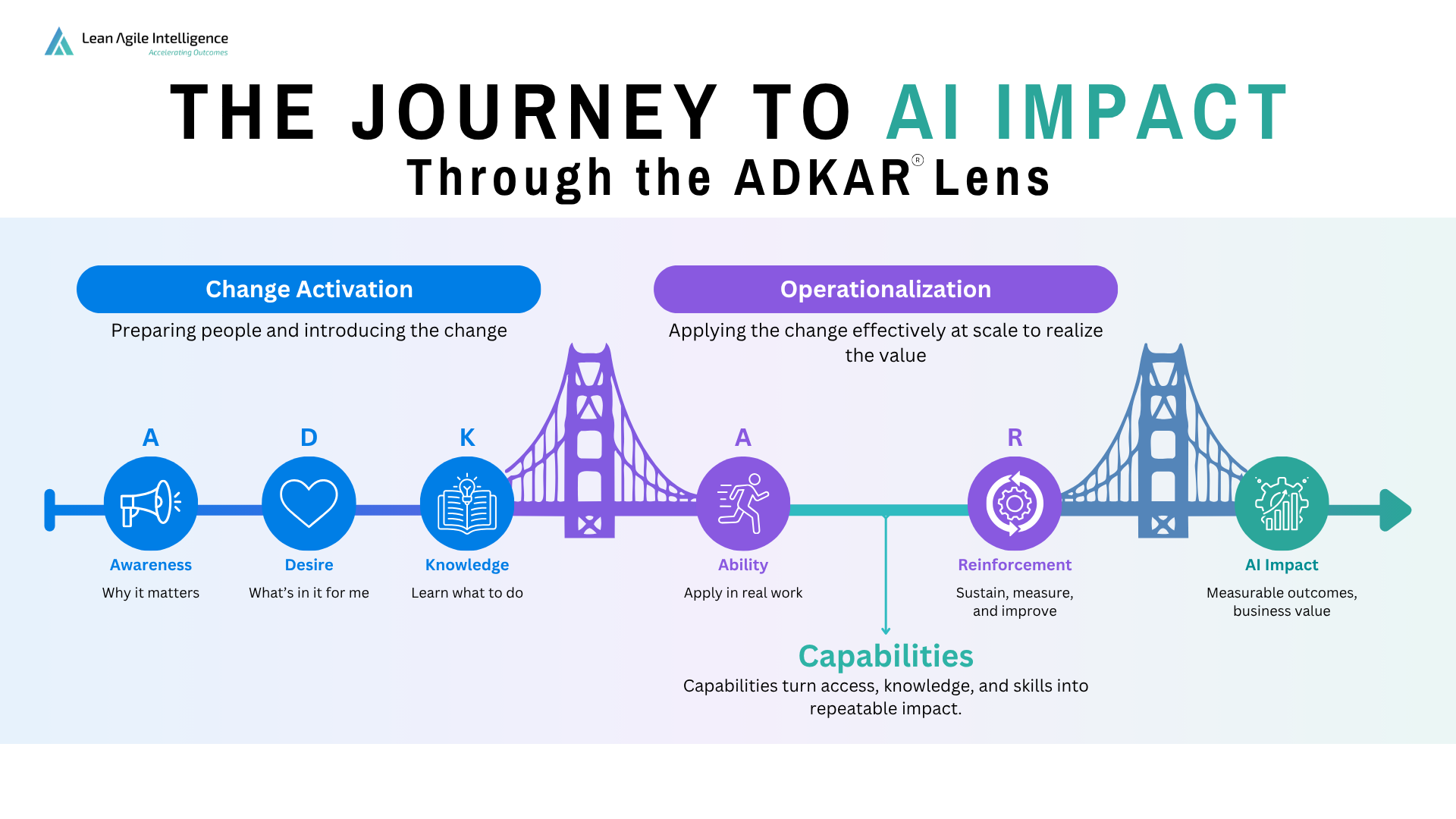
Prosci's ADKAR model provides a useful lens for analyzing this issue. It helps distinguish between the activities that introduce a change and those required to apply and sustain it.
The model outlines five stages: Awareness, Desire, Knowledge, Ability, and Reinforcement.
The intended journey looks something like this:
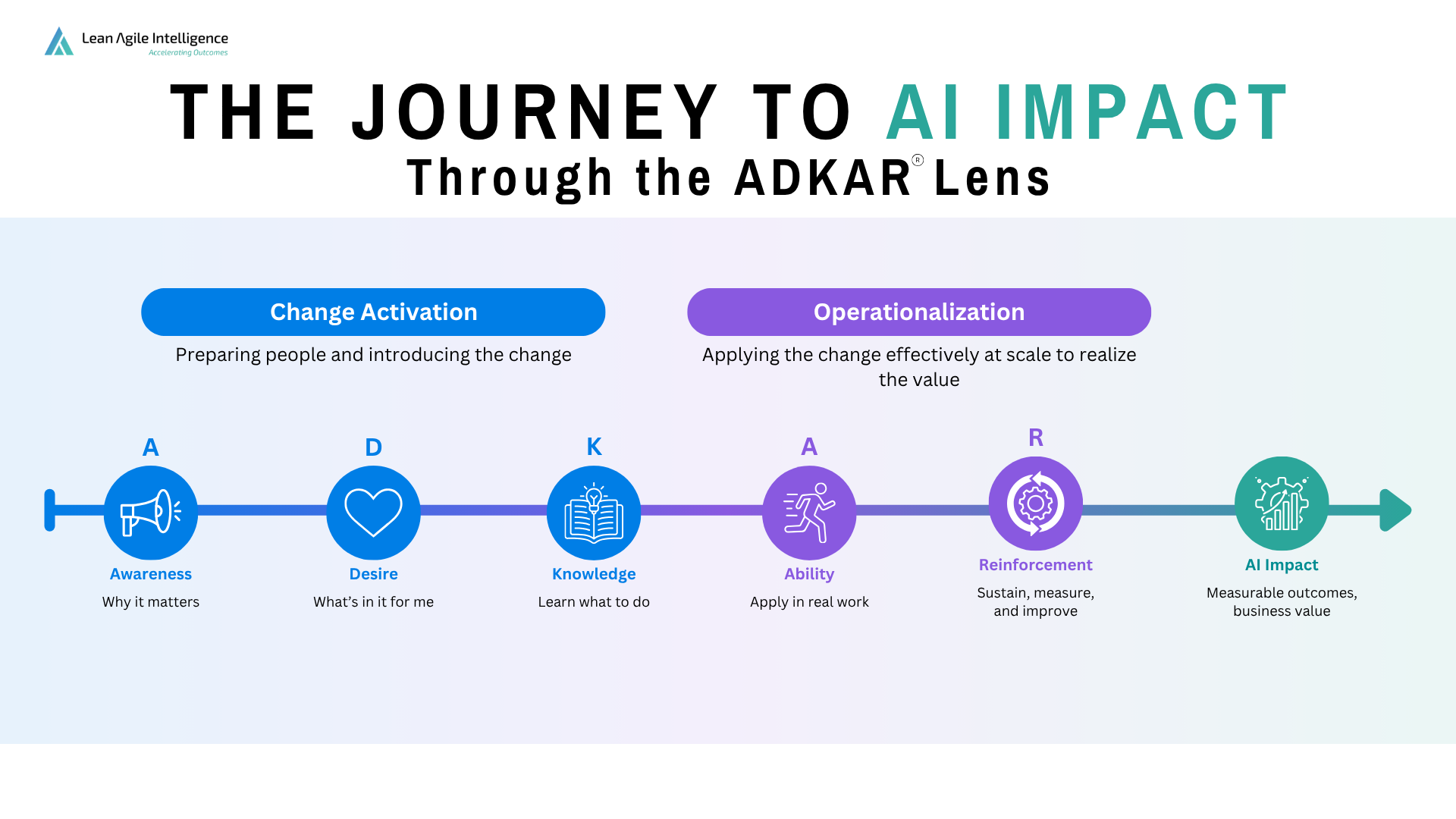
Many organizations do the first three stages well. They approach them with purpose, structure, and intent, investing in awareness campaigns, building desire, and delivering training. These activities are well understood and relatively predictable. This is what I refer to as change activation.
The problem is that most organizations mistakenly treat change activation as the finish line. They assume that once people have access to AI, understand its potential, and receive training, meaningful impact will naturally follow.
Unfortunately, it rarely does. This is where the final two stages become critical.
Ability is about whether people can effectively apply AI in their day-to-day work. Reinforcement is about whether those new ways of working are sustained, measured, and continuously improved over time. Together, these stages represent operationalization.
This is where many organizations struggle. People are given knowledge of what to do, but they struggle to consistently apply it in ways that change behavior, reshape how work gets done, and produce measurable outcomes.
That is the Operationalization Gap.
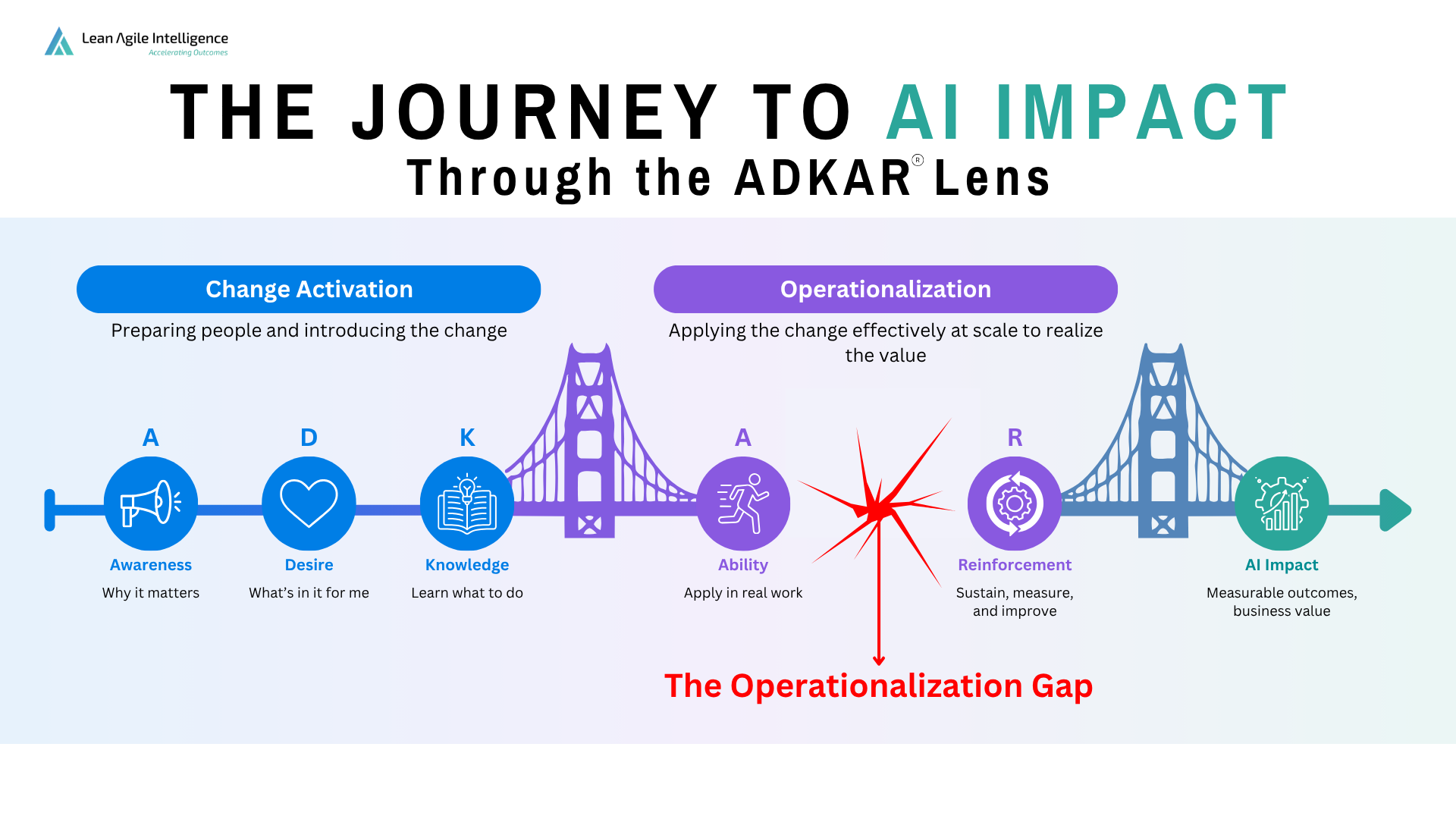
Operationalization is fundamentally different from change activation. It is less linear, more empirical, and significantly harder to execute. Success depends on learning, feedback, measurement, and adaptation within the realities of daily work.
MIT research reinforces this: many AI initiatives struggle not from lack of AI access, but from brittle workflows, limited contextual learning, and poor integration into daily operations.
Organizations do not underinvest in operationalization because it is less important. They underinvest because it is less understood, harder to execute, and more difficult to sustain. In my experience, many organizations recognize the challenge but lack a clear approach for addressing it.
Closing the Operationalization Gap Through Capabilities
Closing the operationalization gap requires organizations to move beyond deploying tools and delivering training and instead focus on building the capabilities teams need to apply AI effectively in real work.
A capability is a demonstrated ability to perform an activity effectively and consistently in a real-world context. Capabilities combine the knowledge, skills, behaviors, practices, and supporting conditions required to achieve a desired outcome.
This aligns with DORA’s research, The ROI of AI-Assisted Software Development, which suggests that the path to ROI is a sequence of capability-building, not a race to adopt the latest model. The question is not whether people have access to AI. It is whether the organization has built the capabilities needed for teams to apply AI effectively in real work.
Tools create access. Training creates knowledge. Practice creates skills.
Capabilities turn access, knowledge, and skills into repeatable impact.
Sign Up For AI Capability Beta Program
The Team Is the Unit of Scale
If capabilities are the key, which capabilities matter most? Where should organizations focus?
Focus on where value is delivered.
While AI is often experienced at the individual level, most business outcomes are produced by cross-functional teams. Work flows through a system of people, handoffs, decisions, reviews, and dependencies. As a result, organizational productivity is rarely constrained by the performance of a single individual. It is constrained by the team's collective ability to move work from idea to outcome.
Atlassian found that 85% of knowledge workers use AI, yet only 29% have embedded it into their actual workflows. As their report notes, just because one developer gets a 20% productivity gain does not mean the entire delivery cycle improves by 20%.
If one person becomes faster but the surrounding team’s skills and workflows remain unchanged, that productivity is absorbed by the system. The constraint shifts from the individual’s output to the team’s ability to absorb, review, integrate, and move work forward.
Value will not be delivered sooner until the team has the capabilities needed to complete deliverables together.
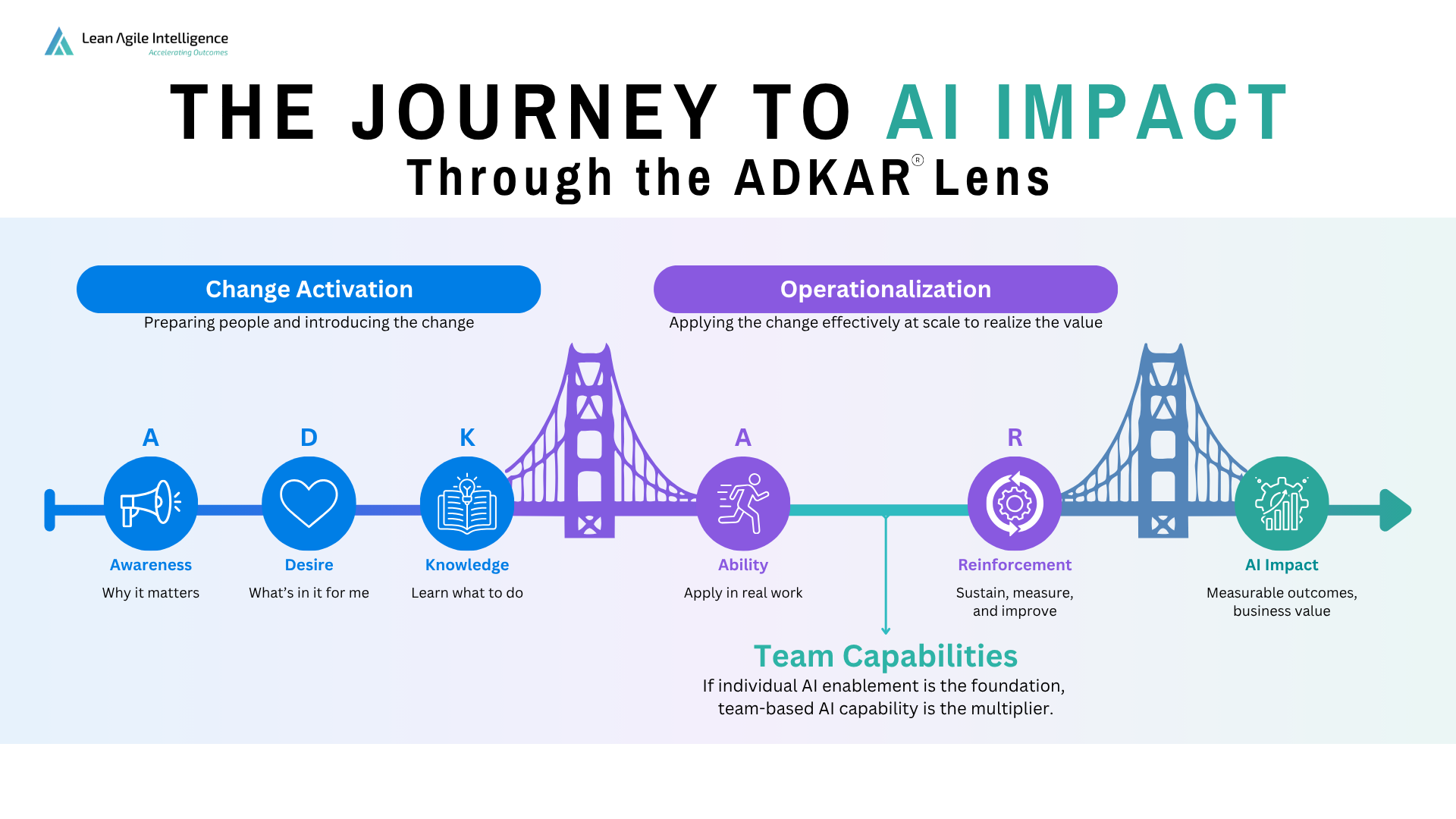
Individual enablement is still necessary. Teams cannot operationalize AI without basic AI literacy, prompting skills, and sound judgment around governance and risk. But organizations do not scale through individual excellence alone. They scale through shared, repeatable capabilities that fit their context.
Here are some simple examples of what that looks like in practice.
|
Team Capability |
Observable Behavior |
|
AI Prompting |
The team uses consistent, shared prompting approaches and has established standards for reviewing and validating AI-generated output before use. |
|
AI-Assisted Requirements Analysis |
The team regularly uses AI to draft, refine, and stress-test requirements, with a shared process for human review and sign-off. |
|
AI-Assisted Coding |
Developers use AI to accelerate code generation and review, with agreed team norms around quality checks, testing, and integration. |
When these capabilities are present, AI stops being a collection of individual productivity hacks and starts reshaping how work gets done collectively.
If individual AI enablement is the foundation, team-based AI capability is the multiplier.
Sign Up For AI Capability Beta Program
Measuring Capabilities as a Leading Indicator
Capabilities can feel invisible, but they aren’t. They show up through how people work, the decisions they make, the inputs and outputs they create, and the results they produce. Because capabilities are observable, they can be defined, assessed, benchmarked, and tracked over time.
This gives organizations a practical way to approach operationalization with the same purpose, rigor, and intent they bring to change activation.
It also gives leaders a mechanism to clarify where teams should focus their AI improvement efforts and helps teams understand what to improve and how.
Most organizations measure outcomes well: revenue, productivity, cycle time, cost, and customer satisfaction. These matter, but they are lagging indicators. By the time they move, the capabilities that produced them have often been in place for months.
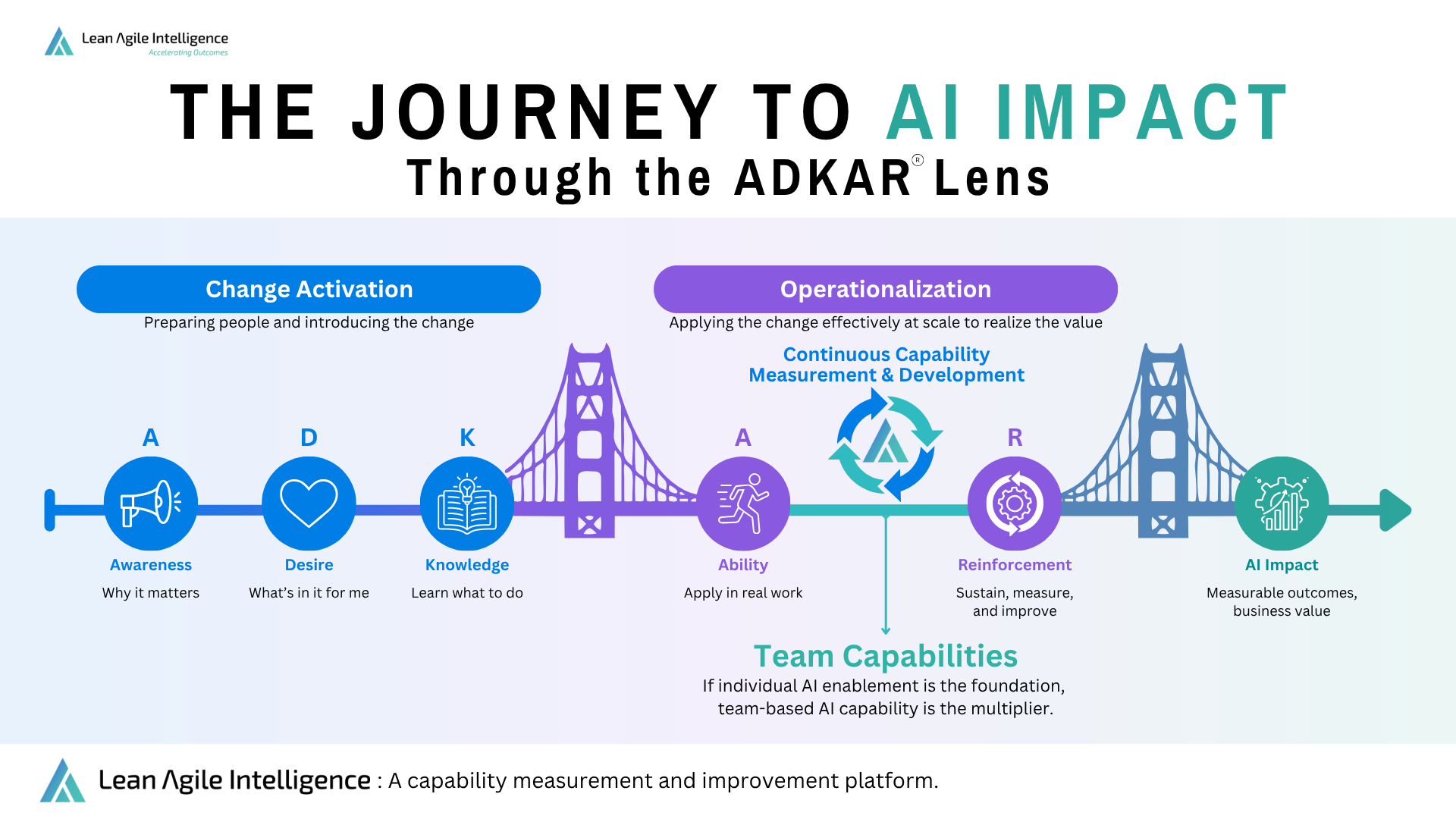
Measuring capabilities directly gives organizations an earlier signal: whether teams are building the skills, shared ways of working, and behaviors needed to turn AI access into real impact.
This connects directly to the final stage of Prosci’s ADKAR model: Reinforcement. You cannot reinforce what you cannot see. Measuring capabilities gives leaders the visibility needed to recognize progress, correct course, sustain the behaviors that drive results, and close the Operationalization Gap.
Sign Up For AI Capability Beta Program
Conclusion
AI adoption is following a familiar pattern: heavy investment, fast deployment, and the assumption that ROI will follow. It doesn’t. Not automatically.
Closing that gap takes deliberate, sustained effort: practice, learning, feedback loops, reinforcement, and measurement. The kind of intentional work that drives behavior change and workflow integration.
Impact is the outcome. Operationalization is the bridge.
The mechanism for getting there is building AI-assisted capabilities where value is delivered: the team. Individual AI excellence is not enough to scale. Enterprise value comes when teams redesign how they execute work together.
Because capabilities show up in observable behaviors, they can be measured. That makes them a leading indicator of future ROI, giving leaders an early signal of where teams are advancing, where they are stuck, and where support is needed before lagging metrics tell the story too late.
The real challenge is moving from the idea of capability building to the discipline of capability measurement: deciding what matters, defining what good looks like, and tracking progress consistently across teams.
A practical starting point: identify the 5 to 10 AI-assisted capabilities most critical to improving productivity, define observable behaviors for each, establish a baseline, and track improvement over time.
That discipline, more than any tool or model, is what separates organizations that talk about AI ROI from those that achieve it.
Lean Agile Intelligence is a capability measurement and improvement platform that helps organizations operationalize AI and accelerate impact.
Our AI Enablement & Productivity Assessments help organizations identify which AI-assisted capabilities matter most, establish a baseline, generate recommendations for improvement, and track progress over time.
We are currently offering a free beta program for organizations looking to move from AI access to AI effectiveness.