AI Adoption vs. AI Operationalization: Why Deploying Tools Isn't Enough
By Team Lean Agile Intelligence
For many organizations, AI adoption is no longer the primary challenge.
Employees have access to tools. Training programs are underway. Teams are experimenting with copilots, generative AI, and new forms of automation. Individual knowledge workers are finding ways to complete tasks faster.
Yet leadership teams are still asking a harder question:
Where is the measurable business impact?
That disconnect is at the center of what we call the AI Productivity Paradox, where individuals can become more productive using AI without the organization experiencing a comparable improvement in value delivery, cost, speed, quality, or other business outcomes.
In the LAI webinar AI Tooling Is Only the Starting Point, Michael McCalla pointed out that organizations have moved beyond asking whether people are using AI. The more important question is whether they are using it effectively, efficiently, and whether that usage translates into meaningful business value.
The distinction is important:
AI adoption gets people using AI. AI operationalization changes how work gets done.
What Is the Difference Between AI Adoption and AI Operationalization?
AI adoption is typically focused on introducing a change and helping people begin using it.
Employees need to understand why AI is being introduced, see value in changing their behavior, and develop the knowledge required to use new tools effectively.
But that is only part of the journey.
AI operationalization is the process of turning AI knowledge and individual usage into repeatable, shared capabilities embedded in day-to-day work.
Using the ADKAR change model as a lens, the webinar separates transformation into two broader phases:
-
Change Activation: Awareness, Desire, and Knowledge
-
Operationalization: Ability and Reinforcement
Change Activation prepares people for the change. Operationalization is where teams actually apply new capabilities in their work, improve them, and sustain them over time.
This is why an organization can have high AI adoption and still struggle to generate meaningful enterprise impact.
Employees may know how to use AI.
They may even use it every day.
But that does not necessarily mean teams have redesigned workflows, created shared AI-assisted practices, removed systemic barriers, established measures of success, or built feedback loops for continuous improvement.
That is the gap between deployment and operationalization or what we call the AI Operationalization Gap.
What Organizations Get Wrong About AI Adoption
Many organizations invest heavily in the first stages of change. Then they expect adoption to scale organically. However, it doesn’t quite work that way.
Here are several common patterns that can prevent enterprise AI adoption from becoming enterprise AI operationalization.
-
Treating tool deployment as the transformation
-
Giving employees access to ChatGPT, Copilot, or another AI platform creates opportunity. But it does not automatically change the operating model. Successful AI transformation requires building new organizational capabilities and ways of working, not simply introducing new technology.
-
Teams still need to determine where AI belongs within their workflows, what practices should change, where human judgment remains essential, and how new ways of working should be governed and improved.
-
-
Focusing almost entirely on individual fluency
-
Prompting skills and individual AI fluency matter. But enterprise performance depends on collective capabilities.
-
Organizations eventually need to move from: “Can our employees use AI?” to “Can our teams use AI together to perform important work more effectively?”
-
This requires looking beyond individual productivity and considering how AI affects the broader system of teams, workflows, and dependencies
-
-
Assuming training creates capability
-
Knowledge is not the same as ability.
-
Teams need opportunities to practice, experiment, receive coaching, evaluate results, and incorporate AI into real work. That takes time and deliberate capacity.
-
-
Leaving expectations unclear
-
If every team is independently trying to determine what AI adoption should look like, practices will vary dramatically.
-
Organizations need enough structure to define important capabilities and establish what good looks like without prescribing exactly how every team must get there.
-
-
Measuring usage without measuring improvement
-
Usage data can be useful, but leaders also need visibility into capabilities, barriers, workflow changes, progress, and relevant performance outcomes.
-
Without that broader view, leaders may know AI is being used but have little idea whether the organization is actually getting better.
-

How to Move From AI Adoption to AI Operationalization
Here’s a simple approach for navigating that complexity:
Be structured, intentional, and data-driven.
1. Structured: Define What Good Looks Like
- Organizations need to clarify the AI-enabled capabilities teams should develop.
- Depending on the environment, these might include:
-
-
AI fluency
-
Responsible AI and governance
-
Tools and data access
-
Prompting and output evaluation
-
AI value management
-
Use-case discovery and prioritization
-
AI-assisted product management
-
AI-assisted engineering
-
AI-assisted testing
-
Workflow redesign
-
- The purpose is not to prescribe exactly how every team works. It is to give teams a shared destination. Teams should understand the what while retaining autonomy over the how. A well-designed AI maturity model can provide that structure by defining what good looks like and giving teams a clear path for capability growth.
- A useful leadership question is:
- If a team were effectively operationalizing AI six months from now, what would we expect to see them doing differently?
- If leaders cannot answer that question clearly, teams will struggle to know what they are working toward.
Do you know where your teams currently stand? Explore LAI's AI assessment capabilities to establish a baseline across critical AI capabilities, identify gaps, and create a clearer picture of what good looks like.
2. Intentional: Build Capability Through Real Work
- AI capabilities will not develop through training alone.
- Teams need targeted support based on their specific needs. They need time to experiment with AI-assisted workflows, practice new behaviors, and learn through real work. That time needs to be intentional.
- Organizations may sometimes need to slow down in the short term to become significantly faster later. Time for experimentation and capability development needs to be considered in capacity planning rather than treated as extracurricular work.
- For leaders, that means asking:
-
-
What capabilities does this team need most?
-
Where could AI materially improve its workflow?
-
What barriers prevent the team from applying what it has learned?
-
Does the team have time to practice?
-
What coaching or enablement would help?
-
What experiment should the team run next?
-
- This shifts enablement from broad, one-size-fits-all training toward targeted capability development.
3. Data-Driven: Measure, Learn, and Adjust
- AI operationalization is an empirical process.
- Leaders need evidence showing where teams are progressing, where they are struggling, and where support or investment is needed.
- To do this, organizations need to be measuring adoption, examining performance metrics, collecting feedback, tracking capability growth, and establishing ownership for improvement. Decisions should be based on patterns across the system rather than one-off observations or anecdotes.
- One practical mechanism is a recurring team-level assessment.
- Assessments should not be treated as audits, grades, or HR evaluations. Their purpose should be to create a baseline, identify barriers, guide improvement, and help teams secure the support they need.
- A simple continuous improvement cycle looks like this:
- Baseline → Gap → Action → Measure → Improve
- That turns assessment into a management mechanism for the transformation rather than a reporting exercise.
🚀 Want to Accelerate AI Operationalization Across Your Organization?
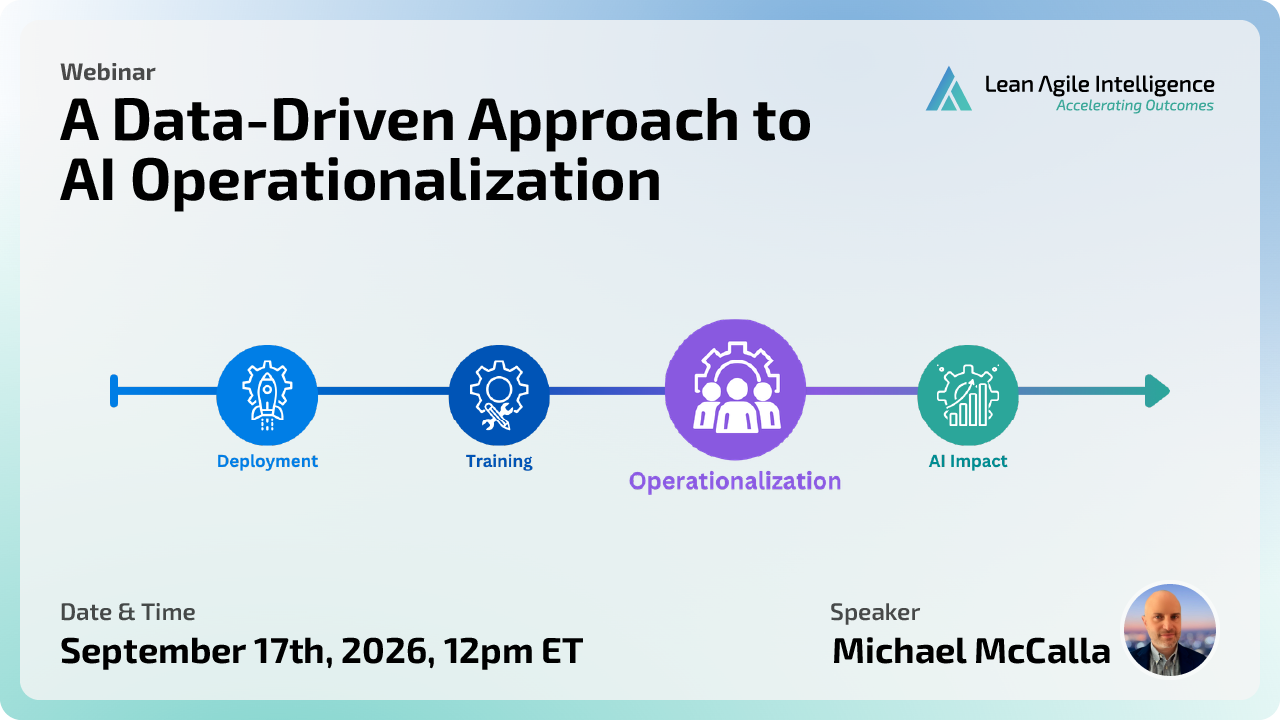
AI deployment is accelerating, but measurable impact isn’t keeping pace.
The next challenge isn’t simply giving people access to AI. It’s operationalizing AI so it can be used effectively, consistently, and at scale.
Join us on September 17 at 12 PM ET for our free webinar:
A Data-Driven Approach to AI Operationalization
Learn how to:
➤ Understand the AI Productivity Paradox and what causes it
➤ Define AI operationalization and how it differs from adoption
➤ View AI operationalization through an organizational change lens
➤ Identify practical ways to accelerate operationalization at the team and organizational levels
Move beyond AI deployment and start building a structured path toward measurable, scalable impact.
👉 Register for the Free Webinar

What Should Organizations Measure Beyond AI Adoption?
There is no single metric that proves AI operationalization is working.
Leaders need multiple layers of evidence.
-
Adoption and usage
-
Are people actually engaging with AI?
-
Start with basic signals:
-
Tool access
-
Active usage
-
Frequency of AI use
-
Relevant training or enablement participation
-
-
-
Capability maturity
-
Are teams developing the capabilities required to use AI effectively?
-
For example:
-
Can teams identify and prioritize valuable AI use cases?
-
Are shared AI-assisted workflows emerging?
-
Can employees evaluate AI output appropriately?
-
Are responsible AI practices understood and applied?
-
Do teams understand how AI affects their roles and workflows?
-
-
-
Improvement activity
-
Are teams actively improving how they use AI?
-
Track whether teams are actively working on the transformation:
-
Improvement actions identified
-
Actions assigned to owners
-
Experiments completed
-
Barriers removed
-
Practices adopted or refined
-
-
-
Team and organizational outcomes
-
Are the relevant business or delivery measures improving?
-
Depending on the use case, these could include:
-
Cycle time
-
Throughput
-
Quality
-
Rework
-
Cost
-
Employee capacity
-
Customer outcomes
-
Time to market
-
-
The objective is not to claim every performance improvement was caused by AI.
It is to understand whether increased AI capability and changing ways of working correlate with the outcomes the organization is trying to improve.
What Should Leaders Do Next?
Leaders responsible for enterprise AI adoption should first determine where the transformation is breaking down.
Start with five questions:
-
What business outcomes are we expecting AI to improve?
-
What AI-assisted capabilities do our teams need to develop?
-
Where is AI actually embedded into shared team workflows?
-
What barriers are preventing teams from progressing?
-
Can we measure progress across teams, portfolios, and the enterprise?
The answers will tell you whether your primary challenge is still AI adoption or whether you have entered the harder phase of AI operationalization.
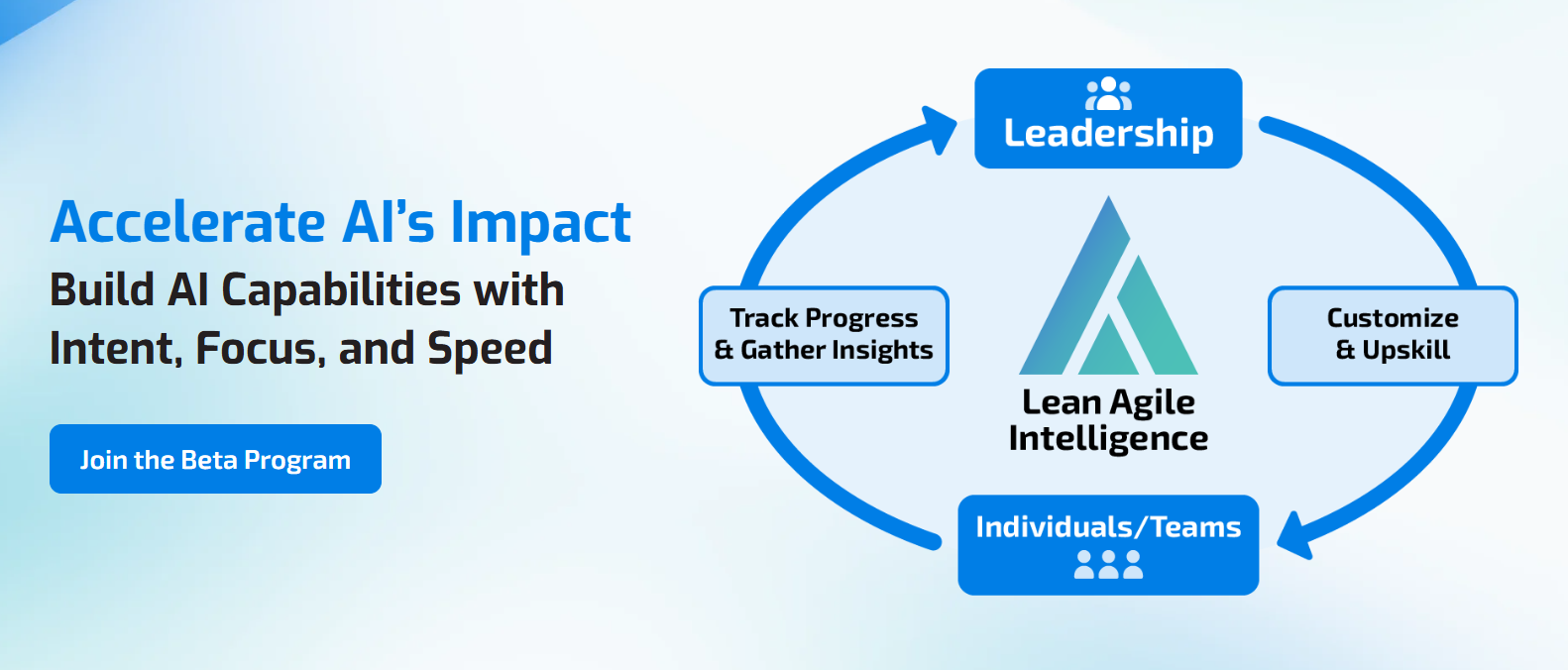
Organizations looking to test this approach can explore LAI's AI assessment beta program and use team-level assessments to establish a baseline, identify gaps, and begin building a measurable improvement cycle.
AI Adoption Is the Starting Point, Not the Finish Line
Organizations have made tremendous progress providing access to AI and building individual fluency.
Now the definition of success needs to evolve.
The next stage of AI adoption is not simply getting more people to use AI more often. It is building shared capabilities, redesigning workflows, creating feedback loops, removing barriers, measuring progress, and continuously improving how teams use AI to deliver value.
That is AI operationalization.
And because operationalization is fundamentally a transformation effort, it requires more than technology. It requires a structured, intentional, and data-driven approach that connects capability development to the way work actually gets done.
Organizations that make that shift will be in a much better position to answer the question leadership ultimately cares about:
Not “Are we using AI?” but “Are we getting better because of it?”
Ready to move beyond AI adoption and start operationalizing it across your teams?
Join Lean Agile Intelligence's AI Assessment Beta Program to assess current AI capabilities, establish a baseline, identify gaps and barriers, and create a more structured, data-driven path to improvement.