AI Infrastructure: Building the Foundation for Reliable, Scalable, and Secure AI
By Lean Agile Intelligence Product & Research Team
AI Infrastructure provides the technical foundation organizations need to move AI from individual experimentation into reliable, scalable, and secure work.
AI ambitions quickly outrun the infrastructure supporting them. A data scientist configures a local environment to test a model. Another team provisions its own cloud resources. Developers wait for specialized compute.
An AI solution works in a proof of concept but struggles when usage increases.
Each new initiative triggers another round of:
- Configuration
- Access requests
- Infrastructure setup
- Security work
- Deployment troubleshooting
The organization is experimenting with AI, but the underlying infrastructure is still assembled one use case at a time.
That creates more than technical inconvenience.
It increases the friction between: AI Opportunity → Experimentation → Deployment → Reliable Operation
AI workloads also introduce infrastructure requirements that differ from many traditional applications.
Depending on the use case, organizations need:
- Specialized compute
- Model access
- Dynamic scaling
- Deployment environments
- Storage
- Security controls
- Observability
- Networking
- Automated provisioning
- Cost management
DORA's research emphasizes flexible infrastructure and rapid resource provisioning as important characteristics of high-performing technology environments. Google Cloud's AI architecture guidance similarly emphasizes scalable infrastructure, standardization, automation, observability, and repeatable deployment practices.
Organizations don't simply need somewhere to run AI.
They need AI Infrastructure that reliably enables AI-powered work.
What Is AI Infrastructure?
AI Infrastructure is the organizational capability to provide the reliable, scalable, secure, and repeatable technical foundation required to develop, deploy, and operate AI-enabled solutions.
AI Infrastructure is one capability within LAI's broader AI Maturity Model, which evaluates the capabilities organizations need to move from AI adoption toward operationalization and measurable business outcomes.
That includes the:
- Environments
- Computing resources
- Model access
- Deployment mechanisms
- Storage
- Networking
- Identity and access controls
- Security controls
- Monitoring
- Automation
- Supporting platform services
required for AI-powered work.
A stronger AI Infrastructure capability helps organizations answer:
- Can teams get an AI environment when they need one?
- Is the required computing capacity available?
- Do teams use standard environments or build their own?
- Can AI solutions move reliably from development into production?
- Does infrastructure scale with demand?
- Is provisioning automated?
- Are deployment patterns repeatable?
- Can infrastructure reliability be monitored?
- Can security and access controls be applied consistently?
- Can infrastructure cost and utilization be understood?
- Does the infrastructure evolve as AI needs change?
The objective is not: More GPUs
or: A larger centralized AI platform
It is: Less technical friction between an AI opportunity and a reliable environment capable of supporting it.
The central question therefore becomes: Can our AI Infrastructure reliably enable AI work at the speed and scale the organization requires?
What Level of AI Infrastructure Maturity Are You?
Before strengthening AI Infrastructure, identify whether teams still build technical environments independently or whether infrastructure has become a shared and increasingly automated organizational capability.
LAI's AI Infrastructure Maturity Model uses five levels to describe that progression.
| Level | Where You Are | Primary Focus |
|---|---|---|
| Level 1: Starting | AI experimentation depends heavily on local machines, manually configured environments, and whatever technical resources teams can obtain. | Identify the infrastructure friction repeatedly slowing AI work. |
| Level 2: Emerging | Teams provision more capable AI environments independently, but configurations, controls, and infrastructure knowledge remain fragmented. | Turn repeated infrastructure configurations into reusable patterns. |
| Level 3: Enabling | Shared environments, supported compute, standard configurations, and repeatable deployment paths are available to teams. | Turn shared infrastructure into an easy-to-consume internal platform capability. |
| Level 4: Operationalizing | Provisioning, deployment, scaling, security, and monitoring are integrated directly into the AI workflow. | Automate the path from development to a reliable running environment. |
| Level 5: Optimizing | AI Infrastructure continuously improves based on demand, performance, reliability, cost, developer experience, and changing AI needs. | Continuously improve infrastructure effectiveness rather than simply adding capacity. |
The objective is not to evaluate how sophisticated the technology stack looks.
It is to understand: How reliably can teams obtain and operate the infrastructure their AI work actually requires?
The Five Levels of AI Infrastructure Maturity
LAI's AI Infrastructure Maturity Model describes how organizations progress from isolated technical setups toward standardized, automated infrastructure that becomes part of the normal AI delivery workflow.
The five levels are: Starting → Emerging → Enabling → Operationalizing → Optimizing
The progression moves from: Local Setups → Independent Provisioning → Shared Infrastructure → Automated AI Workflows → Continuous Optimization
Initially, teams assemble whatever environments they need to experiment.
Repeated configurations reveal common infrastructure needs.
Standard environments make those capabilities reusable.
Automation embeds provisioning and deployment directly into the AI workflow.
Measurement and learning then improve:
- Provisioning
- Deployment
- Scaling
- Reliability
- Capacity
- Cost
- Developer experience
The objective is not: Build the biggest AI platform.
It is: Create a technical foundation that makes reliable AI work progressively easier to develop, deploy, and operate.

Level 1: Starting — AI Runs Wherever Teams Can Make It Work
At the Starting level, shared AI Infrastructure is largely absent.
Experiments depend on:
- Individual laptops
- Manually configured environments
- Locally installed dependencies
- Whatever cloud resources a team can obtain
- Manually coordinated compute
A proof of concept works perfectly on one developer's machine but has no obvious path to a shared environment.
Developers spend significant time configuring libraries and dependencies before experimentation begins.
Specialized compute is difficult to obtain.
AI adoption can begin at this level, but the infrastructure does not yet reliably support broader use.
Observable Evidence
Common signals include:
- No shared AI infrastructure
- Manual environment setup
- Local-only AI execution
- Limited computing resources
- Repeated dependency configuration
- Manual access requests
- No repeatable deployment path
The critical problem is not simply decentralization.
It is: Every AI effort begins by rebuilding the technical foundation required to do the work.
How to Progress to Emerging
Start by understanding the infrastructure required by AI work already happening.
Do not begin by designing a comprehensive enterprise AI platform for every future scenario.
Select a few representative AI use cases. Identify what teams repeatedly need.
Typical requirements include:
- Compute
- Storage
- Model access
- Development environments
- Secrets management
- Network connectivity
- Logging
- Deployment
- Data access
- Security controls
Look for repeated friction.
The objective is to create the first shared technical foundation based on: Real AI demand
rather than: Hypothetical future requirements
Practical Example: Create an AI Infrastructure Friction Map
Select three active AI use cases.
For each one, document: Use Case → Environment → Compute → Data → Model → Security → Deployment → Current Setup Time
For example:
| AI Use Case | Infrastructure Friction |
|---|---|
| Internal knowledge assistant | Developers configure environments manually |
| Model experimentation | GPU access requires manual coordination |
| Customer-support AI | No shared deployment environment |
| Document processing | Each developer maintains local dependencies |
Then ask:
- Which setup step repeats most often?
- Where are teams waiting?
- Which environments could be shared?
- Which resources are difficult to obtain?
- Which manual configuration should be standardized first?
Do not try to solve everything. Choose one high-frequency infrastructure problem and make it easier.
The progression at Starting is: Isolated Technical Setup → Initial Shared Foundation
Level 2: Emerging — Teams Build Their Own AI Environments
At the Emerging level, AI Infrastructure becomes more capable, but teams still create and provision environments independently.
One team configures a cloud environment. Another hosts models locally.
A third creates custom infrastructure for its AI application.
Different projects use different:
- Compute configurations
- Security patterns
- Deployment approaches
- Networking models
- Logging practices
The organization is learning what infrastructure AI requires.
But infrastructure knowledge remains distributed.
Observable Evidence
Observable signals include:
- One-off AI environment provisioning
- Local model hosting
- Infrastructure configurations specific to individual AI workloads
- Ad hoc cloud AI environments
- Repeated security configuration
- Duplicate deployment patterns
- Specialists repeatedly helping teams solve similar setup problems
AI work is progressing.
Infrastructure capability is not yet reusable enough.
How to Progress to Enabling
Identify the technical configurations teams repeatedly create.
Ask:
- Which environments look similar?
- Which compute configurations repeatedly appear?
- Which security controls recur?
- Which model-access patterns recur?
- Which deployment steps are duplicated?
- What does every team configure before meaningful AI work begins?
- Where are specialists repeatedly solving the same infrastructure problem?
Turn those recurring configurations into reusable patterns.
The progression becomes: "This team knows how to build an AI environment."
to: "The organization has a supported pattern for this type of AI environment."
Practical Example: Create a Standard AI Environment Template
Choose one common workload.
For example:
Standard Generative AI Development Environment
Compute
- Approved CPU/GPU configuration
Models
- Access to approved enterprise models
Storage
- Standard development storage
Security
- Identity-based access
- Secrets management
- Logging enabled
Development
- Standard runtime
- Approved libraries
- Source-control integration
Observability
- Resource logging
- Application logging
Deployment
- Defined path into a test environment
Automate as much configuration as practical through repeatable infrastructure definitions.
Instead of developers asking: "How do I build an AI environment?"
they should increasingly ask: "Which standard environment fits this use case?"

Level 3: Enabling — Standard AI Infrastructure Is Available
At the Enabling level, the organization has moved from reusable patterns to a shared AI Infrastructure capability.
Teams have access to standard environments. Computing resources are intentionally available. Supported deployment mechanisms exist. Provisioning becomes more consistent.
AI initiatives no longer rebuild the entire technical foundation independently.
Observable Evidence
Observable evidence includes:
- Shared AI Infrastructure
- Intentional compute availability
- Standard AI environments
- Supported model deployment
- Common security patterns
- Repeatable provisioning
- Defined infrastructure ownership
- Standard monitoring capabilities
The organization moves from: "We know how to provision AI Infrastructure."
to: "Teams know where to go to obtain the infrastructure they need."
How to Progress to Operationalizing
Turn shared infrastructure into a self-service internal platform experience. Teams should increasingly obtain common AI capabilities without relying on infrastructure specialists to manually configure every resource. Self-service does not mean unrestricted access.
The platform should provide: Safe, approved, repeatable paths that make the preferred way of working easier.
The objective is not to create a rigid platform that blocks legitimate variation.
It is to provide strong defaults for common AI workloads while preserving a path for exceptions.
Practical Example: Create an AI Infrastructure Service Catalog
Create a small catalog of supported environments.
AI Experiment Environment
- Best for:
- Early experimentation
- Prompt testing
- Prototypes
- Includes:
- Approved model access
- Standard runtime
- Limited compute
- Logging
AI Development Environment
- Best for:
- Application development
- Integration testing
- Team collaboration
- Includes:
- Scalable compute
- Shared storage
- CI/CD integration
- Security controls
- Monitoring
Production AI Environment
- Best for:
- Enterprise workflows
- Customer-facing AI
- Higher-volume workloads
- Includes:
- Automated deployment
- Scaling
- Availability controls
- Advanced monitoring
- Security controls
- Backup and recovery
For every environment, document: Purpose → Included Capabilities → Provisioning Method → Expected Provisioning Time → Owner
Then measure adoption. If teams continue building their own infrastructure, investigate why.
The objective is not to force standardization.
It is: Make the standard path easier than rebuilding the infrastructure independently.

Level 4: Operationalizing — AI Infrastructure Becomes Part of the Workflow
At the Operationalizing level, AI Infrastructure becomes integrated directly into the workflow through which AI systems are developed, deployed, and operated.
Teams no longer routinely submit manual requests and wait for someone to configure an environment.
Provisioning, deployment, security, scaling, and monitoring increasingly happen through repeatable automation.
This represents the maturity shift from: Infrastructure available
to: Infrastructure consumed as part of normal AI work
Observable Evidence
Observable evidence includes:
- Automated AI-environment provisioning
- Standard deployment workflows
- Automated scaling
- Security controls applied automatically
- Monitoring enabled consistently
- Reduced environment-provisioning time
- Reduced manual infrastructure-team intervention
At Enabling: Shared infrastructure exists.
At Operationalizing: The AI workflow reliably consumes that infrastructure when needed.
How to Progress to Optimizing
Automate the path from development to a reliable running environment.
A common AI workflow becomes:
Code / Model Change
↓
Automated Validation
↓
Infrastructure Provisioned
↓
AI Artifact Deployed
↓
Security Controls Applied
↓
Monitoring Enabled
↓
Environment Available
The infrastructure should increasingly become part of the delivery system rather than a separate activity teams wait on.
Dynamic scaling also matters because AI workloads vary significantly.
Demand changes with:
- Experimentation
- Model size
- Training workloads
- Inference volume
- Agent activity
- Data processing
The organization should make those requirements measurable rather than relying entirely on static provisioning.
Practical Example: Create a Self-Service AI Environment
Choose one standard AI environment and automate provisioning.
A developer provides:
- Project Name
- Environment Type
- Compute Profile
- Model Required
- Data Classification
Automation then:
- Provisions the environment
- Applies network controls
- Applies identity controls
- Configures model access
- Enables logging
- Enables monitoring
- Creates required storage
- Applies resource limits
- Connects the deployment pipeline
- Returns access information
Then measure:
- Provisioning Lead Time
- How long from request to usable environment?
- Manual Touches
- How many infrastructure-team actions remain?
- Deployment Reliability
- How often does deployment complete without manual intervention?
- Resource Utilization
- Is significantly more or less infrastructure being provisioned than the workload requires?
- Availability
- Can important AI workloads reliably obtain the infrastructure they need?
For example:
- Before automation:
Several days to provision a standard environment. - After automation:
A substantially shorter provisioning process.
The exact number matters less than the direction and reliability of the improvement.
The objective is: Make infrastructure an enabler of AI flow rather than a dependency teams repeatedly wait on.

Level 5: Optimizing — Infrastructure Evolves With AI Demand
At the Optimizing level, AI Infrastructure continuously evolves based on actual demand, performance, reliability, cost, developer experience, and changing AI requirements.
AI infrastructure needs change quickly. New models require different compute profiles. Agentic systems introduce new demand patterns. Workloads move from experimentation into production. Inference demand grows. Infrastructure capabilities improve. Cost structures change. An infrastructure design that worked well six months ago does not automatically remain the right design today.
The organization therefore moves from asking: "Can our infrastructure support AI?"
to: "How should our infrastructure evolve to support AI work more effectively?"
Observable Evidence
Observable signals include:
- Regular AI Infrastructure reviews
- Comprehensive infrastructure monitoring
- On-demand provisioning
- Capacity adjusted to demand
- Improving provisioning and deployment trends
- Cost optimization
- Infrastructure capabilities evolving with AI workloads
- Improving developer experience
How to Sustain and Continuously Improve
Create a continuous infrastructure improvement loop: Observe → Measure → Learn → Optimize
Examine both: Infrastructure Performance
and: User Experience
Useful areas include:
- Latency
- Traffic
- Errors
- Availability
- Resource saturation
- CPU/GPU utilization
- Provisioning time
- Deployment time
- Failure rate
- Infrastructure cost
- Developer waiting time
The objective is not simply to make technical metrics look better.
Use those measures to understand whether infrastructure is becoming easier and more reliable for the teams doing AI work.
Practical Example: Run a Quarterly AI Infrastructure Review
Review the infrastructure across five areas.
1. Demand
Ask:
- Which environments are most heavily used?
- Where is compute demand increasing?
- Which new AI use cases are emerging?
- Which model capabilities are teams requesting?
- Where are agent workloads changing usage patterns?
2. Performance
Track:
- Provisioning time
- Deployment time
- Compute time
- Latency
- Availability
- Failure rate
3. Capacity
Review:
- CPU/GPU utilization
- Peak demand
- Resource constraints
- Scaling events
- Queue time
- Wait time
4. Cost
Examine:
- Cost by workload
- Idle infrastructure
- Underused resources
- Expensive workload patterns
- Cost changes as demand scales
5. Developer Experience
Ask:
- Where are teams still waiting?
- Which requests remain manual?
- Which infrastructure capabilities are difficult to use?
- What infrastructure are teams still building themselves?
- Where do teams avoid the standard platform?
Turn those findings into an AI Infrastructure Improvement Backlog.
| Improvement | Reason | Measure |
|---|---|---|
| Add GPU autoscaling | Demand varies significantly | Utilization / cost |
| Automate development environments | Manual setup still occurs | Provisioning time |
| Add new model-serving profile | Larger models are being adopted | Deployment reliability |
| Improve infrastructure observability | Performance issues surface too late | Detection time |
| Simplify self-service provisioning | Teams still submit manual requests | Manual touches |
| Retire unused environment | Low demand | Infrastructure cost |
Then choose: Keep → Automate → Scale → Right-Size → Simplify → Expand → Retire
Optimization is not simply: More infrastructure.
It is infrastructure that becomes:
- More available when needed
- More efficient when used
and: Less visible as friction to the people doing AI-powered work
Connecting AI Infrastructure to AI Adoption and AI Transformation
AI Infrastructure supports AI adoption and AI transformation by giving teams a reliable technical path from experimentation into repeatable, operational AI workflows.
AI adoption can begin with very little infrastructure. An employee can use an AI assistant immediately. A developer can create a local prototype. A team can run a small experiment.
But as AI usage expands, organizations need increasingly repeatable technical foundations.
A useful progression is: AI Adoption → Growing AI Demand → Shared Infrastructure → Automated AI Workflow → AI Transformation
AI Adoption Creates Demand
- More employees and teams identify AI opportunities.
Shared Infrastructure Reduces Rebuilding
- Common environments, compute, security, and deployment capabilities become reusable.
Automation Makes AI Work Repeatable
- Infrastructure becomes part of development and delivery workflows.
AI Transformation Requires Operational Scale
- More important AI-enabled processes depend on infrastructure being:
- Reliable
- Secure
- Observable
- Scalable
- Available when needed
This is why infrastructure should not be treated only as a technology concern.
As AI transformation progresses, infrastructure increasingly determines how easily teams move from:
Idea → Experiment → Working AI System → Operational Workflow
The objective is not to claim that stronger AI Infrastructure alone creates AI transformation.
It is to establish the technical conditions required for AI-enabled work to move beyond isolated experimentation.
Related capabilities: AI Security, AI Governance
Key Takeaway
AI Infrastructure maturity isn't measured by how much compute an organization owns or how sophisticated its platform appears. It is demonstrated when teams can reliably obtain, deploy, scale, monitor, and operate the infrastructure their AI work requires—and that capability continuously improves as demand evolves.
From AI Adoption to Operational AI Workflows
AI Infrastructure becomes operationalized when shared technical environments evolve into automated capabilities embedded directly into the AI workflow.
AI adoption can begin on a laptop. Enterprise AI cannot depend on one.
The AI Infrastructure Maturity Model progresses from:
Local Setups → Independent Provisioning → Shared Infrastructure → Automated AI Workflows → Continuous Optimization
Initially, teams use whatever technical resources allow them to experiment. Repeated patterns reveal common infrastructure needs. Standard environments reduce duplicated effort. Self-service capabilities make infrastructure easier to consume.
Automation integrates provisioning, deployment, scaling, security, and monitoring into the AI workflow.
Measurement and continuous improvement then help infrastructure keep pace with changing demand.
That is the difference between: Infrastructure that can run AI
and: Infrastructure operationalized for AI-enabled work
The goal is not to build the largest or most sophisticated AI platform.
It is to create: A reliable, scalable, secure, and increasingly automated technical foundation that makes valuable AI work easier to develop, deploy, and operate.
Evaluate Whether AI Infrastructure Is Actually Enabling the Work
Having cloud resources, GPUs, or AI environments demonstrates technical availability.
The more important question is whether teams can reliably obtain and operate the infrastructure needed for AI work without repeatedly rebuilding the technical foundation.
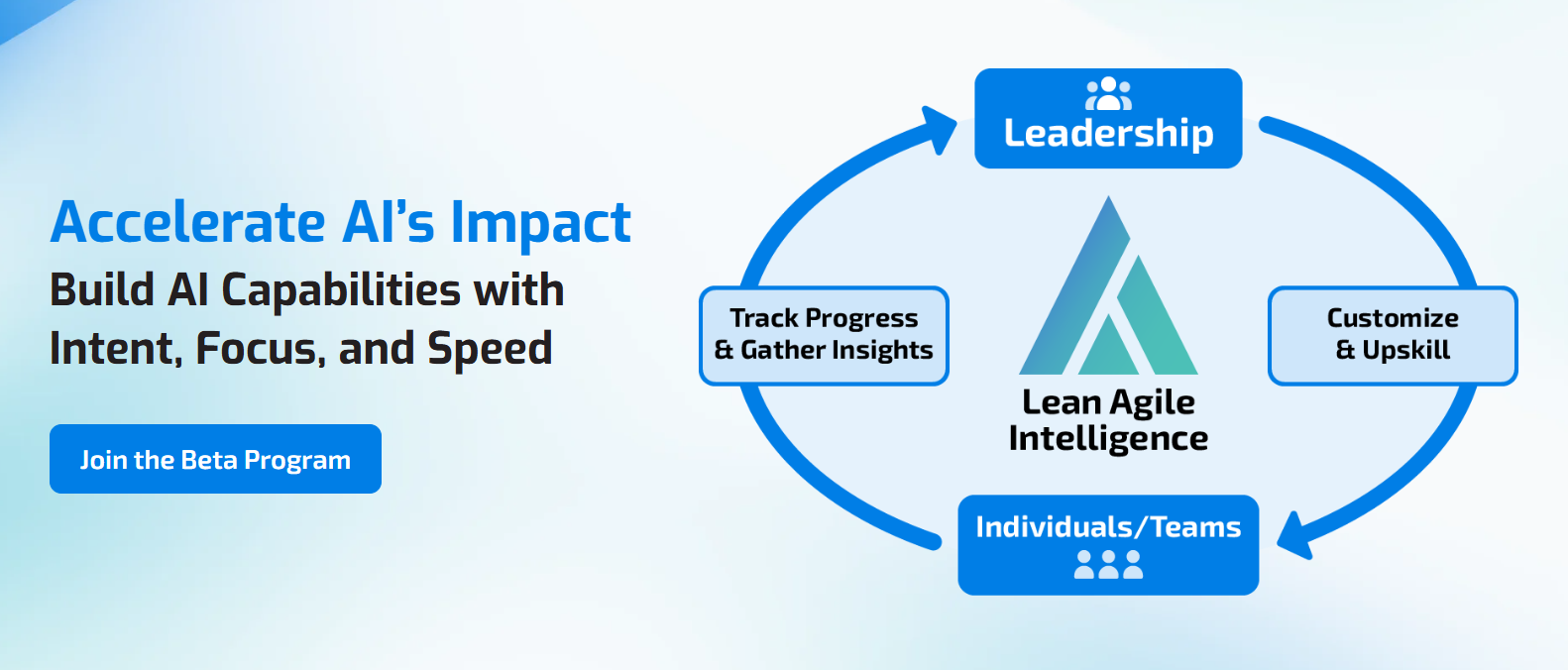
Lean Agile Intelligence helps organizations establish a baseline across AI capabilities and determine whether AI Infrastructure remains dependent on local setups, has become a shared capability, or is embedded directly into standard AI workflows.
For AI Infrastructure, that means evaluating whether the organization:
- Understands the infrastructure needs of important AI use cases
- Reduces repeated local environment setup
- Creates reusable infrastructure patterns
- Provides standard AI environments
- Makes compute intentionally available
- Establishes supported deployment paths
- Provides self-service capabilities where appropriate
- Automates environment provisioning
- Integrates security controls into standard workflows
- Automates scaling where appropriate
- Monitors infrastructure reliability and performance
- Measures provisioning and deployment lead time
- Reviews capacity and cost
- Improves developer experience
- Continuously adapts infrastructure as AI demand changes
LAI's AI Enablement & Productivity Assessment establishes a baseline across AI Infrastructure and the related capabilities teams need to operationalize AI, identifies gaps, and measures progress over time.
Assess Your AI Infrastructure Capability
Prefer to start with early access? Join the AI Assessment Beta Program.