As organizations invest more heavily in AI, AI maturity models, AI readiness assessments, and broader AI assessments have become popular ways to benchmark progress, assess readiness, build alignment, and guide next steps.
Many of these models provide valuable visibility into foundational areas such as strategy, governance, technology, data, skills, and organizational readiness.
The limitation is that they often stop there.
Those foundations matter, but they are not enough. AI transformation is not simply a technology or tool rollout.
It is an operating model change.
Organizations can have thousands of employees using AI, hundreds of use cases underway, and significant technology investments, yet still struggle to turn AI adoption into measurable ROI.
That exposes the real gap: AI activity is not AI effectiveness.
Access does not tell you whether people are using AI well. Usage does not tell you whether AI is meaningfully improving how work gets done. More prompts, pilots, licenses, or use cases do not tell you whether AI is becoming embedded in the workflows, practices, and behaviors that shape day-to-day work.
Real impact begins when AI becomes part of how teams actually work, because that is where value is delivered.
A strong AI maturity model should therefore go beyond readiness and AI adoption. It should help organizations understand whether AI is progressing toward AI operationalization, becoming embedded in real work, what is limiting progress, and whether greater effectiveness is producing better outcomes.
To do that, a strong AI maturity model should:
- Reflect how AI is showing up in real work
- Be grounded in observable evidence
- Connect AI effectiveness to meaningful outcomes
- Provide a clear, actionable path forward
When those elements are present, an AI maturity model becomes more than a snapshot of readiness. It becomes a structured way to understand, enable, and continuously improve AI effectiveness across the organization.

What Should an Effective AI Maturity Model Measure?
- Reflect How AI Is Showing Up in Real Work
- A strong AI maturity model should examine how AI is being applied across the work itself.
- That includes software delivery practices such as coding, testing, and product development, but also broader use cases such as communication, content creation, research, data analysis, decision-making, documentation, and routine task automation.
- The goal is to understand where AI is effectively enabling work and where gaps still need to be addressed.
- It should also create a data-driven feedback loop that helps leaders quickly identify patterns, address gaps, and target enablement where it is needed most.
- Be Grounded in Observable Evidence
- A strong maturity model should ground its assessment in observable behaviors, practices, artifacts, and measures wherever possible.
- This creates a more concrete and consistent view of how AI is actually being applied and provides clearer evidence of progression over time.
- Connect AI Effectiveness to Meaningful Outcomes
- A strong maturity model should connect improvements in AI effectiveness to the outcomes the organization is trying to influence.
- Those outcomes may include:
- Productivity
- Quality
- Customer Experience
- Innovation
- Risk Management
- Readiness
- Employee Engagement
- This allows organizations to understand whether becoming more effective with AI is actually contributing to better results.
- Give Teams and Leaders a Clear Path to Improve
- A maturity model should not simply identify where improvement is needed. It should help teams and organizational leaders act on what they learn.
- Teams should be able to understand:
- Where they are today
- What meaningful progress looks like
- What may be getting in the way
- What practical improvements they can try
- Whether those improvements are working
- At the team level, this creates the structure and guidance to experiment, learn, and improve organically through the work itself.
- At the organizational level, it gives leaders visibility into common gaps, barriers, and patterns so they can provide targeted enablement and address broader conditions that may be limiting progress.
- These four principles—real work, observable evidence, meaningful outcomes, and actionable improvement—form the foundation of Lean Agile Intelligence’s approach to AI maturity.
LAI’s Outcome-Driven AI Maturity Model
Lean Agile Intelligence (LAI) approaches AI maturity through an outcome-driven AI Capability Progression Model designed to help organizations move from AI adoption toward AI operationalization, greater AI effectiveness, and measurable business value.
The model brings together four core elements:
Outcomes → Dimensions → Capabilities → Progression

- Outcomes: What results are we trying to improve?
- Dimensions: What broader areas of AI effectiveness influence those results?
- Capabilities: What specific practices, behaviors, and measures need to improve?
- Progression: How effectively are those capabilities being applied today?
Together, these elements create a continuous improvement system:
Outcomes → Dimensions → Capabilities → Progression → Measurement → Learning → Improvement
This gives teams and leaders a structured way to understand where AI effectiveness is strong, where gaps exist, what should improve next, and whether those improvements are producing better results.

AI Outcomes
Capabilities and dimensions provide the means. Outcomes provide the reason.
LAI begins with the results an organization is trying to improve. Those outcomes help determine where attention and investment should be focused.
For AI, this keeps improvement focused on impact rather than adoption for its own sake.
|
Outcome |
Definition |
What It Means for AI |
|---|---|---|
|
Productivity |
Greater output completed in less time with the same resources. |
AI reduces effort, accelerates activities, improves access to information, and enables more effective use of available capacity. The objective is measurable improvement in performance, not simply perceived time savings. This distinction is important because individual AI productivity does not automatically translate into enterprise performance or ROI |
|
Quality |
Reliable outputs that meet defined standards with minimal errors or rework. |
AI improves consistency, helps identify issues earlier, supports review and testing, and enables better-informed decisions while maintaining reliable outputs. |
|
Customer Experience |
Positive customer interactions that meet needs efficiently and effectively. |
AI helps organizations better understand customers, respond to needs, personalize experiences, solve problems, and deliver value more effectively. |
|
Innovation |
Creative solutions that add value. |
AI expands the ability to explore ideas, identify opportunities, generate alternatives, experiment rapidly, and turn promising ideas into valuable solutions. |
|
Risk Management |
Proactive identification and mitigation of risks to ensure safe and responsible results. |
AI practices help organizations identify, evaluate, manage, and monitor risk while creating the guardrails needed for responsible experimentation and scaling. |
|
Readiness |
The state of being prepared to perform or adapt as required. |
AI readiness reflects whether the organization has the direction, skills, technology, data, governance, and operating conditions needed to adapt as AI opportunities evolve. |
|
Employee Engagement |
Demonstrated investment through participation and collaboration. |
Employees participate in learning, experimentation, collaboration, and improvement so AI becomes something developed and operationalized with them rather than simply introduced to them. |
These outcomes give capability improvement a clear purpose: greater AI effectiveness should contribute to better organizational results.
The next step is understanding the dimensions and capabilities that influence those outcomes.

AI Maturity Dimensions and Capabilities
AI effectiveness is made up of many different capabilities, and those capabilities do not progress at the same rate.
An organization may be strong in AI governance but weak in AI fluency. Engineering teams may use AI effectively for coding and testing, while product teams are still experimenting. AI tools may be widely available, but data access or workflow integration may remain a barrier.
These differences also make it important to look across team boundaries, workflows, and organizational silos, rather than optimizing AI capability within individual functions in isolation.
That is why LAI organizes AI maturity into dimensions and capabilities.
Dimensions represent broader areas of AI effectiveness.
Capabilities represent the specific practices, behaviors, and measures within those dimensions that organizations can assess and improve.
Together, they provide a more detailed view of where AI is working well, where gaps exist, and where improvement should be focused
|
Dimension |
What It Measures |
Primary Outcomes |
Related AI Capabilities |
|---|---|---|---|
|
AI-Assisted Engineering |
The extent to which AI better enables engineering activities, helping improve the speed, efficiency, reliability, and quality of engineering work. |
Productivity, Quality |
|
|
AI-Assisted Testing |
The extent to which AI better enables testing activities and helps organizations perform testing more efficiently and effectively while maintaining or improving confidence in results. |
Productivity, Quality |
AI-Assisted Test Case Creation |
|
AI Product Management |
The extent to which AI better enables product management activities, including understanding customers, supporting decisions, managing priorities, and improving product work. |
Productivity, Quality, Customer Experience |
|
|
Responsible AI |
The extent to which the organization enables the safe and responsible use of AI through appropriate governance, security, controls, risk practices, and behaviors. |
Risk Management, Readiness |
|
|
AI Fluency |
The extent to which people have the understanding and skills required to use AI effectively, evaluate its outputs, understand its limitations, and apply it appropriately to their work. |
Productivity, Readiness, Employee Engagement |
|
|
AI Value Management |
The extent to which the organization identifies, measures, and manages the value created through AI investments and applications. |
Innovation, Productivity, Readiness |
AI Impact Measurement |
|
AI-Assisted Routine Task Enablement |
The extent to which AI better enables routine task completion by reducing manual effort, accelerating recurring activities, and allowing employees to redirect capacity toward higher-value work. |
Productivity |
AI-Assisted Communication AI-Assisted Content Generation AI-Assisted Task Automation |
|
AI-Assisted Insights |
The extent to which AI better enables insight generation, synthesis, interpretation, and decision support. |
Innovation, Customer Experience, Productivity |
AI-Assisted Data Analysis AI-Assisted Ideation AI-Assisted Research |
|
AI Direction |
The extent to which the organization creates clarity and alignment around how AI should be used, where it matters, and what it is expected to accomplish. |
Readiness, Employee Engagement, Productivity |
AI Roadmap AI Usage Clarity |
|
AI Technology & Data |
The extent to which reliable tools, platforms, infrastructure, integrations, and data enable effective and scalable AI use. |
Readiness, Productivity, Quality |
AI Data Access AI Infrastructure AI Tools & Platforms AI Workspace Integration |
This creates a direct connection between the outcomes the organization wants to improve, the dimensions that influence those outcomes, and the specific capabilities teams can strengthen.
Each capability can then be evaluated across LAI’s five stages of progression, giving teams and leaders a clear view of where AI effectiveness is strongest, where gaps exist, what needs to improve next, and which business outcomes those improvements are intended to influence.
Organizations looking to apply this approach broadly across teams can explore LAI's AI Enablement & Productivity Assessment.

The Five Stages of AI Capability Progression
AI capabilities develop progressively as organizations move from early AI adoption toward consistent, embedded, and continuously improved application.
LAI represents that progression through five stages:
Starting → Emerging → Enabling → Operationalizing → Optimizing
- Starting
- Early adoption. Building fundamentals.
- At the Starting stage, AI application is still developing. Individuals or teams may be experimenting, but they are still establishing the foundational practices, skills, guidance, and conditions needed for more effective use.
- Emerging
- Developing consistency. Expanding adoption.
- At the Emerging stage, AI use is expanding, and teams are beginning to apply it more consistently.
- Experimentation is becoming more intentional, but practices may still vary across teams and individuals.
- Enabling
- Establishing consistency. Building confidence.
- At the Enabling stage, the structures and conditions needed for reliable AI use are increasingly in place.
- Teams are developing greater confidence in how and where to apply AI, and shared practices and approaches are beginning to create more consistent application across the work.
- Operationalizing
- Embedding practices. Measuring impact.
- At the Operationalizing stage, AI operationalization becomes embedded in established workflows, practices, and day-to-day ways of working.
- The focus also shifts from adoption to impact, with teams and leaders measuring whether AI is improving how work gets done and producing the expected results.
- Optimizing
- Scaling success. Sustaining impact.
- At the Optimizing stage, teams refine, expand, and sustain effective AI practices.
- Teams learn from results and continuously improve how they apply AI, while leaders identify successful patterns, remove broader barriers, and scale what works across the organization.
Progression Should Be Grounded in Observable Evidence
Progression should not be based only on how mature a team believes it is. Each stage should be supported, wherever possible, by observable evidence of how AI is actually being applied.
Examples per stage include:
- Starting — AI use appears sporadically and individually. Any evidence is isolated to a few people, with no shared approach and nothing visible at the team level.
- Emerging — AI shows up in relevant work artifacts and experimentation is happening across more of the team, but approaches still vary person to person.
- Enabling — Teams are using shared practices and consistent approaches, and AI use is becoming predictable rather than individual.
- Operationalizing — AI is incorporated into established workflows, and results are being measured.
- Optimizing — Workflows have been redesigned around what AI makes possible, and teams are adjusting how they work based on what the results show.
The evidence should evolve as the capability progresses.
At earlier stages, the evidence may simply show that AI use and experimentation are occurring. As the capability advances, the evidence should increasingly demonstrate consistent application, workflow integration, measurable impact, and continuous improvement.
This gives teams a clearer understanding of what progression actually looks like and gives leaders a more consistent, data-driven view of AI effectiveness across the organization.
Progression Is About Increasing AI Effectiveness
The goal is not for every area of AI to reach Optimizing.
The goal is to understand where greater effectiveness is needed, what meaningful progression looks like, and how teams and leaders can continue improving the areas that matter most.
As those capabilities progress, AI moves beyond adoption and becomes an increasingly consistent and measurable part of how the organization operates.

From AI Adoption to AI Operationalization
AI adoption tells an organization that AI is being used.
AI operationalization means AI is becoming a consistent, repeatable part of how work gets done.
That is the gap between AI adoption and AI operationalization.
Closing that gap requires more than access to tools. Teams need the skills, guidance, data, technology, governance, and operating conditions to apply AI effectively within their workflows. They also need feedback and measurement to understand what is working, where gaps remain, and how to improve.
As those conditions strengthen, AI moves from isolated use and experimentation toward embedded practices, measurable effectiveness, and continuous improvement.
The progression becomes:
AI Adoption → Capability Development → AI Operationalization → Greater AI Effectiveness → Measurable Business Outcomes
This is why adoption alone is an incomplete measure of progress. The objective is to operationalize AI so it becomes part of how work is performed, increases AI effectiveness, and ultimately produces better business results.
Key Takeaway
AI maturity is not defined by how much AI an organization uses. It is defined by how effectively AI is applied in the work and whether greater AI effectiveness produces better business outcomes.
LAI’s outcome-driven approach connects:
Outcomes → Dimensions → Capabilities → Progression → Measurement → Learning → Improvement
This creates a continuous feedback loop that helps teams improve organically while giving leaders the data they need to identify patterns, remove broader barriers, and target enablement where it is needed most.
A strong AI maturity model should ultimately help teams and leaders answer:
- Where are we today?
- What capabilities matter most?
- What should we improve next?
- What business outcome should that improvement influence?
- And are we actually getting better?
The goal is not simply to become more mature in AI. The goal is to continuously improve AI effectiveness so it delivers measurable business value.
Ready to better understand how AI is actually progressing across your teams?
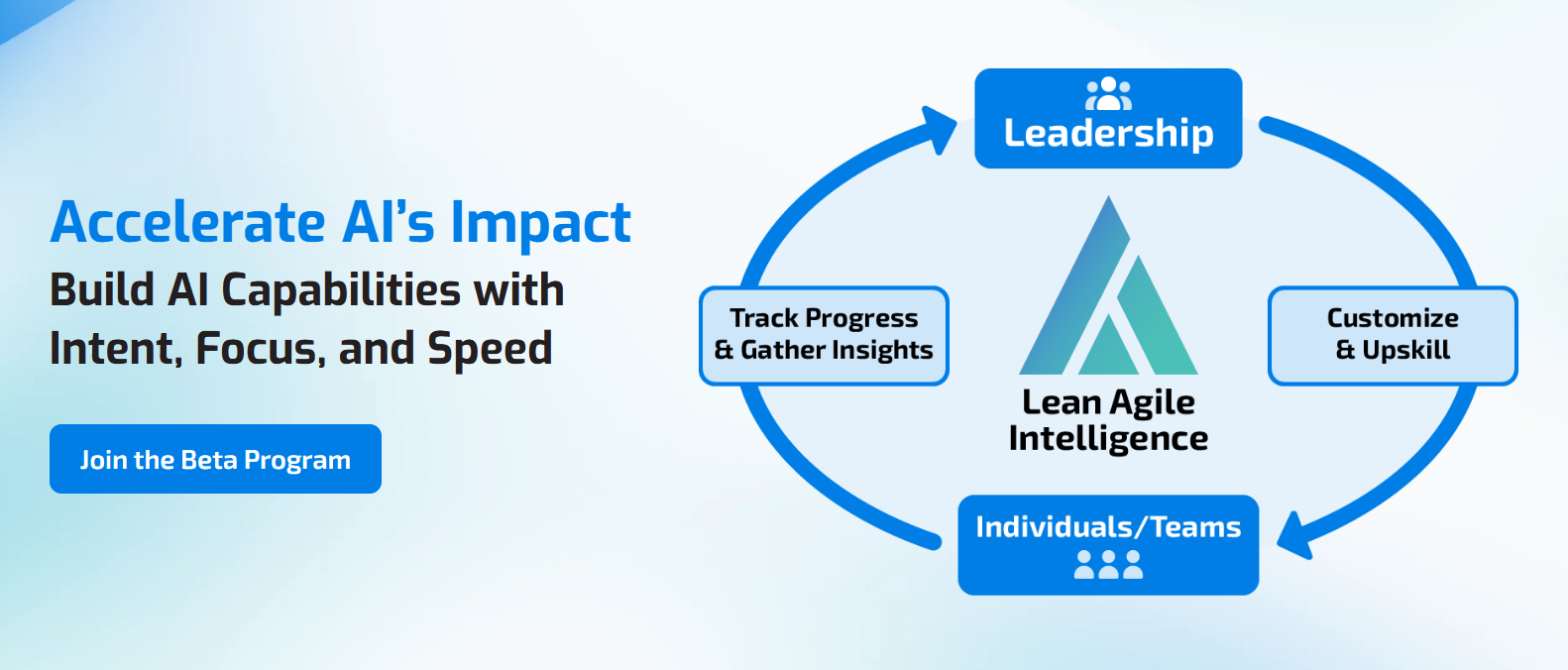
Join Lean Agile Intelligence's AI Assessment Beta Program to understand your teams' current AI capabilities, establish a baseline, identify gaps and barriers, and create a structured, data-driven path toward continuous improvement.