AI Resources for Leaders: From Strategy to Measurable Impact
By Team Lean Agile Intelligence
AI has moved out of the innovation lab and into the boardroom.
It’s no longer a question of if your organization should be using AI. That decision has already been made by competitors, by your teams, and in many cases, by leadership expectations coming from above.
The pressure shows up in different ways:
- Executives asking how AI is improving productivity
- Teams already experimenting with tools in pockets across the organization
- Competitors moving faster, or at least appearing to
On the surface, it can feel like progress is happening. But when you step back, a different picture often emerges.
This is where many leaders find themselves asking the hard question:
“How do we actually use AI in a way that drives meaningful, measurable outcomes?”
The challenge isn’t getting started, it’s turning scattered experimentation into something that is intentional, repeatable, and scalable across the organization.

What Leaders Actually Need
To move from experimentation to impact, leaders don’t need more noise. They need clarity across a small set of critical areas.
Through our work, these consistently show up as the capabilities that determine whether AI efforts stay fragmented or start to scale.
- Clarity on Where AI Should Be Applied
- Not every problem needs AI.
- Leaders need a clear way to identify:
- where AI can create meaningful value
- which use cases are worth prioritizing
- and how those align with broader business goals
- Without this, organizations tend to spread effort too thin or invest in low-impact initiatives.
- Consistency in How AI Is Used
- Even with the right tools, outcomes vary widely depending on how AI is used.
- Leaders need visibility into:
- whether teams are using AI effectively
- whether there are shared practices in place
- and how to move from individual experimentation to consistent usage
- Because inconsistent usage leads to inconsistent results.
- Confidence in Managing Risk
- As AI adoption grows, so does exposure to risk.
- This includes:
- data privacy concerns
- security vulnerabilities
- ethical considerations
- and misuse of AI outputs
- Leaders need clear approaches to governance that allow teams to move quickly, without creating unnecessary risk.
- Integration Into Real Work
- AI doesn’t create value sitting on the side. It creates value when it’s embedded into how work actually gets done.
- That means understanding:
- how AI fits into existing workflows
- where it reduces friction
- and how it supports, rather than disrupts, teams
- Without integration, AI remains an experiment instead of a capability.
- Visibility Into Impact and ROI
- Ultimately, leaders need to answer a simple question: “Is this making a difference?”
- That requires:
- clear metrics
- visibility into adoption
- and a way to connect AI usage to real outcomes
- Without this, it’s difficult to justify continued investment or scale what’s working.
Taken together, these areas form the foundation of effective AI adoption.
Not as isolated efforts but as a connected system that enables organizations to move from exploration to measurable impact.

Curated AI Resources for Leaders
The resources below are grouped around core areas leaders need to navigate AI enablement and adoption.
They’re not exhaustive, they’re selected because they support real decisions, real trade-offs, and real outcomes.
AI Strategy & Use Case Selection
Focuses on identifying and prioritizing the AI opportunities that drive the most business value, ensuring efforts are aligned to real outcomes rather than experimentation.
- Identifying and Scaling AI Use Cases — OpenAI: A practical guide to identifying high-value AI opportunities and scaling them across the organization.
- AI Business Use Cases — IBM: A structured overview of where AI delivers measurable value across industries.
- How to Identify AI Use Cases That Align with Business Goals — Vation Ventures: Helps leaders connect AI initiatives directly to strategic priorities and outcomes.
- Evaluate and Prioritize an AI Use Case — Microsoft: A framework for evaluating feasibility and prioritizing the right AI investments.
- The 4 Steps to Building an Effective AI Strategy — Stanford: A concise approach to turning AI ambition into an actionable strategy.
AI Understanding for Better Decision-Making
Provides leaders with the foundational understanding needed to make informed decisions about AI without requiring deep technical expertise.
- Generative AI for Everyone — DeepLearning.AI: A clear, non-technical foundation for understanding how AI works and where it applies.
- What Is ChatGPT Doing… and Why Does It Work? — Stephen Wolfram: Builds a deeper mental model of how AI systems function.
- Generative AI for Beginners — Microsoft: Structured learning to help leaders understand core concepts and capabilities.
- ChatGPT for Any Role — OpenAI Academy: Shows how AI applies across different roles and functions in an organization.
AI Usage & Prompting at Scale
Centers on how AI is used across teams, emphasizing consistent prompting practices and usage patterns that lead to reliable, high-quality outcomes.
- Prompting — OpenAI Academy: A practical introduction to prompting and how it impacts outcomes.
- Prompt Engineering White Paper — Google: A deeper dive into prompt design principles and patterns.
- Prompt Engineering Guide — PromptingGuide.ai: A library of prompting strategies that support consistent, repeatable usage.
- Prompt Engineering Best Practices — DigitalOcean: Practical tips for improving reliability and quality of AI outputs.
AI Governance, Risk & Security
Ensures AI is used responsibly and safely by addressing data protection, ethical considerations, compliance, and risk management from the start.
- What is AI Governance? — IBM: Defines governance frameworks and how organizations manage AI responsibly.
- Govern AI — Microsoft: Practical guidance for implementing governance across the AI lifecycle.
- Responsible AI Framework — Harvard: Key principles for building ethical, accountable AI systems.
- AI Ethics Recommendation — UNESCO: Global standards for fairness, transparency, and human oversight.
- GenAI Security Risks to Avoid — Google Cloud: Highlights common risks and how to mitigate them early.
AI Workflow Integration & Organizational Adoption
Focuses on embedding AI into everyday workflows so it becomes a natural part of how teams operate, rather than a standalone tool.
- AI in the Workplace — McKinsey: Explores how organizations scale AI adoption across teams and workflows.
- AI Integration into Workflows — Zapier: A practical guide to embedding AI into existing tools and processes.
- AI Workflow Automation — Atlassian: Explains how AI enhances collaboration and delivery workflows.
- How to Choose Tasks to Automate with AI — ProductTalk: Helps identify high-value automation opportunities.
AI Impact Measurement & ROI
Enables organizations to assess whether AI is delivering meaningful value by tracking adoption, performance, and measurable business outcomes.
- AI Measurement Framework — LinearB: A structured approach to measuring AI performance, adoption, and impact.
- Measuring AI Adoption & ROI — Wrench AI: Guidance on tracking adoption and linking it to business outcomes.
- AI ROI Metrics That Matter — Authority AI: Breaks down the metrics leaders should focus on.
- ROI of AI — DataCamp: Covers key drivers, KPIs, and challenges in measuring AI success.
Where to Start Turning Insight Into Action
For leaders looking to move forward, the goal isn’t to do everything at once. It’s to create clarity and focus.
A simple place to start is by watching the recording of our webinar here:
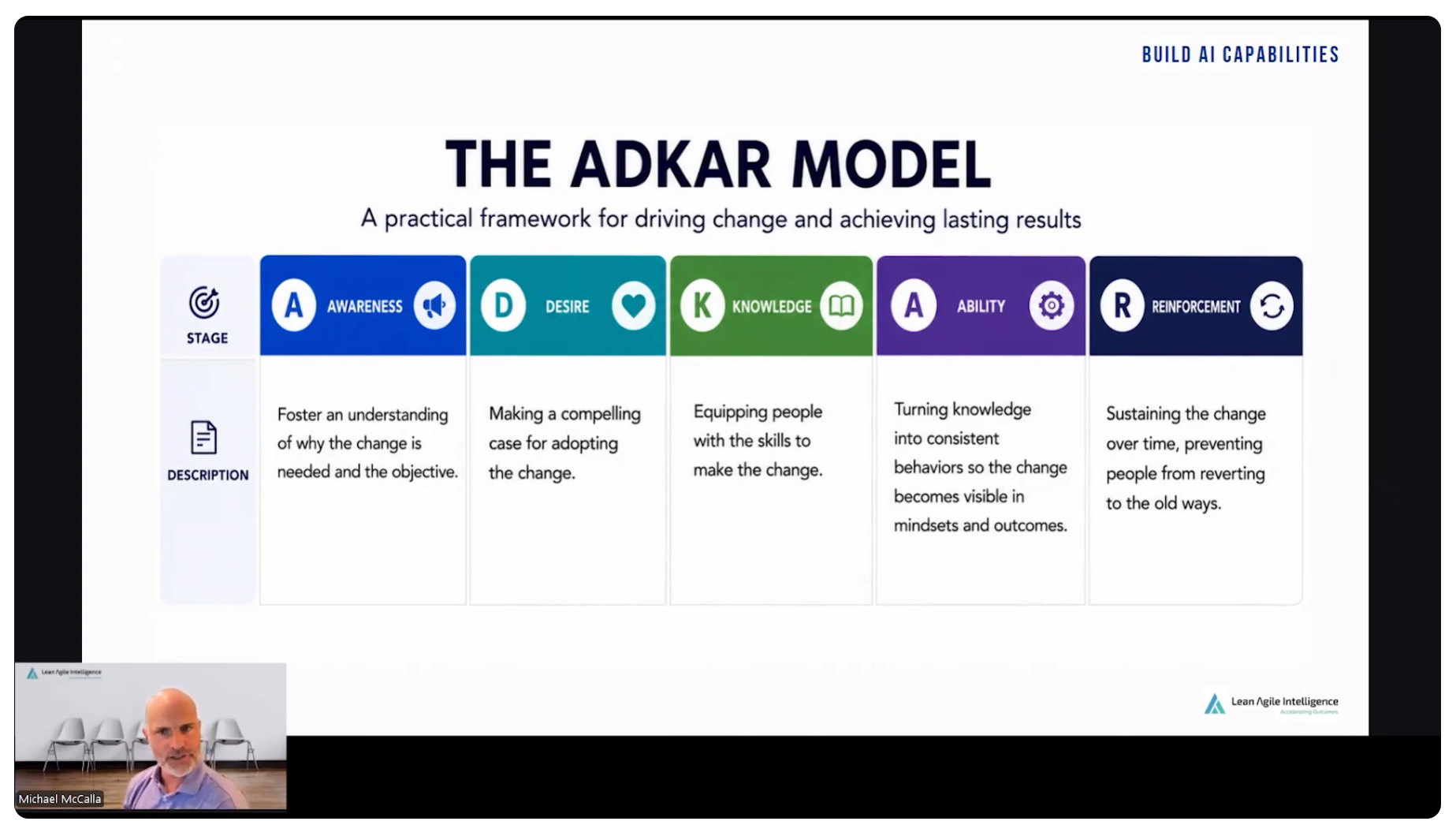
Build AI Capabilities with Intent, Focus, and Speed
In this webinar, we walked through how leading organizations were turning AI from experimentation into real, measurable productivity.
If you’re already ready to go deeper, we’ve also been working on something to help with exactly this challenge.
Our AI Assessments Beta Program is designed to help organizations understand:
-
where they stand today
-
where gaps exist
-
and where to focus next
Because ultimately, success with AI isn’t about knowing more. It’s about using it effectively to drive meaningful outcomes.
👉 Explore the AI Assessments Beta Program
What’s Next
As AI continues to evolve, the challenge for leaders isn’t access to tools, it’s knowing what to trust and where to focus. That’s exactly why we’ve started curating AI resources for leaders you can rely on to stay grounded in what actually drives impact.
You can also explore more of those resources here in this post: AI Resources You Can Trust
In upcoming posts, we’ll go deeper into what it takes to move from AI exploration to real effectiveness, including practical approaches to prompting, identifying high-value use cases, and measuring AI impact in a way that connects to outcomes.
Upcoming posts will focus on:
- AI Resources for Product Managers: using AI to shape strategy, prioritize effectively, and connect work to outcomes
- AI Resources for Business Agility Coaches: enabling better ways of working, improving flow, and guiding AI adoption toward measurable outcomes across teams
- AI Resources for Engineering Team: practical tools, workflows, and prompting approaches to integrate AI directly into development work
Each collection is built around how AI shows up in real, day-to-day work, not just theory.
If you’d like to stay up to date as these are released, follow along, there’s more coming.