AI Impact Measurement: How to Turn AI Activity Into Measurable Business Value
By Lean Agile Intelligence Product & Research Team
AI Impact becomes measurable when organizations define what should improve, establish a baseline, track the right outcomes, and use the evidence to decide what happens next.
AI success is easy to claim and surprisingly difficult to prove. A team demonstrates an impressive AI solution.
Employees report saving time. Leaders hear stories about faster work. AI adoption increases. Another pilot launches.
Then someone asks the harder question: What actually improved?
Without intentional measurement, organizations accumulate AI success stories without knowing whether the work improved in areas such as:
- Productivity
- Quality
- Customer experience
- Cost
- Risk
- Revenue
- Employee experience
- Speed
That distinction is becoming increasingly important as AI investment and adoption expand.
The problem is not necessarily that AI is failing to create business value.
Often, organizations have not developed the capability to:
Define expected impact → Establish a baseline → Measure what changes → Interpret the evidence → Decide what happens next
Organizations don't simply need AI success stories. They need AI Impact Measurement.
This is also why AI transformation cannot be measured by deployment, licenses, training, or usage alone. The more important question is whether AI is changing how work gets done and creating measurable business value.
What Is AI Impact Measurement?
AI Impact Measurement is the organizational capability to define the expected impact of an AI initiative, measure what changes, and use that evidence to guide decisions.
AI Impact Measurement is one capability within LAI's broader AI Maturity Model, which evaluates the capabilities organizations need to move from AI adoption toward operationalization and measurable business outcomes. It sits within the AI Value Management dimension alongside AI Use Case Discovery and AI Use Case Prioritization.
The word impact matters.
Usage is useful information.
So are:
- Licenses activated
- Active users
- Prompts submitted
- Employees trained
- Agents created
- Pilots completed
But those measures primarily tell us:
AI activity occurred.
AI Impact Measurement asks a different set of questions:
- What problem was the AI solution intended to improve?
- What outcome should change if it works?
- What was the baseline before AI?
- What measure would demonstrate meaningful improvement?
- What happened after AI was introduced?
- What guardrails need to remain stable?
- What did the solution cost?
- What did we learn?
- Should we scale, improve, pivot, continue, or stop?
Microsoft has described AI business-value measurement through questions such as what value an AI investment is expected to create, how that value will be measured, and what the organization will do with the evidence.
Potential value areas include:
- Revenue
- Productivity and efficiency
- Security and risk
- Employee experience
- Customer experience
- Quality
- Cost
That broader perspective matters because AI Impact does not look the same for every use case.
A customer-support assistant might be evaluated through:
- Resolution time + Quality + Customer satisfaction
An AI coding solution might be examined through:
- Cycle time + Rework + Quality
An AI risk solution might focus on:
- Coverage + Detection + Exposure
An internal knowledge assistant might examine:
- Search time + Answer quality + Task completion
The objective is not to force every AI initiative into the same ROI equation.
It is to define what success means for the specific use case, measure it consistently, and use the evidence to make better decisions.
What Level of AI Impact Measurement Maturity Are You?
Before strengthening AI Impact Measurement, identify whether your organization is primarily reporting AI activity or consistently measuring whether AI-supported work is producing the outcomes it was intended to improve.
LAI's AI Impact Measurement Maturity Model uses five levels to describe that progression.
Organizations looking for a broader organizational baseline can use LAI’s AI Readiness Assessment to evaluate AI Impact Measurement alongside AI Use Case Discovery, AI Use Case Prioritization, strategy, technology, governance, and other capabilities that influence whether AI investment produces value.
| Level | Where You Are | Primary Focus |
|---|---|---|
| Level 1: Starting | AI success is described through demos, stories, adoption, or perceived time savings without consistent baselines or success measures. | Define success before trying to prove it. |
| Level 2: Emerging | Teams measure selected AI experiments, but methods and metrics vary significantly across the organization. | Learn which measures actually reflect the value each use case is intended to create. |
| Level 3: Enabling | Shared templates and measurement practices distinguish AI adoption, solution performance, and business impact. | Create repeatable impact measurement without forcing every use case into the same metric. |
| Level 4: Operationalizing | Baselines, targets, measurement checkpoints, and impact reviews are embedded into the AI initiative lifecycle. | Make evidence part of scale, funding, and operating decisions. |
| Level 5: Optimizing | AI Impact evidence continuously influences strategy, investment, workflow design, priorities, and decisions to scale, improve, pivot, or stop. | Turn impact measurement into a learning and decision-making capability. |
The goal is not to produce more AI dashboards.
It is to understand whether the organization can distinguish AI activity from measurable business value and use that distinction to make better decisions.
The Five Levels of AI Impact Measurement Maturity
LAI's AI Impact Measurement Maturity Model describes how organizations progress from anecdotal claims about AI success toward evidence that consistently informs business decisions.
The five levels are: Starting → Emerging → Enabling → Operationalizing → Optimizing
The progression moves from:
Anecdotal Success → Early Measurement → Shared Impact Practices → Workflow-Embedded Measurement → Evidence-Driven Decisions
Initially, teams move beyond demonstrations and stories by defining what success should mean.
Experiments begin producing evidence.
Shared measurement practices make results more comparable and repeatable.
Workflow integration ensures impact measurement happens throughout the AI initiative lifecycle.
Finally, evidence begins changing:
- Investments
- Priorities
- Workflows
- Strategy
- Scale decisions
The objective is not simply to measure more.
It is to make AI Impact visible enough to influence what the organization does next.

Level 1: Starting — AI Success Is Mostly Anecdotal
At the Starting level, AI solutions are being explored or deployed, but their impact is rarely measured against a defined baseline and expected outcome.
Teams demonstrate what AI does. Employees report saving time. Sponsors share positive stories. Leaders see rising AI adoption and infer success. Those signals are useful. They do not establish that a meaningful outcome improved.
The organization struggles to distinguish: "People are excited about this."
from: "This improved an outcome that matters."
Observable Evidence
Common signals include:
- Anecdotal AI success claims
- AI outcomes not consistently tracked
- No defined success metrics
- No baseline comparisons
- AI adoption used as a proxy for value
- Time-saving estimates based primarily on employee perception
- Successful demos interpreted as successful business outcomes
Anecdotes are not useless.
They often identify where value deserves further investigation.
The problem is treating anecdotal evidence as sufficient proof of AI Impact.
How to Progress to Emerging
Start small. For every meaningful AI use case, define: One Problem → One Desired Outcome → One or Two Measures before expanding the solution.
Do not start by trying to create a perfect enterprise-wide ROI framework.
Start by creating the habit of: Defining success before measuring success.
For each use case, ask:
- What Problem Are We Trying to Improve?
- Be specific about the current condition.
- What Should Change?
- Identify the intended outcome.
- What Happens Today?
- Establish a baseline.
- What Will We Measure?
- Choose one or two useful measures.
- What Must Not Get Worse?
- Identify an appropriate guardrail.
Practical Example: Create an AI Impact Hypothesis
Before beginning the next AI pilot, complete this statement:
We believe using AI to [change in workflow] will improve [desired outcome] from [baseline] to [target], which we will evaluate using [measure].
For example:
We believe using AI to summarize customer-support cases will reduce average case preparation time from 12 minutes to 8 minutes without increasing case errors.
Capture:
- Problem: What needs to improve?
- AI Intervention: What changes in the workflow?
- Baseline: What happens today?
- Success Measure: What outcome will be monitored?
- Target: What level of improvement would justify continued investment?
- Guardrail: What must not deteriorate?
Then evaluate the same outcome after the experiment.
The first step in AI Impact Measurement is not a dashboard.
It is: A measurable definition of success.

Level 2: Emerging — Teams Begin Measuring AI Experiments
At the Emerging level, teams actively measure selected AI experiments, but the approaches remain inconsistent across the organization.
Teams discuss potential cost savings. AI demonstrations include early performance observations. Experiment owners define success measures.
Some pilots compare outcomes before and after AI. This represents an important progression.
The organization is moving from: "AI seems valuable."
toward: "Let's test whether something meaningful changes."
But different teams often measure different things in different ways.
One measures hours saved. Another measures user satisfaction. Another reports AI adoption.
Another demonstrates the technology and calls the pilot successful.
The organization is learning how to measure AI Impact, but the capability remains local.
Observable Evidence
Observable signals include:
- Ad hoc AI solution demonstrations
- Discussions about cost or time savings
- Success measures appearing in experiments
- Selected pilots measuring outcomes
- Some baseline comparisons
- Different value definitions across teams
- Measurement approaches dependent on the experiment owner
How to Progress to Enabling
Capture what teams are learning about AI Impact Measurement.
Review active AI use cases and ask:
- What outcome is each use case trying to improve?
- What measures are teams using?
- Which measures actually help determine success?
- Where was a baseline established?
- Which measures proved difficult to collect?
- Where are teams measuring activity instead of impact?
- Which guardrails are important?
- Which measurements influence decisions?
Then organize measures into a small set of business-value categories.
Examples include:
- Productivity and efficiency
- Cost
- Quality
- Revenue
- Customer experience
- Employee experience
- Risk
The important principle is: Measure the business value the AI solution was actually designed to create.
Do not require every use case to demonstrate improvement across every category.
Practical Example: Introduce an AI Experiment Scorecard
For each experiment, capture:
| Field | Example |
|---|---|
| Problem | Customer-service preparation takes too long |
| Desired Impact | Faster case preparation |
| Baseline | 12 minutes |
| Target | 8 minutes |
| Actual Result | 8.7 minutes |
| Quality Guardrail | No increase in case errors |
| AI Cost | $X per case |
| Learning | Greatest benefit observed on complex cases |
| Decision | Continue / Adjust / Scale / Stop |
Review the scorecard at the end of every experiment. Do not require financial ROI for every early AI use case.
An experiment produces useful evidence even when the conclusion is:
"This did not improve the targeted outcome enough to justify scaling."
Avoiding additional investment in a weak use case is also useful business learning.

Level 3: Enabling — Shared AI Impact Measurement Practices Are Defined
At the Enabling level, AI Impact Measurement becomes a shared and repeatable organizational capability.
Teams use common templates. Success measures are documented. AI use cases connect to relevant business outcomes or OKRs.
Demonstrations increasingly show not only: What the AI does
but: What changed after it was introduced
Measurement becomes part of the organization's shared AI language.
Observable Evidence
Evidence includes:
- Documented AI success measures
- Common impact-measurement templates
- AI use cases connected to business outcomes or OKRs
- Impact evidence included in AI demonstrations
- Baseline expectations established consistently
- Guardrail measures used where appropriate
- Shared decision rules for experiments
The organization moves from many definitions of AI success toward: Repeatable evidence of AI Impact
How to Progress to Operationalizing
Establish a shared AI Impact Measurement framework.
For every significant AI use case, define:
Business Problem → Expected Impact → Baseline → Measure → Target → Measurement Method → Review Cadence
Then distinguish three types of measures.
AI Adoption
- Is the solution being used?
- Examples:
- Active users
- Usage frequency
- Workflow adoption
- Feature utilization
- Examples:
AI adoption matters because a solution that no one uses has little opportunity to influence the work.
But adoption alone does not establish business value.
AI Performance
- Is the AI solution performing adequately?
- Examples:
- Accuracy
- Completion rate
- Output quality
- Reliability
- Acceptance rate
- Examples:
These measures help determine whether the AI itself is functioning well enough to support the workflow.
Business Impact
- Did the targeted business outcome change?
- Examples:
- Cycle time
- Cost
- Throughput
- Quality
- Revenue
- Customer satisfaction
- Risk
- Employee effort
- Examples:
This distinction prevents one of the most common measurement mistakes: Strong AI adoption does not automatically mean strong AI Impact.
A widely used AI solution can still produce limited measurable business value.
A lower-volume use case can create significant value in a critical workflow.
The framework therefore needs consistency without pretending every AI use case creates value in the same way.
Practical Example: Create an AI Impact Canvas
Require each significant AI initiative to complete one page.
AI Impact Canvas
- Business Problem: What are we trying to improve?
- Current Baseline: What happens today?
- AI Change: What will AI change within the workflow?
- Primary Outcome Measure: What business result should improve?
- Guardrail Measure: What must not get worse?
- Target: What level of improvement represents success?
- Measurement Source: Where will the evidence come from?
- Review Date: When will impact be evaluated?
- Decision Rule: What result leads us to scale, improve, continue, pivot, or stop?
For example:
- Primary outcome: Reduce support resolution time by 20%
- Guardrail: Customer satisfaction does not decline
That is stronger than measuring time savings in isolation because improvement in one measure can create a negative effect elsewhere.
The goal is: Repeatable AI Impact Measurement without one-size-fits-all metrics.

Level 4: Operationalizing — Measurement Becomes Part of the AI Workflow
At the Operationalizing level, AI Impact Measurement becomes embedded into the lifecycle through which AI initiatives are proposed, experimented with, launched, scaled, and reviewed.
Success measures are not added to a presentation after the AI solution has already been built.
Measurement checkpoints become part of the work. Where practical, evidence is collected automatically.
Leaders can determine whether important AI initiatives are producing the expected outcomes without requiring teams to reconstruct evidence manually for every review.
The organization increasingly knows: What value was expected → What happened → What decision should follow
Observable Evidence
Observable evidence includes:
- AI impact checkpoints built into initiative workflows
- Automated metric collection
- AI impact dashboards
- AI use cases connected to OKRs or business metrics
- Scale decisions requiring evidence
- Sustained-impact measures after rollout
- Greater availability of baseline and current-state data
At Enabling: The organization knows how to measure AI Impact.
At Operationalizing: Measurement consistently influences the AI lifecycle and the decisions within it.
How to Progress to Optimizing
Embed measurement into specific decision points.
For example:
- Use-Case Intake → Define expected impact.
- Experiment Approval → Establish baseline, target, and guardrail.
- Pilot Review → Compare evidence against baseline.
- Scale Decision → Determine whether results support broader investment.
- Operational Review → Determine whether the impact remains sustained.
This establishes an important operating principle:
No scale decision without impact evidence.
Where practical, automate the measures needed for evaluation rather than relying entirely on manually assembled spreadsheets and estimates.
The objective is not perfect attribution.
It is to create enough consistent evidence to make a stronger decision.
Practical Example: Add an AI Impact Gate to the Initiative Lifecycle
Create three impact checkpoints.
Checkpoint 1: Before the Experiment
- Required:
- Defined problem
- Baseline
- Primary success measure
- Guardrail measure
- Target
Checkpoint 2: Before Scaling
- Review:
- Actual impact
- AI adoption
- Quality
- Cost
- Unexpected consequences
- Relevant qualitative feedback
Decision: Scale → Improve → Continue Experimenting → Pivot → Stop
Checkpoint 3: After Scaling
- Monitor:
- Is impact sustained?
- Is AI adoption changing?
- Is cost changing?
- Are downstream outcomes changing?
- Has the workflow changed?
- Does the original value hypothesis remain valid?
Then create an AI Impact Dashboard for high-priority use cases.
For example:
| AI Solution | Target | Baseline | Current | Status |
|---|---|---|---|---|
| Support assistant | -20% resolution time | 25 min | 19 min | On track |
| Coding assistant | -15% cycle time | 8 days | 7.4 days | Below target |
| Sales assistant | +10% conversion | 18% | 21% | Above target |
| Knowledge assistant | -30% search time | 20 min | 12 min | Above target |
The dashboard should drive a conversation.
Not simply display numbers.
Ask:
- What changed?
- What didn't?
- What else changed at the same time?
- What have we learned?
- What should we do next?
That keeps the organization from turning correlation into an unsupported claim of causation.

Level 5: Optimizing — Measurement Changes What the Organization Does
At the Optimizing level, AI Impact Measurement becomes a learning and decision-making capability that consistently influences what the organization scales, improves, redirects, or stops.
The organization regularly reviews AI Impact as part of business discussions.
Measures evolve as use cases mature.
New measures are introduced when existing ones no longer provide enough insight.
Evidence influences:
- AI strategy
- Investment
- Prioritization
- Workflow design
- Scale decisions
- Product decisions
- Change decisions
The organization is not simply measuring AI more consistently.
It is using evidence to get better at deciding: Where and how AI should create business value.
Observable Evidence
Observable signals include:
- AI Impact included in recurring business reviews
- Success measures refined as learning improves
- Evidence driving strategic pivots
- Existing AI investments reviewed against outcomes
- Low-value AI initiatives redesigned or stopped
- Strong-performing use cases considered for broader investment
- Improving time to evaluate AI Impact
This is an important distinction.
Measurement maturity is not achieved when every AI initiative has a dashboard.
It is achieved when the evidence: Changes decisions.
How to Sustain and Continuously Improve
Create a continuous impact-management loop: Hypothesize → Measure → Learn → Decide → Improve
Regularly ask:
- Which AI solutions show the strongest evidence of impact?
- Which have high AI adoption but limited measurable business value?
- Where are outcomes improving but costs increasing?
- Which metrics no longer represent the value we care about?
- Which guardrails are deteriorating?
- What unintended consequences have appeared?
- Which AI investments deserve additional scale?
- Which need redesign?
- Which should stop?
- What does the evidence suggest about future AI strategy?
The objective is not to prove that every AI investment succeeded.
Mature AI Impact Measurement should sometimes lead to the opposite conclusion.
Practical Example: Run a Quarterly AI Impact Review
Review the organization's highest-priority AI initiatives each quarter.
For each use case, capture:
- Expected Value
- What outcome were we trying to improve?
- Evidence
- What happened relative to baseline?
- Cost
- What does the solution cost to operate, support, and change?
- AI Adoption
- Are the intended users actually using it?
- Guardrails
- Did anything important deteriorate?
- Learning
- What did we learn that we did not know when the investment began?
- Decision
- Choose:
- Scale: Evidence supports broader investment.
- Continue: Impact is tracking with expectations.
- Improve: The opportunity remains, but changes are needed.
- Pivot: Evidence suggests a different workflow, use case, or approach.
- Stop: Observed value does not justify continued investment.
- Choose:
For example:
| AI Initiative | Evidence | Decision |
|---|---|---|
| Customer support assistant | Resolution time ↓24%, CSAT stable | Scale |
| Meeting assistant | High adoption, no measurable workflow improvement | Improve |
| Sales research agent | Prep time ↓40%, conversion unchanged | Pivot |
| AI coding assistant | Cycle time ↓12%, rework ↓8% | Continue |
| Internal chatbot | Low adoption and limited measurable value | Stop |
These examples illustrate decision logic. They do not establish that AI alone caused the observed changes.
Then maintain an AI Impact Improvement Backlog.
Potential items include:
- Automate a missing measure
- Establish a better baseline
- Replace an AI adoption metric with an outcome measure
- Add a quality guardrail
- Improve attribution
- Change the measurement window
- Add qualitative evidence
- Test a new value hypothesis
- Improve cost measurement
Optimization means the organization continuously improves both: Its understanding of the impact associated with AI-enabled work
and: Its ability to recognize that impact quickly enough to make better decisions
Connecting AI Adoption to Business Value
AI adoption is an important input, but business value depends on what changes in the work after AI is adopted.
Organizations often begin with adoption because it is easier to measure.
They track:
- Licenses
- Active users
- Prompts
- Sessions
- Feature usage
- Training completion
Those measures answer: Are people using AI?
They do not answer: Is anything important improving?
A more complete measurement chain is: AI Adoption → Change in Workflow → Change in Performance → Business Value
For example:
Customer Support
Adoption
Percentage of agents using the AI assistant
↓
Workflow Change
Less manual searching and case preparation
↓
Performance Measure
Resolution time / quality
↓
Business Value
Customer experience / cost / capacity
Software Delivery
Adoption
Percentage of developers using AI assistance
↓
Workflow Change
AI supports coding, testing, or review
↓
Performance Measure
Cycle time / rework / defects
↓
Business Value
Delivery performance / capacity / quality
Enterprise Knowledge Work
Adoption
Employees using an AI knowledge assistant
↓
Workflow Change
Less time locating and synthesizing information
↓
Performance Measure
Search time / task completion
↓
Business Value
Productivity / employee experience / operating capacity
The point is not to assume every link in the chain is causal.
It is to define the pathway clearly enough to investigate: Where value appears—and where it breaks down.
High adoption with no workflow improvement tells one story. Workflow improvement with poor quality tells another. Strong performance improvement with unexpectedly high cost tells another. AI Impact Measurement makes those distinctions visible.
Related capabilities: AI Use Case Prioritization, AI Strategy
Key Takeaway
AI Impact Measurement maturity isn't achieved when an organization produces an ROI number or reports high AI adoption. It is demonstrated when teams consistently define expected business value, establish a baseline, measure what changes, and use that evidence to decide what to scale, improve, pivot, continue, or stop.
From AI Adoption to Measurable AI Impact
AI Impact becomes operational when organizations move beyond measuring AI adoption and consistently connect AI initiatives to expected outcomes, evidence, and business decisions.
AI adoption generates activity quickly. Measurable impact requires more discipline.
The AI Impact Measurement Maturity Model progresses from:
Anecdotal Success → Early Measurement → Shared Impact Practices → Workflow-Embedded Measurement → Evidence-Driven Decisions
Initially, organizations begin testing whether AI appears to create value.
Early experiments produce evidence. Shared practices make measurement more consistent.
Embedding measurement into AI workflows makes it operational.
Business reviews and investment decisions then turn measurement into an organizational capability.
That is the shift from: "Are people using AI?"
to: "What is changing in the business, and what does the evidence tell us to do next?"
The goal is not to prove every AI investment was successful.
A mature measurement capability should identify initiatives that:
- Need to scale
- Need improvement
- Need more evidence
- Need a different approach
- Should stop
Discovering that an AI solution is not producing enough value is not measurement failure.
It is: Measurement helping the organization avoid a weaker decision.
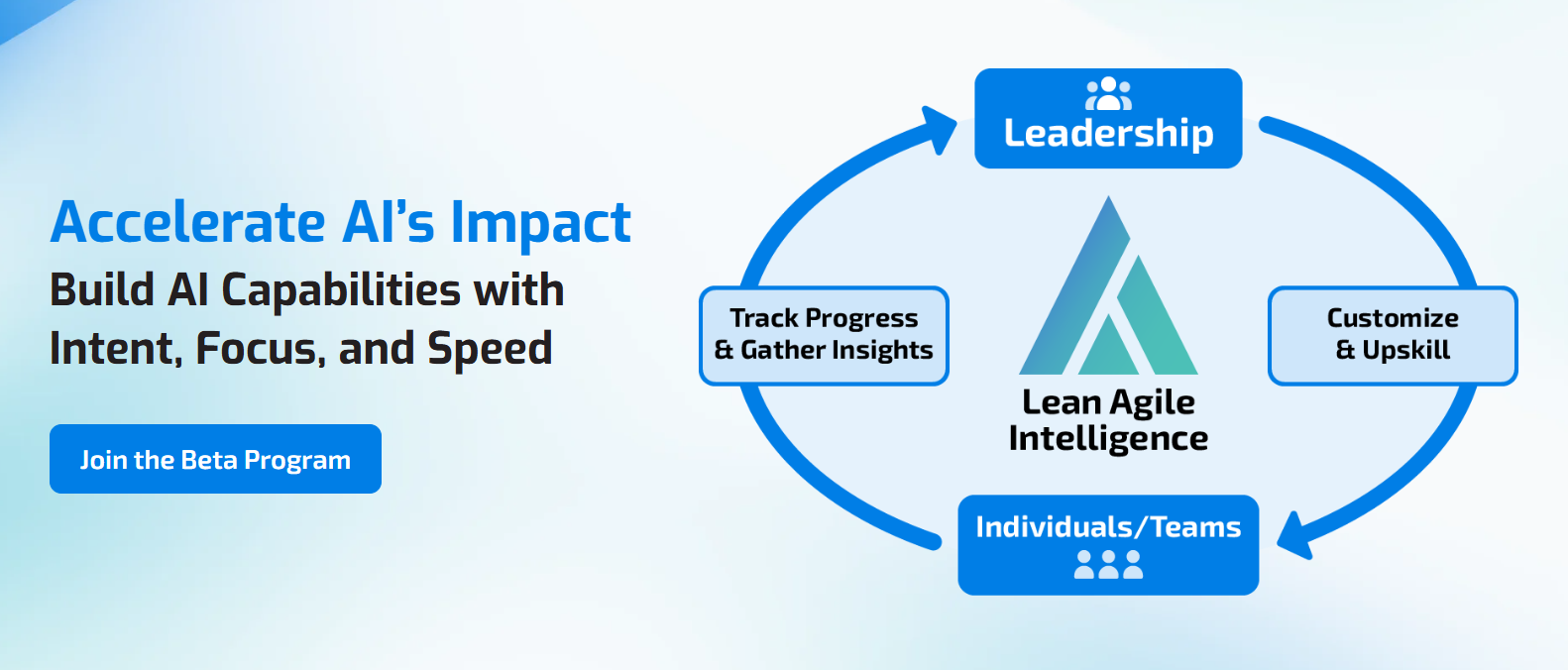
Evaluate Whether AI Activity Is Becoming Business Value
AI demos, adoption, and success stories provide useful signals.
The more important question is whether the organization consistently knows what each AI initiative is expected to improve, measures what changes, and uses the evidence to make decisions.
AI Impact Measurement is one of 21 capabilities measured in LAI's AI maturity assessment for software delivery teams. It establishes a baseline, identifies gaps and barriers, and shows what to improve next.
For AI Impact Measurement, that means evaluating whether the organization:
- Defines expected business value before implementation
- Establishes meaningful baselines
- Distinguishes AI adoption from business impact
- Selects use-case-specific outcome measures
- Uses guardrails to detect negative tradeoffs
- Measures AI cost where relevant
- Integrates measurement into experiments and scale decisions
- Monitors whether impact remains sustained
- Reviews evidence through recurring business cadences
- Uses measurement to scale, improve, pivot, or stop investments
- Continuously improves its approach to measuring AI Impact
Take the AI Maturity Assessment
Prefer to start with early access? Join the AI Assessment Beta Program.