Why Teams Should Be the Target of AI Enablement, Not Individuals: A Better Path to AI Productivity
By Team Lean Agile Intelligence
Most organizations began AI enablement in a logical place: the individual.
Give employees access to AI tools. Teach them how to prompt. Provide training on responsible use. Encourage experimentation. Build AI fluency. Those investments matter.
But if the goal is sustainable AI productivity and measurable business impact, individual enablement cannot be the end state.
Organizations do not deliver value through isolated individuals. Work flows through cross-functional teams, shared workflows, dependencies, decisions, handoffs, and systems. As a result, making individuals better at using AI does not automatically improve how the team performs.
That suggests a different target for the next stage of AI enablement:
The primary unit of AI enablement should be the team, not the individual.
Individual fluency remains foundational. But teams are where AI knowledge becomes shared practices, where workflows can actually change, and where productivity gains can begin to translate into better delivery.
Why Individual AI Enablement Only Gets You So Far
There is nothing wrong with teaching individuals how to use AI. As a matter of fact, that should be the first step.
The problem is assuming individual capability will naturally become organizational capability.
One person may use AI to research faster. Another may automate part of a development task. Someone else may create a highly effective prompting technique.
Those are useful improvements, but they can remain isolated.
The next challenge is moving from knowledge into collective behaviors and capabilities. It is not enough for a few individuals or even most individuals to become more productive. Teams need shared ways of working that allow those capabilities to become repeatable and scalable.
We explore the broader disconnect between individual productivity and enterprise performance in The AI Productivity Paradox: Why Employee Productivity Isn't Translating Into Enterprise ROI.
Put simply:
If work is performed collectively, AI enablement eventually needs to become collective too.

Why Teams Are the Right Unit of AI Enablement
Teams sit at the point where individual skills meet actual value delivery, making them the natural unit for developing shared AI capabilities.
1. Teams Own Workflows, Not Just Tasks
Individual AI enablement naturally focuses on tasks:
-
Write this faster.
-
Summarize this.
-
Generate this code.
-
Create this test.
Team-based enablement asks a different question:
How should the way this team works change because AI is now available?
That shifts the focus from optimizing isolated tasks to improving the entire workflow.
Where are the delays? Which handoffs add little value? Where could AI improve decision-making? What work could be redesigned rather than simply accelerated?
This becomes especially important when AI is introduced into fragmented teams, workflows, and organizational silos, where local productivity gains can create even more work downstream.
This is the shift toward AI-assisted ways of working: shared practices at the team and team-of-teams level where AI becomes embedded into how work is actually performed.
2. Teams Turn Context Into Shared Capability
Enterprise-wide training has to be broad. But the most valuable applications of AI are highly contextual. A product team, engineering team, finance team, marketing team, and operations team may all need basic AI fluency, but they will not use AI in the same ways.
-
A product team may focus on discovery, research synthesis, experimentation, or requirements.
-
An engineering team may focus on development, code review, testing, or documentation.
This is why targeted enablement matters. Teams need support based on their specific needs and opportunities, along with time to practice and apply new capabilities in real work.
Just as importantly, useful individual techniques need to become shared practices. If one employee develops an effective AI workflow, can the rest of the team repeat it? Has the team agreed when to use it? Is it becoming part of how the team works?
A capability becomes scalable when it moves from:
Individual experimentation → Shared team practice
Organizations can define the capabilities that matter while still allowing each team to determine the how based on its context.
3. Teams Expose the Barriers Training Cannot Fix
Individual training can improve knowledge, but it cannot fix policies that restrict data access, remove cumbersome approval processes, create time for experimentation, resolve integration problems, or clarify expectations leadership has never defined.
These barriers become much easier to see when AI enablement is evaluated in the context of a team's actual work.
Common barriers include unclear expectations, insufficient coaching and support, insufficient time to practice, and systemic constraints created by existing processes, policies, and tools.
A team-based approach changes the enablement conversation from:
“Why aren't people using AI more?”
to:
“What is preventing this team from using AI effectively?”
That is a much more actionable question.

What Should Team-Based AI Enablement Look Like?
Team-based enablement does not replace individual training. It connects learning to collective application and continuous improvement.
A practical team-based AI enablement approach can be built around four steps.
-
Define the Capabilities Teams Need
-
Start by identifying the AI capabilities teams are expected to develop.
-
Depending on the organization, these might include:
-
AI fluency
-
Responsible AI and governance
-
Use-case discovery and prioritization
-
AI-assisted ways of working
-
-
The specific capabilities can vary by function.
-
The goal is to give teams clarity about what good looks like without prescribing exactly how every team gets there.
-
-
Establish a Team-Level Baseline
-
Before deciding what enablement a team needs, understand where it is today.
-
Where is the team already succeeding? Which capabilities remain primarily individual rather than shared? What gaps or barriers are preventing progress?
-
A team-level assessment can create that baseline.
-
Importantly, assessments should not be positioned as audits, grades, or HR evaluations. They should create conversations that help teams understand their current state, identify barriers, and determine what support they need next.
-
-
LAI's AI assessments help organizations establish team-level baselines across critical AI capabilities, identify gaps and barriers, and determine where targeted enablement can add the most value.
-
-
Target Enablement and Apply It to Real Work
-
Once the baseline is understood, enablement becomes more precise.
-
One team may need help identifying valuable AI use cases. Another may already have strong individual fluency but struggle to create shared practices. A third may be blocked by tooling, data access, or governance.
-
Those teams should not receive identical interventions. Target coaching, training, resources, and leadership support to the team's actual needs—then apply that learning directly to real work.
-
-
Turn Learning Into Improvement Actions
-
A team should leave an enablement cycle knowing what it wants to improve next.
-
That might mean:
-
Experimenting with an AI-assisted workflow
-
Standardizing a successful practice
-
Removing a governance or technology barrier
-
Improving output evaluation
-
Expanding a high-value use case
-
-
The important point is to convert insight into action with clear ownership.
-
A simple cycle is:
-
Baseline → Priority → Experiment → Improvement Action → Measure Again
-
-
🚀 Want to Accelerate AI Operationalization Across Your Organization?
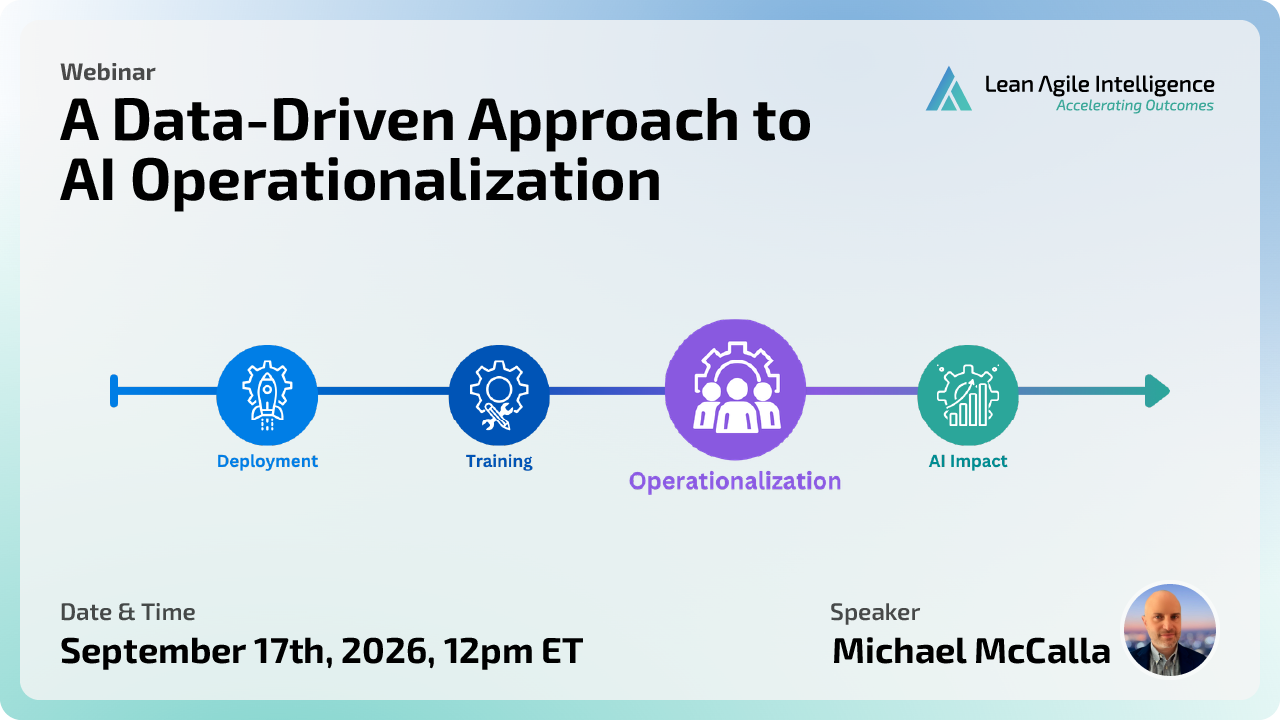
AI deployment is accelerating, but measurable impact isn’t keeping pace.
The next challenge isn’t simply giving people access to AI. It’s operationalizing AI so it can be used effectively, consistently, and at scale.
Join us on September 17 at 12 PM ET for our free webinar:
A Data-Driven Approach to AI Operationalization
Learn how to:
➤ Understand the AI Productivity Paradox and what causes it
➤ Define AI operationalization and how it differs from adoption
➤ View AI operationalization through an organizational change lens
➤ Identify practical ways to accelerate operationalization at the team and organizational levels
Move beyond AI deployment and start building a structured path toward measurable, scalable impact.
👉 Register for the Free Webinar
What Should Leaders Measure?
Team-based AI enablement requires more than tracking training completion or tool usage.
Leaders should look at four things:
-
Shared Practice: Are useful individual behaviors becoming repeatable team practices?
-
Workflow Application: Is AI becoming embedded in the team's actual work?
-
Barrier Removal: Are issues involving tools, data, policies, capacity, or support being addressed?
-
Performance Improvement: Are relevant measures such as cycle time, quality, throughput, or capacity improving?
The value is not the assessment score itself. It is the feedback loop.
Team-level results can also roll up across teams, portfolios, and the enterprise, giving leaders visibility into where progress is occurring and where systemic issues may require broader action.
Team-based enablement is also part of the broader move from AI adoption to AI operationalization. For a deeper look at that transition, see AI Adoption vs. AI Operationalization: Why Deploying Tools Isn't Enough.
AI Productivity Becomes More Valuable When It Becomes a Team Capability
Individual AI fluency will continue to matter.
Organizations need employees who understand the technology, know how to use it responsibly, and can identify opportunities in their own work.
But the larger opportunity emerges when that capability becomes collective.
When teams develop shared AI-assisted ways of working, individual knowledge can become collective capability. Experiments can become repeatable practices. Barriers become visible. Improvement becomes measurable.
That is how AI productivity begins to move beyond isolated task efficiency and into the system where organizations actually deliver value.
Enable individuals to learn AI. Enable teams to change how work gets done.
Want to see what team-based AI enablement could look like in your organization?
Join Lean Agile Intelligence's AI Assessment Beta Program to establish a baseline with your teams, identify AI capability gaps and barriers, and create targeted improvement actions based on where teams actually need support.