AI Use Case Prioritization: How to Focus AI Investment on the Opportunities That Matter Most
By Lean Agile Intelligence Product & Research Team
An AI Use Case Prioritization becomes an investment decision when an organization must choose which opportunities deserve funding, people, technology, and organizational capacity.
Most organizations do not have an AI idea problem. They have an AI prioritization problem.
Once employees and leaders begin exploring AI, opportunities appear everywhere.
Customer service wants an AI assistant. Sales sees an opportunity to automate research. Engineering wants coding agents. Operations identifies repetitive knowledge work. Product teams envision new AI-enabled customer experiences.
Soon, the organization has far more potential AI Use Cases than it has:
- Budget
- People
- Data
- Infrastructure
- Leadership attention
- Change capacity
to implement them.
Without a clear way to prioritize those opportunities, decisions become driven by:
- Executive enthusiasm
- Technology novelty
- The loudest stakeholder
- Vendor influence
- Whichever team has capacity
- Which idea appeared first
That creates a dangerous pattern:
AI investment becomes disconnected from AI value. That is also why AI transformation cannot be driven by technology novelty or the number of tools deployed. Investment should follow the opportunities most likely to improve how the organization works and produce measurable value.
The challenge is especially important because measurable AI returns remain uneven.
Microsoft's AI planning guidance emphasizes evaluating AI Use Cases based on considerations such as strategic value, business impact, technical feasibility, resource requirements, and organizational capabilities before deciding what should move forward.
Organizations don't simply need a backlog of AI opportunities.
They need a repeatable capability for AI Use Case Prioritization.
What Is AI Use Case Prioritization?
AI Use Case Prioritization is the organizational capability to consistently evaluate competing AI opportunities and decide where limited AI investment, people, and capacity should be directed.
Discovery answers: Where could AI create value?
Prioritization answers: Which of those opportunities should we invest in now?
That distinction matters.
A use case might offer significant potential value but be technically unrealistic today.
Another might be easy to implement but strategically insignificant.
A third might have strong long-term potential but depend on data, governance, infrastructure, or workforce capabilities the organization has not yet developed.
Strong prioritization makes those tradeoffs explicit.
It helps leaders answer questions such as:
- How strongly does this AI Use Case support business strategy?
- What measurable value could it create?
- How significant is the employee or customer problem?
- Is AI actually appropriate for the problem?
- Is the necessary data available?
- Is the solution technically feasible?
- What organizational change is required?
- What governance or risk requirements exist?
- How much AI investment is required?
- How quickly could meaningful evidence emerge?
- What should this opportunity displace if it moves forward?
- What dependencies must be addressed first?
Microsoft recommends comparing AI opportunities based on strategic value and implementation feasibility while considering factors such as business impact, technical complexity, resources, and organizational alignment.
Google Cloud similarly emphasizes dimensions such as business value, actionability, feasibility, data readiness, adoption, risk tolerance, and speed to value.
The objective is not to create a mathematical formula that automatically chooses the winner.
It is to establish a repeatable decision-making process that directs limited AI investment toward the opportunities with the strongest combination of value, feasibility, readiness, and strategic relevance.
Figure Out Where You Are
Before strengthening AI Use Case Prioritization, identify how your organization currently decides which AI opportunities receive funding, people, and organizational attention.
LAI's AI Use Case Prioritization Maturity Model uses five stages to describe that progression.
Organizations looking for a broader baseline can use LAI’s AI Readiness Assessment to evaluate AI Use Case Prioritization alongside AI Strategy, Use Case Discovery, Impact Measurement, technology, data, governance, and the other capabilities that determine whether investment decisions can actually be executed.
|
Stage |
Where You Are |
Primary Focus |
|---|---|---|
|
AI Use Cases compete for attention without consistent criteria, and priorities are often driven by opinion, enthusiasm, or local capacity. |
Make the reasons behind AI investment decisions explicit. |
|
|
Teams compare AI opportunities more intentionally, but prioritization remains fragmented across functions. |
Create shared visibility into the AI Use Case portfolio. |
|
|
A common scoring framework, ranked backlog, and shared decision criteria are established. |
Make prioritization repeatable and comparable across opportunities. |
|
|
AI Use Case Prioritization directly influences funding, planning, capacity, and portfolio decisions. |
Connect prioritization to where organizational resources actually go. |
|
|
Existing and proposed AI investments are continuously compared and reprioritized based on evidence, realized value, changing conditions, and strategic relevance. |
Redirect AI investment as evidence changes. |
The objective is not to create the perfect ranking.
It is to understand how consistently AI investment decisions reflect shared evidence and intentional tradeoffs rather than individual opinion.
The AI Use Case Prioritization Maturity Model
LAI's AI Use Case Prioritization Maturity Model describes how organizations progress from opinion-driven AI investment toward evidence-informed portfolio decisions that continuously change as implementation results emerge.
The five stages are:
Starting → Emerging → Enabling → Operationalizing → Optimizing
The progression moves from:
Opinion-Driven Selection → Portfolio Visibility → Shared Criteria → Planning-Integrated Prioritization → Evidence-Driven Investment
At first, organizations make the reasons behind AI investment decisions visible.
Shared visibility makes it possible to compare opportunities across functions.
Common criteria make prioritization repeatable.
Planning integration ensures priorities actually influence where money and capacity go.
Evidence from implementation then continuously changes future investment decisions.
The objective is not: Which AI idea sounds best?
It is: Where should our next unit of AI investment go?

Starting: AI Priorities Are Driven by Opinion
At the Starting stage, AI Use Cases are selected without a consistent prioritization process.
An executive wants an AI agent. A business unit requests a chatbot. A technology team finds an interesting capability and starts experimenting. Each idea might be legitimate.
The problem is that the organization has no common way to compare one opportunity against another.
It therefore has: AI projects
without necessarily having: AI priorities
What This Looks Like
Common signals include:
- Opinion-driven AI Use Case selection
- Unclear prioritization criteria
- No shared AI Use Case backlog
- Limited connection between AI opportunities and strategy
- AI investments evaluated independently
- Executive sponsorship carrying disproportionate influence
- Resources committed without explicit portfolio tradeoffs
The weakness becomes especially visible when resources become constrained.
If five AI Use Cases compete for funding and the organization cannot explain why one deserves investment before another, prioritization remains largely implicit.
How to Progress to Emerging
Make the decision criteria visible.
Do not begin with a complicated scoring model.
Start with three questions.
- Does It Matter?
- What business problem or strategic objective does this AI Use Case support?
- Can We Realistically Do It?
- Do we have the:
- Technology
- Data
- Skills
- Capacity
- Integrations
- Governance
- Security
- required?
- Do we have the:
- Will People Use It?
- Does the proposed solution address a meaningful need, and does it fit realistically into the work?
The objective is not perfect prioritization.
It is to move from: "I think this is important."
to: "Here is why this deserves AI investment relative to our other opportunities."
Practical Example: Create a Simple AI Priority Filter
Before approving a meaningful AI experiment, answer six questions.
Strategic Alignment
- Does this directly support a funded or established business priority?
- Yes / Somewhat / No
Business Value
- Does the opportunity have the potential to materially affect:
- Cost
- Revenue
- Productivity
- Quality
- Customer experience
- Risk
- High / Medium / Low
User Need
- Is there a meaningful employee or customer problem?
- High / Medium / Low
Feasibility
- Can the organization realistically implement it?
- High / Medium / Low
Readiness
- Are the required:
- Data
- Infrastructure
- Skills
- Governance
- Capacity
- in place?
- High / Medium / Low
Time to Evidence
- How quickly can the organization learn whether the opportunity is worth further investment?
- Short / Medium / Long
Do not calculate a weighted score yet.
Use the questions to force a structured conversation.
If a proposed AI Use Case has: Low strategic alignment + Low business value
it should not move forward simply because the technology is interesting.
Those constraints also reinforce why AI enablement ultimately has to consider teams and workflows, not just individuals. AI investment consumes shared team capacity, changes how work flows, and competes with other work the organization could fund.

Emerging: Prioritization Begins to Take Shape
At the Emerging stage, teams begin comparing AI Use Cases more intentionally, but prioritization remains fragmented across the organization.
Some intake documents reference proposed AI solutions.
Teams discuss which opportunities should move forward.
AI initiatives enter backlogs. Individual business units develop their own approaches. This is progress. But prioritization remains local. One group emphasizes productivity. Another focuses on feasibility. Another gives executive sponsorship greater weight.
The organization has: Prioritization activity
but not yet: A shared prioritization capability
What This Looks Like
Observable signals include:
- AI Use Cases implemented locally
- Intake documents referencing AI initiatives
- Ad hoc prioritization discussions
- AI work items proposed in business or technology backlogs
- Different functions using different criteria
- Limited enterprise visibility into competing AI investment
- Duplicate or overlapping opportunities
The next challenge is to make comparison possible across teams.
How to Progress to Enabling
Create one shared AI Use Case backlog.
The backlog does not need to govern every small experiment.
Its purpose is to create visibility into the significant opportunities competing for organizational AI investment.
For every use case, capture:
Problem → Expected Value → Strategic Alignment → Feasibility → Owner → Status
Then hold a recurring prioritization discussion rather than allowing significant AI initiatives to enter implementation independently.
The objective at this stage is: Visibility before sophistication.
Practical Example: Build the First AI Use Case Backlog
Create one shared portfolio view.
|
AI Use Case |
Strategic Priority |
Expected Value |
Feasibility |
Owner |
Status |
|---|---|---|---|---|---|
|
Support assistant |
Customer experience |
High |
High |
Service |
Evaluate |
|
Sales research agent |
Revenue growth |
High |
Medium |
Sales |
Evaluate |
|
Meeting summary tool |
Productivity |
Low |
High |
IT |
Experiment |
|
AI coding assistant |
Delivery performance |
Medium |
High |
Engineering |
Pilot |
|
Autonomous approval agent |
Efficiency |
High |
Low |
Operations |
Hold |
Use five simple status values:
- Discover: Needs additional definition.
- Evaluate: Ready for prioritization.
- Experiment: Approved for learning.
- Implement: Evidence supports implementation.
- Hold: Not currently prioritized.
Review the backlog regularly.
Once leaders see competing AI Use Cases together, they can make: Portfolio tradeoffs
instead of: Isolated project decisions

Enabling: Shared AI Use Case Prioritization Practices Are Defined
At the Enabling stage, AI Use Case Prioritization becomes a shared organizational capability supported by common criteria and a repeatable decision framework.
The organization has:
- A defined prioritization model
- A ranked AI Use Case backlog
- Documented decisions
- Shared evaluation criteria
- High-priority opportunities prepared for experimentation or implementation
The organization increasingly has a common answer to:
"What makes one AI Use Case a stronger priority than another?"
What This Looks Like
Evidence includes:
- Defined AI Use Case Prioritization framework
- Ranked AI portfolio
- Documented prioritization decisions
- Shared scoring criteria
- Clear rationale for funding or holding opportunities
- High-priority AI work prepared for execution
The major shift is from: Local judgment
to: Shared decision criteria
How to Progress to Operationalizing
Introduce a scoring framework that balances potential value with the organization's ability to realize that value.
A useful model examines:
- Strategic Alignment
- How directly does the AI Use Case support an important organizational priority?
- Business Value
- How meaningful is the expected outcome?
- User Value
- How important is the problem to employees or customers?
- Feasibility
- How realistic is implementation given:
- Technology
- Data
- Integration
- Complexity
- How realistic is implementation given:
- Organizational Readiness
- Can the organization successfully absorb, adopt, govern, and operationalize the change?
- The scores do not make the decision automatically.
- They make the tradeoffs visible.
Practical Example: Create an AI Use Case Scoring Rubric
Score each AI Use Case from 1–5.
Example weighting:
- Strategic Alignment — 25%
- Business Value — 25%
- User Value — 15%
- Feasibility — 20%
- Organizational Readiness — 15%
For example:
|
AI Use Case |
Strategy |
Value |
User |
Feasibility |
Readiness |
|---|---|---|---|---|---|
|
Support agent |
5 |
5 |
5 |
4 |
4 |
|
Sales research |
4 |
4 |
5 |
4 |
3 |
|
Meeting notes |
2 |
2 |
3 |
5 |
5 |
|
Autonomous pricing |
5 |
5 |
4 |
1 |
1 |
The scores do not automatically select the winner. They surface important questions.
For example:
Autonomous pricing has high potential value but extremely low readiness.
That leads to a more useful decision:
Do not fund full implementation yet. Determine which data, governance, technical, and operating capabilities would need to improve before the AI Use Case becomes viable.
The outcome is not simply: Fund / Reject
It can also be: Build the capabilities required to make a high-value opportunity viable later.

Operationalizing: Prioritization Becomes Part of Planning and Investment
At the Operationalizing stage, AI Use Case Prioritization directly influences where funding, people, technology capacity, and organizational attention are allocated.
AI Use Cases are not ranked once and forgotten.
Prioritization becomes part of standard:
- Quarterly planning
- Portfolio management
- Investment reviews
- Product planning
- Annual budgeting
- AI Center of Excellence decisions
- Transformation planning
- Capacity allocation
This is where AI operationalization becomes visible in investment behavior.
At Enabling: The organization knows how to prioritize AI Use Cases.
At Operationalizing: Prioritization consistently changes where money and capacity go.
What This Looks Like
Observable evidence includes:
- A consistent AI Use Case scoring rubric
- AI initiatives funded based on prioritization decisions
- Explicit connection between AI investment and strategy
- Portfolio-level comparison of opportunities
- Evidence included in investment decisions
- Dependencies considered before funding
- Time to value monitored
How to Progress to Optimizing
Integrate AI Use Case Prioritization into the planning and investment mechanisms the organization already uses.
Do not create a completely separate AI investment process if AI decisions belong inside existing portfolio governance.
Require every significant AI initiative to provide:
- Priority Score
- How does it compare against the shared criteria?
- Strategic Connection
- Which strategic priority does it support?
- Value Hypothesis
- What measurable outcome is expected to improve?
- Investment Required
- What:
- People
- Technology
- Funding
- Capacity
- are required?
- What:
- Dependencies
- What needs to exist before implementation?
- Evidence
- What has experimentation demonstrated?
- Recommended Decision
- Fund → Experiment → Hold → Reject
Then review competing AI Use Cases together.
Practical Example: Add an AI Prioritization Gate to Quarterly Planning
For example:
|
AI Use Case |
Priority |
Evidence |
Decision |
|---|---|---|---|
|
Customer support agent |
89 |
Pilot showed lower handling time |
Fund |
|
Meeting assistant |
61 |
Strong usage, limited measurable improvement |
Hold |
|
Sales research agent |
82 |
Pilot showed lower research effort |
Fund |
|
Autonomous pricing |
68 |
Data and governance gaps remain |
Experiment Later |
Do not treat these example numbers as evidence that the AI capability alone caused the observed result.
Use pilots to strengthen the investment decision.
Then track the progression: Idea Identified → Prioritized → Experimented → Implemented → Evidence Reviewed
The goal is not simply faster funding.
It is faster movement toward evidence that tells the organization whether continued AI investment is justified.

Optimizing: Evidence Continuously Changes AI Priorities
At the Optimizing stage, AI Use Case Prioritization becomes a dynamic portfolio-management capability in which real evidence continuously changes where the organization invests.
An AI Use Case that ranked highly six months ago does not automatically remain a high priority today.
Business conditions change. Technology changes. AI capabilities evolve. Implementation reveals complexity. Strategic priorities shift.
Some AI investments deliver more value than expected.
Others produce little meaningful improvement.
Prioritization therefore shifts from: "Which AI ideas look strongest?"
to: "Where does the current evidence suggest our next unit of AI investment belongs?"
What This Looks Like
Observable signals include:
- Regular AI Use Case value reviews
- Existing and proposed investments compared together
- New criteria introduced based on implementation learning
- Portfolio decisions influenced by actual evidence
- Low-value investments reduced or stopped
- Strong opportunities receiving additional investment
- Prioritization criteria changing as organizational understanding improves
Prioritization is now a true AI investment portfolio capability.
How to Sustain and Continuously Improve
Create a continuous prioritization loop: Prioritize → Fund → Measure → Learn → Re-rank
Do not evaluate only new AI Use Cases.
Compare proposed opportunities against investments already consuming:
- Money
- Teams
- Technology
- Management attention
- Organizational change capacity
The question becomes: Is this still the best use of these resources?
For every active AI Use Case, review:
- Expected Value
- What did we originally believe would improve?
- Observed Results
- What evidence has emerged?
- Investment
- What resources are currently being consumed?
- Strategic Relevance
- Does the initiative still support an important priority?
- Future Potential
- Is there meaningful additional upside?
- Decision
- Choose:
- Scale: Strong evidence and additional potential.
- Continue: Performing in line with expectations.
- Improve: Potential remains, but changes are needed.
- Reprioritize: Reduce AI investment relative to stronger alternatives.
- Stop: Evidence no longer justifies continued investment.
- Choose:
Practical Example: Run a Quarterly AI Portfolio Prioritization Review
Review existing and proposed AI Use Cases together.
|
AI Use Case |
Evidence |
Decision |
|---|---|---|
|
Support agent |
Strong results and continued upside |
Scale |
|
Meeting assistant |
High usage, limited measurable impact |
Reprioritize |
|
Coding assistant |
Positive delivery indicators under review |
Continue |
|
Sales research agent |
Strong pilot evidence |
Fund |
|
Legacy chatbot |
Poor usage and high support cost |
Stop |
The point is not simply to report AI KPIs.
It is to translate evidence into resource-allocation decisions.
Also examine whether the prioritization criteria themselves need to change.
The organization might learn that:
- Data readiness matters more than initially expected
- Change readiness strongly influences implementation
- High-frequency workflows deserve greater weighting
- Agentic AI requires different investment horizons
- Workflow redesign matters more than tool deployment
- Certain risks deserve greater weight
- User adoption needs to be considered earlier
Update the prioritization model accordingly.
Optimization means the organization becomes better at both: Choosing AI Opportunities
and: Redirecting AI investment when evidence changes
Key Takeaway
AI Use Case Prioritization maturity isn't achieved when an organization ranks a backlog of AI ideas. It is demonstrated when shared criteria consistently influence where AI investment goes—and real-world evidence continuously changes what gets funded, scaled, improved, reprioritized, or stopped.
From AI Use Cases to AI Investment Operationalization
AI operationalization requires AI Use Case priorities to influence real investment decisions—not simply exist as rankings in a backlog.
AI Use Case Discovery creates options. AI Use Case Prioritization creates focus.
The maturity model progresses from:
Opinion-Driven Selection → Portfolio Visibility → Shared Criteria → Planning-Integrated Prioritization → Evidence-Driven Investment
Initially, organizations make AI investment decisions more explicit. Portfolio visibility allows competing opportunities to be compared. Shared criteria make decisions repeatable. Planning integration makes prioritization operational.
Evidence then allows the organization to continuously redirect investment based on what it learns.
That is the difference between: Having AI opportunities
and: Managing an AI investment portfolio
The goal is not to implement every promising AI Use Case.
It is to become consistently better at answering:
Which AI opportunity deserves our next dollar, our next team, and our next unit of organizational capacity?
Evaluate Whether AI Priorities Are Actually Driving Investment
Having a ranked list of AI Use Cases establishes visibility.
The more important question is whether those priorities actually influence where the organization allocates money, people, technology, and change capacity.
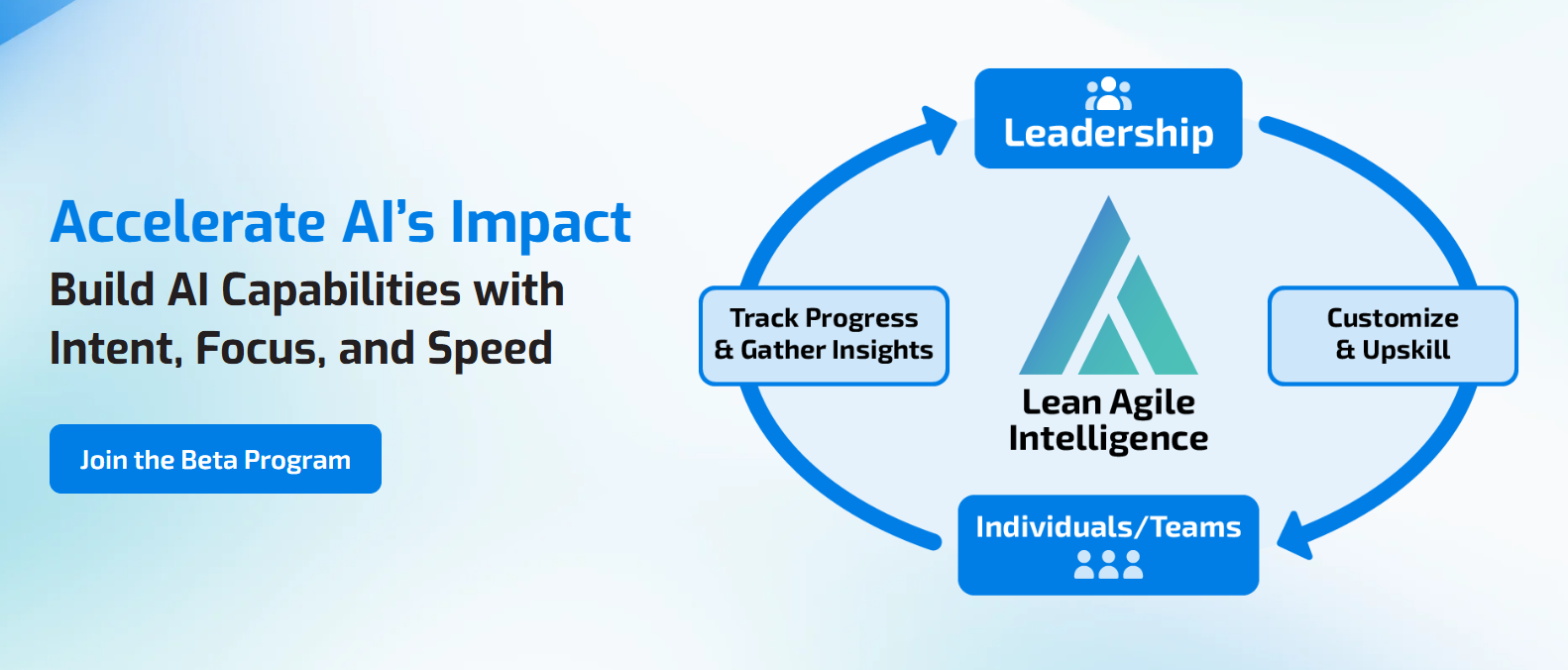
Lean Agile Intelligence helps organizations establish a baseline across AI capabilities and determine whether AI Use Case Prioritization remains dependent on individual opinion, has become a shared decision practice, or is embedded into planning and investment workflows.
For AI Use Case Prioritization, that means evaluating whether the organization:
- Maintains visibility across meaningful AI Use Cases
- Connects opportunities to strategy
- Uses shared prioritization criteria
- Evaluates business and user value
- Considers feasibility and readiness
- Makes AI investment tradeoffs explicitly
- Connects priorities to funding and capacity
- Reviews implementation evidence
- Reprioritizes existing AI investments
- Stops initiatives when evidence no longer supports continued investment
- Continuously improves how investment decisions are made