AI isn’t just another tool being introduced into organizations, it’s reshaping how work actually happens.
It’s changing how teams think, how decisions are made, how quickly work moves, and how value is delivered.
And like any meaningful shift, it doesn’t land evenly. Some teams move fast. Some hesitate. Others experiment without direction.
This is where the challenge begins.
For business agility coaches, it’s no longer just about introducing practices. It’s about helping teams adapt to a fundamentally different way of working.
So the question becomes:
How do we help teams use AI in a way that actually improves how they work, not just how fast they move?

AI Resources That Support Real Adoption
The resources below focus on what agility coaches actually need—not just understanding AI, but helping it take hold across teams.
AI Strategy & Use Case Clarity
Helps teams and leaders align on where AI should be applied by connecting use cases to real outcomes, ensuring efforts are focused on what creates meaningful value rather than scattered experimentation.
-
Identifying and Scaling AI Use Cases — OpenAI: Helps coaches guide teams in identifying high-value AI opportunities tied to real outcomes.
-
AI Business Use Cases — IBM: Provides examples that help connect AI use to business value across different contexts.
-
How to Identify AI Use Cases That Align with Business Goals — Vation Ventures: Supports aligning team-level AI use with broader organizational goals.
-
Evaluate and Prioritize an AI Use Case — Microsoft: A practical framework coaches can use to facilitate prioritization discussions.
AI Understanding for Teams
Builds a shared, practical understanding of AI across teams, reducing confusion and enabling more confident, effective use without requiring deep technical expertise.
-
Generative AI for Everyone — DeepLearning.AI: Builds foundational understanding that coaches can use to align teams.
-
Generative AI for Beginners — Microsoft: A structured learning path for introducing AI concepts to teams.
-
ChatGPT for Any Role — OpenAI Academy: Helps teams see how AI applies to their specific roles and responsibilities.
-
Generative AI in a Nutshell — YouTube: A quick, accessible overview to build shared understanding.
AI Usage & Prompting Practices
Focuses on how teams interact with AI day-to-day, establishing consistent prompting patterns and practices that lead to more reliable, repeatable outcomes.
-
Prompting — OpenAI Academy: Introduces prompting fundamentals that can be standardized across teams.
-
Prompt Engineering Guide — PromptingGuide.ai: A library of prompting techniques to improve consistency and effectiveness.
-
Prompt Engineering Best Practices — DigitalOcean: Practical tips coaches can translate into team-level practices.
-
Prompt Design Strategies — Google Cloud: Helps teams move from ad hoc prompting to more intentional usage.
AI in Workflow & Flow of Work
Centers on embedding AI into existing workflows to reduce friction, improve flow efficiency, and support how work actually gets done across teams.
-
AI Integration into Workflows — Zapier: Shows how AI can be embedded into existing workflows to reduce friction.
-
AI Workflow Automation — Atlassian: Explains how AI supports collaboration and improves flow efficiency.
-
How to Choose Tasks to Automate with AI — ProductTalk: Helps identify where automation can improve flow without over-optimizing.
-
AI in the Workplace — McKinsey: Explores how organizations embed AI into how work gets done at scale.
AI Impact & Flow Metrics
Helps teams measure the impact of AI using meaningful metrics, connecting AI usage to improvements in flow, delivery, and business outcomes.
-
AI Measurement Framework — LinearB: Connects AI usage to engineering and delivery performance.
-
Measuring AI Adoption & ROI — Wrench AI: Helps coaches assess adoption and connect it to outcomes.
-
AI ROI Metrics That Matter — Authority AI: Breaks down what to measure to understand impact.
-
AI Product Analytics — Moesif: Shows how AI-driven insights can inform better decisions and outcomes.
AI Governance & Responsible Use
Ensures teams use AI safely and responsibly by establishing clear guardrails around data, ethics, and usage while still enabling teams to move quickly and experiment.
-
What is AI Governance? — IBM: Defines governance in a way that coaches can translate into team practices.
-
Govern AI — Microsoft: Provides structured guidance for implementing governance across teams.
-
Responsible AI Framework — Harvard: Outlines principles that support ethical, accountable AI usage.
-
AI Ethics Recommendation — UNESCO: A global perspective on responsible AI practices.

AI as a System of Change for Business Agility Coaches
AI adoption isn’t a single change, it’s a system shift.
It touches on how direction is set, how teams build shared understanding, how practices shape behavior, how work flows through systems, and how progress is measured over time. When any one of these is missing, adoption slows or stalls.
This is where business agility coaches play a critical role, not in introducing AI, but in helping it become part of how work actually happens.
The role itself is evolving. It’s no longer just about facilitating practices or improving team processes. It’s about enabling AI-supported ways of working, guiding behavior change at scale, and connecting AI usage to real outcomes.
In practice, a few challenges consistently show up. AI usage varies widely across teams, practices struggle to scale, and outcomes are often unclear.
These patterns aren’t unusual. But without addressing them, AI remains an experiment instead of becoming a capability the organization can rely on.
Where to Start Turning Insight Into Action
For business agility coaches, the goal isn’t to introduce more tools. It’s to create clarity and alignment across how teams work.
A simple place to start is by watching the recording of our webinar here:
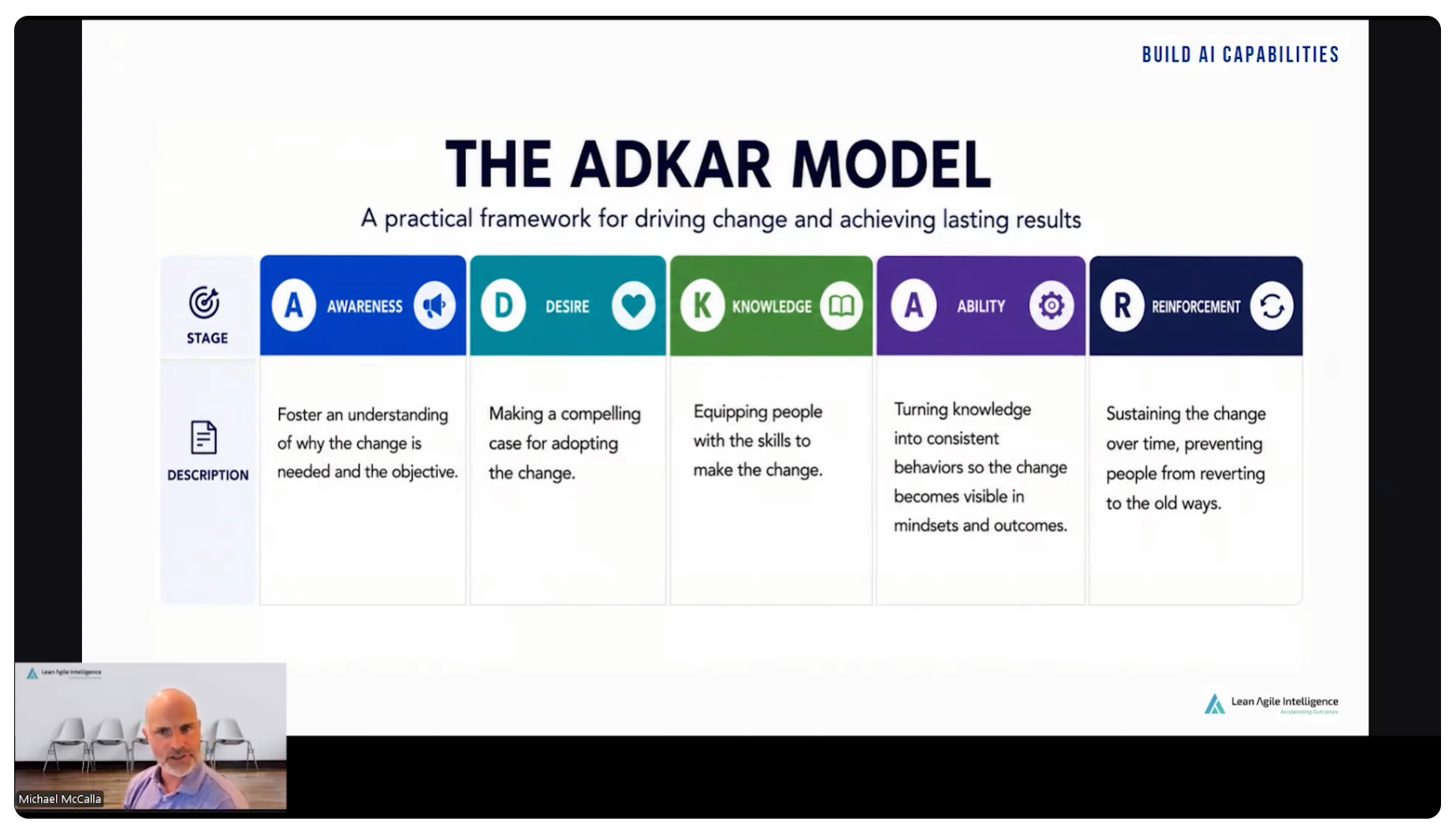
Build AI Capabilities with Intent, Focus, and Speed
In this webinar, we walked through how leading organizations were turning AI from experimentation into real, measurable productivity.
If you’re already ready to go deeper, we’ve also been working on something to help with exactly this challenge.
Our AI Assessments Beta Program is designed to help organizations understand:
-
where they stand today
-
where gaps exist
-
and where to focus next
Because ultimately, success with AI isn’t about knowing more. It’s about using it effectively to drive meaningful outcomes.
👉 Explore the AI Assessments Beta Program
What’s Next
As we explored these resources while building AI assessments, one thing became clear:
The challenge isn’t introducing AI. It’s understanding how effectively it’s being used and improving that in a structured, intentional way.
You can also explore more of those resources here in this post:
In upcoming posts, we’ll go deeper into what it takes to move from AI exploration to real effectiveness, including practical approaches to prompting, identifying high-value use cases, and measuring AI impact in a way that connects to outcomes.
Upcoming posts will focus on:
-
AI Resources for Engineering Teams: practical tools, workflows, and prompting approaches to integrate AI directly into development work
If you’d like to stay up to date as these are released, follow along, there’s more coming.