AI Roadmap: Turning AI Strategy Into Coordinated Execution
By Lean Agile Intelligence Product & Research Team
An AI roadmap turns AI strategy into a coordinated path for deciding what should happen, in what sequence, with which dependencies, and with what organizational capacity.
AI initiatives rarely suffer from a shortage of ideas. Business leaders identify new use cases. Technology teams explore platforms and models. Functions launch pilots. Data teams address foundational needs. Security, governance, and legal groups establish requirements.
Meanwhile, executives want to understand:
- What are we doing?
- What comes next?
- What needs to happen first?
- When should we expect meaningful progress?
Without a clear AI roadmap, those efforts quickly become disconnected. Priorities compete. Timelines conflict. Dependencies surface late. Teams react to the newest opportunity. Different stakeholders receive different answers about what matters most.
An AI strategy establishes where the organization wants to go.
The AI roadmap creates the practical bridge between that strategic direction and coordinated execution.
Microsoft's AI planning guidance describes planning as the connection between strategy and execution, bringing together prioritized initiatives, timelines, resources, dependencies, and expected outcomes.
The organization therefore does not simply need a list of AI projects.
It needs an AI roadmap.
What Is an AI Roadmap?
An AI roadmap is a high-level plan that translates AI strategy into a coordinated sequence of capabilities, initiatives, priorities, dependencies, milestones, and investment decisions.
AI Roadmap is one capability within LAI's broader AI Maturity Model, which evaluates the capabilities organizations need to move from AI adoption toward operationalization and measurable business outcomes.
A useful AI roadmap helps leaders and teams answer:
- What AI capabilities and initiatives are we pursuing?
- Which strategic outcomes do they support?
- What should happen first?
- What are the major milestones?
- Which initiatives depend on data, infrastructure, governance, security, or skills?
- What organizational capacity is required?
- Which initiatives compete for the same resources?
- What are we intentionally not prioritizing?
- What needs to become true before a future initiative can begin?
- How should new evidence change the sequence?
- What should stakeholders expect over the next quarter, six months, or year?
The roadmap should not be confused with a rigid project plan.
AI changes too quickly for organizations to assume every initiative, date, technology, and dependency identified today will remain correct months from now.
A stronger roadmap provides enough stability to coordinate work while leaving room to respond to:
- New evidence
- Changing strategic priorities
- New AI capabilities
- Capacity constraints
- Dependency changes
- Implementation learning
- Shifts in expected value
The objective is not to predict the future perfectly.
It is to create: Shared Direction → Intentional Sequencing → Dependency Visibility → Coordinated Execution → Continuous Reprioritization
The roadmap should make it easier for stakeholders to understand:
- Where are we going?
- What needs to happen next?
- What could prevent progress?
What Level of AI Roadmap Maturity Are You?
Before strengthening your AI roadmap, identify whether the organization is still coordinating AI initiative by initiative or using a shared roadmap to guide priorities, sequencing, dependencies, and investment.
LAI's AI Roadmap Maturity Model uses five levels to describe that progression.
| Level | Where You Are | Primary Focus |
|---|---|---|
| Level 1: Starting | AI initiatives are planned independently, priorities conflict, and dependencies often surface after work begins. | Create shared visibility into active and planned AI work. |
| Level 2: Emerging | Early roadmaps connect initiatives, timing, dependencies, and outcomes, but planning remains incomplete or inconsistently interpreted. | Strengthen sequencing and dependency awareness. |
| Level 3: Enabling | The roadmap is connected to AI strategy and increasingly influences prioritization and stakeholder alignment. | Connect strategy, roadmap priorities, initiatives, and execution. |
| Level 4: Operationalizing | The AI roadmap is embedded into planning, portfolio, investment, dependency, and stakeholder-review cadences. | Make the roadmap a working decision artifact rather than a presentation. |
| Level 5: Optimizing | The roadmap continuously changes based on evidence, value, progress, dependencies, strategic priorities, and available capacity. | Continuously redirect capacity toward the AI work that matters most. |
The objective is not to determine whether a roadmap document exists.
It is to understand whether the roadmap actually coordinates AI work and influences what the organization does next.
The Five Levels of AI Roadmap Maturity
LAI's AI Roadmap Maturity Model describes how organizations progress from reactive AI planning toward coordinated execution and continuous reprioritization.
The five levels are: Starting → Emerging → Enabling → Operationalizing → Optimizing
The progression moves from: Reactive Planning → Emerging Roadmap → Shared Alignment → Roadmap-Driven Planning → Continuous Reprioritization
Initially, organizations create visibility into disconnected AI initiatives. Early roadmap development reveals sequencing and dependencies. A shared roadmap connects strategic priorities to initiatives and execution. Operational integration makes the roadmap part of normal planning and decision-making. Measurement and learning then allow the organization to change the roadmap as evidence and capacity change.
The objective is not: A perfect long-term plan.
It is: A clear, coordinated, and adaptable path from AI strategy to execution.

Level 1: Starting — AI Planning Is Reactive and Uncoordinated
At the Starting level, there is no meaningful AI roadmap or the roadmap has little influence over actual planning.
AI initiatives emerge independently. Teams establish their own timelines. Priorities change based on immediate requests or executive attention. Dependencies are discovered after work begins.
For example:
- Two high-priority AI initiatives need the same data team during the same quarter.
- A customer-facing AI use case depends on governance capabilities that do not yet exist.
- A business leader expects an AI solution next quarter without realizing that infrastructure, data-access, and security work must happen first.
The organization is planning: Initiative by initiative
rather than: As a coordinated portfolio of AI work
Observable Evidence
Common signals include:
- Conflicting AI priorities
- Uncoordinated timelines
- Reactive planning
- No shared AI roadmap
- Dependencies discovered late
- Different functions maintaining separate AI plans
- Limited visibility into capacity conflicts
- AI initiatives with unclear strategic outcomes
The organization can have significant AI activity while still lacking a shared answer to:
"What are we actually doing, in what order, and why?"
How to Progress to Emerging
Start by creating visibility. Do not begin with a highly detailed five-year roadmap.
Identify the organization's most meaningful:
- Active AI initiatives
- Planned AI initiatives
- Enabling capabilities
- Strategic outcomes
- Approximate timing
- Owners
- Major dependencies
Then examine the portfolio together.
Look for:
- Competing timelines
- Shared dependencies
- Capacity conflicts
- Missing ownership
- Unclear business outcomes
- Initiatives competing for the same technology or data
- Foundational capabilities required by several use cases
The objective at Starting is to move from: Many disconnected AI plans
to: One shared view of the AI work
Practical Example: Create an AI Initiative Map
Bring together representatives from:
- Business
- Technology
- Data
- Security
- Governance
- AI enablement
For each significant initiative, capture: AI Initiative → Strategic Outcome → Owner → Current Level → Target Horizon → Major Dependency
For example:
| Initiative | Outcome | Horizon | Key Dependency |
|---|---|---|---|
| Customer support assistant | Improve support flow | Next | Knowledge data access |
| Developer coding assistant | Improve delivery flow | Now | Security approval |
| AI sales assistant | Reduce preparation effort | Next | CRM integration |
| Internal knowledge agent | Improve information access | Later | Identity + document access |
Then identify:
- Competing timelines
- Shared dependencies
- Missing owners
- Capacity conflicts
- Initiatives with unclear outcomes
Use the result to create the first one-page AI roadmap. At this level, the roadmap does not need to be sophisticated.
It needs to make the organization's AI work: Visible enough to coordinate.

Level 2: Emerging — The AI Roadmap Begins to Take Shape
At the Emerging level, early AI roadmaps are being created, reviewed, and refined. Stakeholders begin seeing AI investments represented together.
Teams conduct dependency and impact analysis. AI use-case discovery informs future work. Leaders communicate expected sequencing and timing.
The organization moves from: Reactive planning
toward: Intentional sequencing
But the roadmap remains incomplete or interpreted differently across functions.
It often functions more as a communication artifact than as a consistent planning mechanism.
Observable Evidence
Observable signals include:
- Draft AI roadmaps
- Dependency analysis
- Impact analysis
- AI use-case discovery informing future work
- Stakeholder communication about AI investments
- Initial milestone visibility
- Early portfolio-level planning
The roadmap is creating shared understanding. It is not yet consistently driving decisions.
How to Progress to Enabling
Strengthen the roadmap by explicitly connecting: Initiatives + Dependencies + Capacity + Outcomes
For each major AI initiative, ask:
- What must exist before this can begin?
- Which teams or capabilities does it depend on?
- Which other initiatives compete for the same resources?
- Which strategic outcome justifies its priority?
- What is the earliest responsible time to pursue it?
- What new evidence would move it forward?
- What new evidence would move it backward?
- What capability investment unlocks several initiatives?
Dependency analysis is especially important because valuable AI use cases often depend on work across:
- Data
- Infrastructure
- Security
- Governance
- Integration
- Skills
- Change enablement
- Workflow redesign
Practical Example: Build an AI Dependency Map
Take the top 5–10 roadmap initiatives. For each one, identify the major enabling dependencies.
For example:
Customer Service Agent
Depends on:
- Customer knowledge data
- Identity and access
- Model selection
- Governance approval
- Agent evaluation
- Customer-service workflow redesign
- Employee enablement
Now compare those dependencies across initiatives. You might discover that three high-priority use cases all require the same enterprise data-access capability. That should change the roadmap.
Instead of treating the three use cases as independent workstreams, the organization can explicitly evaluate whether the shared capability should move earlier.
A useful roadmap principle is:
When several priority AI initiatives depend on the same capability, roadmap the capability—not only the individual use cases.
This turns the roadmap from: A project list
into: A coordinated plan for AI capability development and execution
Level 3: Enabling — The AI Roadmap Guides Alignment and Prioritization
At the Enabling level, the AI roadmap is defined, connected to AI strategy, and increasingly used to guide prioritization.
The roadmap is published. Stakeholders share a common view of the major priorities. Work can be traced back to roadmap initiatives.
Dependencies are actively coordinated.
The roadmap begins influencing: What moves forward and what does not.
Observable Evidence
Observable evidence includes:
- A published AI roadmap
- Clear connection between roadmap and AI strategy
- AI initiatives tied to strategic outcomes
- Work items connected to roadmap priorities
- Active dependency coordination
- Shared stakeholder understanding
- Explicit sequencing of foundational capabilities and use cases
The key progression is: The roadmap no longer simply describes AI work.
It helps prioritize AI work.
How to Progress to Operationalizing
Create clear traceability from strategy through execution.
A useful hierarchy is:
AI Strategy
What outcomes and strategic priorities matter?
↓
AI Roadmap
Which capabilities and initiatives should progress, and in what sequence?
↓
Initiatives / Use Cases
Which investments advance the roadmap?
↓
Work Items
What must teams actually execute?
This traceability prevents the roadmap from becoming disconnected from real work. The roadmap should also show major dependencies directly rather than burying them inside individual project plans.
Practical Example: Create a Three-Horizon AI Roadmap
Rather than assigning precise dates to every future initiative, organize the roadmap into three horizons.
Now
- Work that is funded and actively underway.
- Examples:
- Establish enterprise AI governance
- Deploy coding assistant
- Improve AI-ready customer data
Next
- Work expected to begin when dependencies, evidence, or capacity become available.
- Examples:
- Customer-service agent
- Enterprise knowledge assistant
- AI sales workflow integration
Later
- Promising opportunities requiring additional learning, capability, or strategic validation.
- Examples:
- Autonomous service workflows
- Agentic product operations
- Enterprise multi-agent orchestration
For every roadmap item, show:
- Strategic Outcome
- Owner
- Major Dependency
- Success Measure
This avoids false precision while still providing useful direction. Then use the roadmap in prioritization discussions.
When a new AI opportunity appears, ask:
What existing roadmap priority would this replace, delay, or consume capacity from?
That question changes the planning conversation.
Instead of endlessly adding work, the organization makes an explicit tradeoff.

Level 4: Operationalizing — The Roadmap Becomes Part of the Operating Rhythm
At the Operationalizing level, the AI roadmap becomes part of the recurring operating system through which AI work is planned, funded, coordinated, and communicated.
Planning cycles reference the roadmap. Milestones are tracked. Dependencies are represented in work-management systems. Portfolio and investment conversations use the roadmap. Stakeholders have a consistent view of what is progressing, what is blocked, and what requires coordinated action.
At Enabling: The roadmap influences priorities.
At Operationalizing: The roadmap becomes part of how AI work is actually managed.
Observable Evidence
Observable evidence includes:
- Planning cycles referencing the AI roadmap
- Roadmap milestones being tracked
- Dependencies connected within work-management systems
- Portfolio reviews using roadmap priorities
- Investment discussions linked to roadmap outcomes
- Executive communication using a shared roadmap
- Improving stakeholder alignment
How to Progress to Optimizing
Integrate roadmap review into the operating cadences that already govern organizational work.
Examples include:
- Quarterly planning
- Portfolio reviews
- Investment discussions
- Executive updates
- Dependency reviews
- AI governance meetings
- AI Center of Excellence reviews
Do not create a roadmap that is refreshed twice per year in isolation.
The roadmap should become: A decision-making artifact
not: A presentation artifact
Practical Example: Run a Monthly AI Roadmap Review
Once per month, bring together the leaders responsible for major AI capabilities and initiatives.
Review five areas.
1. Outcomes
- Which strategic outcomes are roadmap initiatives intended to support?
- What evidence has emerged?
2. Milestones
- What was expected since the last review?
- What actually happened?
3. Dependencies
- What is blocking or threatening roadmap progress?
- Are several initiatives waiting on the same dependency?
4. Capacity
Do we have the:
- People
- Funding
- Data
- Infrastructure
- Skills
- Change capacity
required for upcoming work?
5. Decisions
What needs to change?
Use a simple status model.
- On Track: Progress aligns with current expectations.
- At Risk: A dependency, capacity issue, or new evidence threatens progress.
- Blocked: Work cannot proceed.
- Reprioritize: New evidence suggests the roadmap sequence should change.
Connect major roadmap items to the organization's work-management system so dependencies and milestones are not tracked only in presentation slides.
Then examine roadmap effectiveness through measures such as:
- Dependency Resolution Time
- How quickly are significant cross-initiative blockers resolved?
- Milestone Predictability
- How closely does major work progress align with current planning expectations?
- Stakeholder Alignment
- Do key stakeholders share the same understanding of roadmap priorities?
- AI Initiative Throughput
- How effectively is priority AI work progressing through the organization?
- Strategic Traceability
- What percentage of major roadmap initiatives connect to defined strategic outcomes?
The objective is not: Perfect roadmap adherence.
It is: Better coordination and better planning decisions because the roadmap exists.

Level 5: Optimizing — The Roadmap Evolves With Evidence and Capacity
At the Optimizing level, the AI roadmap is intentionally adjusted as evidence, organizational capacity, dependencies, strategic priorities, and AI capabilities change.
An AI roadmap should never become a fixed commitment to yesterday's assumptions.
Technology changes. Business priorities shift. New opportunities appear. Some initiatives produce useful evidence. Others underperform expectations. Dependencies move. Capacity expands or contracts.
The organization is no longer primarily asking: "Are we delivering everything on the roadmap?"
It is asking: "Does the roadmap still represent the best use of our available AI capacity?"
Observable Evidence
Observable signals include:
- Recurring AI roadmap reviews
- Outcome-driven reprioritization
- Quarterly roadmap adjustments
- Initiatives intentionally accelerated or stopped
- Shared capabilities moved earlier when they unlock multiple priorities
- Roadmap sequencing changed based on evidence
- Improving AI initiative throughput
A mature roadmap is: Stable enough to provide direction
and: Flexible enough to respond to learning
How to Sustain and Continuously Improve
Create a continuous roadmap feedback loop: Plan → Execute → Measure → Learn → Reprioritize
Review more than delivery progress.
Revisit the assumptions behind the roadmap.
Ask:
- Which initiatives still support the most important strategic outcomes?
- Which initiatives show evidence worth further investment?
- Which dependencies constrain several priorities?
- Where is organizational capacity tight?
- Which planned initiative has become less important?
- Which new opportunity deserves consideration?
- Which initiative should stop?
- Should foundational capability work move ahead of additional use cases?
- Are we moving meaningful AI work through the organization more effectively over time?
The objective is not to preserve previous roadmap decisions.
It is to improve future ones.
Practical Example: Run a Quarterly AI Roadmap Reset
At the beginning of each quarter, review every major roadmap item.
For each initiative, evaluate:
- Strategic Value
- Does this still support an important organizational priority?
- Evidence
- What have we learned about its potential or observed value?
- Progress
- Is the initiative moving as expected?
- Capacity
- Do we have the resources required to continue?
- Dependencies
- Has anything changed that should affect sequencing?
- Decision
- Choose one:
- Accelerate
Increase priority or capacity. - Continue
Maintain current direction. - Re-sequence
Change timing because of dependencies or capacity. - Pivot
Change the approach based on learning. - Pause
Stop temporarily while more important conditions are addressed. - Remove
The initiative no longer warrants roadmap investment.
- Accelerate
- Choose one:
For example:
| Initiative | Learning | Roadmap Decision |
|---|---|---|
| Coding assistant | Strong adoption and encouraging delivery indicators | Accelerate |
| Customer agent | Critical data dependency remains unresolved | Re-sequence |
| Meeting assistant | High usage but limited evidence of broader value | Pause / reassess |
| AI data-access capability | Blocks several priority use cases | Move forward |
| Legacy chatbot expansion | New architecture changes the opportunity | Remove / replace |
Do not automatically carry unfinished initiatives into the next quarter. Require an explicit prioritization decision.
The strongest sign of roadmap maturity is not: The organization delivers exactly what it predicted months earlier.
It is: The organization becomes better at directing available capacity toward the AI work that matters most as conditions change.
Connecting AI Strategy, the AI Roadmap, and AI Adoption
AI strategy, the AI roadmap, and AI adoption serve different purposes and work best when they remain connected.
AI Strategy Provides Direction
AI strategy answers:
- Why are we investing in AI?
- What outcomes matter?
- Where should AI create value?
- What strategic principles should guide investment?
The AI Roadmap Coordinates Execution
The AI roadmap answers:
- What should we pursue now?
- What comes next?
- What capabilities need to be built first?
- What dependencies affect sequencing?
- Where should available capacity go?
- What should wait?
AI Adoption Shows What Is Entering the Work
AI adoption helps show:
- Which tools or workflows employees are using
- Where experimentation is increasing
- Which capabilities are becoming part of normal work
- Where additional enablement or workflow integration is required
The relationship is: AI Strategy → AI Roadmap → Execution and AI Adoption → Evidence → Roadmap Adjustment
This matters because growing AI adoption creates more opportunities, requests, dependencies, and investment decisions.
Without a roadmap, increasing adoption easily becomes: More pilots + More tools + More requests + More competition for capacity
The roadmap provides the coordination mechanism. The goal is not to place every AI adoption opportunity onto the roadmap.
It is to determine: Which AI capabilities and investments deserve coordinated organizational attention and in what sequence.
Related capabilities: AI Strategy, AI Use Case Prioritization
Key Takeaway
AI roadmap maturity isn't achieved when an organization publishes a timeline of AI initiatives. It is demonstrated when the roadmap consistently guides priorities, dependencies, planning, investment, and stakeholder expectations—and changes as the organization learns where its AI capacity should go next.
From AI Strategy to AI Operationalization
An AI roadmap operationalizes AI strategy by turning strategic direction into an adaptable sequence of coordinated capabilities, initiatives, dependencies, and decisions.
AI adoption creates opportunities. AI strategy establishes direction. The AI roadmap turns that direction into a coordinated path forward.
The maturity model progresses from:
Reactive Planning → Emerging Roadmap → Shared Alignment → Roadmap-Driven Planning → Continuous Reprioritization
Initially, organizations create visibility into AI work. Early roadmaps coordinate initiatives and dependencies. A shared roadmap aligns strategic priorities and execution. Embedding the roadmap into planning makes it operational. Measurement and learning allow the organization to redirect capacity as conditions change.
That is the difference between: Having a collection of AI initiatives
and: Operationalizing an AI roadmap
The goal is not to predict every AI investment years in advance.
It is to maintain a clear, shared, and adaptable view of:
- What the organization intends to accomplish
- What must happen to accomplish it
- What needs to happen first
- What could block progress
- How new evidence should change the plan
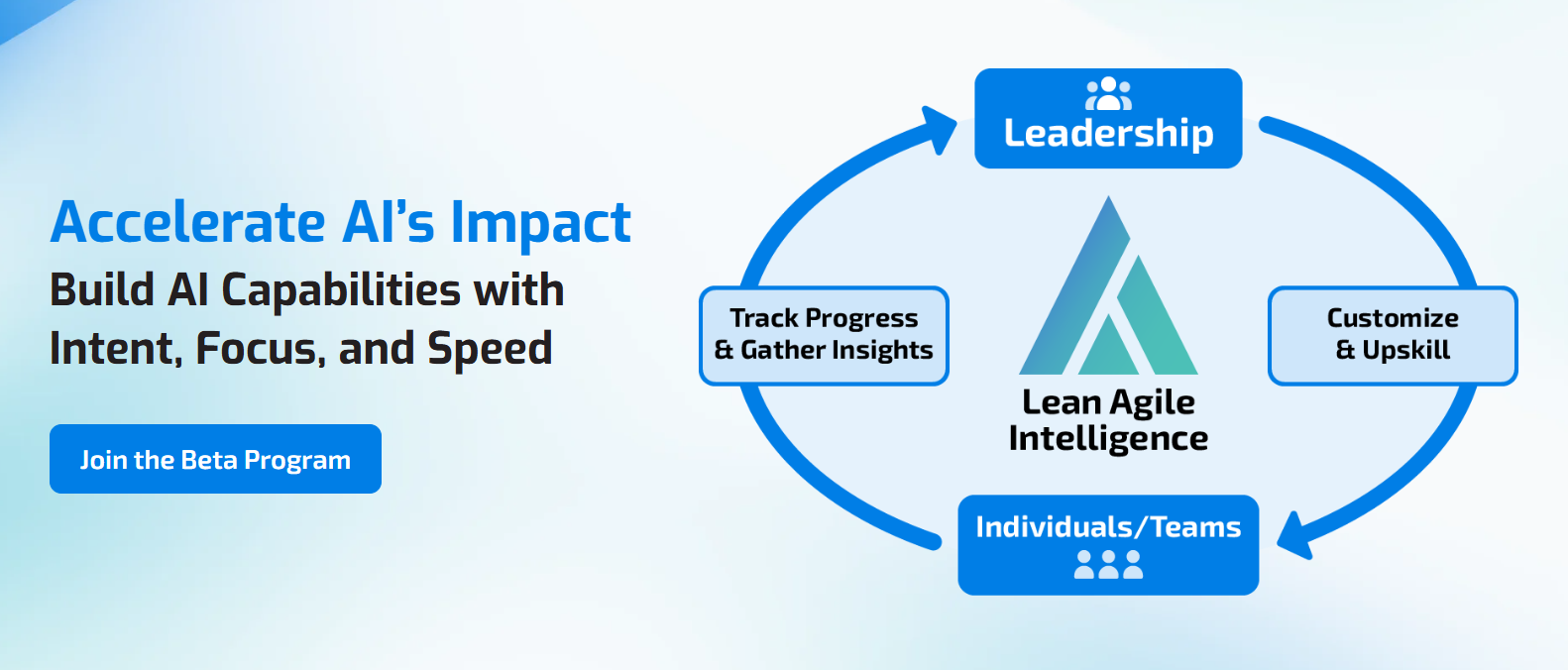
Evaluate Whether Your AI Roadmap Is Actually Guiding Execution
Publishing an AI roadmap creates visibility.
The more important question is whether the roadmap influences real planning, prioritization, dependencies, investment, and execution.
Lean Agile Intelligence helps organizations establish a baseline across AI capabilities and determine whether AI planning remains reactive, has become a shared roadmap, or is embedded into standard operating and planning cadences.
For AI Roadmap, that means evaluating whether the organization:
- Connects the roadmap to AI strategy
- Maintains visibility across priority AI initiatives
- Links initiatives to strategic outcomes
- Makes major dependencies visible
- Identifies capacity conflicts
- Sequences shared capabilities and use cases intentionally
- Connects roadmap priorities to real work
- Uses the roadmap in planning and investment decisions
- Tracks milestones and dependencies
- Reviews evidence from active initiatives
- Reprioritizes based on capacity and learning
- Explicitly pauses or removes lower-value work
- Continuously improves how AI work moves through the organization
LAI's AI Enablement & Productivity Assessment establishes a baseline across AI Roadmap and the related capabilities teams need to operationalize AI, identifies gaps, and measures progress over time.
Assess Your AI Roadmap Capability
Prefer to start with early access? Join the AI Assessment Beta Program.