AI Understanding: Building the AI Fluency Required to Operationalize AI
By Lean Agile Intelligence Product & Research Team
AI understanding gives employees the foundational knowledge they need to recognize where AI fits, use it appropriately, understand its limitations, and make better decisions as AI adoption expands across the organization.
AI tools are becoming easier to access faster than organizations are becoming capable of using them well.
Employees hear terms such as generative AI, large language models, agents, retrieval-augmented generation, hallucinations, context windows, and prompting—but their understanding varies dramatically.
Some employees expect AI to know everything. Others assume it is little more than an advanced search engine. Some trust AI-generated answers too readily. Others avoid AI because they do not understand what it actually does well.
That uneven understanding creates an operational problem.
Employees cannot consistently identify valuable AI use cases if they do not understand AI's capabilities.
They cannot recognize limitations if they do not understand how AI behaves.
And they cannot make informed decisions about when to trust, challenge, or avoid AI if everyone operates from a different mental model.
Microsoft describes AI fluency as beginning with strong foundations: understanding what AI is, the technologies it includes, responsible AI, and how AI applies to work. Its learning resources also differentiate education by role rather than assuming every employee needs the same technical depth.
Organizations don't simply need people with access to AI.
They need AI Understanding.
What Is AI Understanding?
AI Understanding is the organizational capability to ensure people understand what AI is, how it works at a practical level, what it does well, where its limitations matter, and how those characteristics should influence the way they work.
This does not mean every employee needs to become a machine-learning engineer.
A business leader, product manager, developer, HR partner, marketer, and data scientist require different levels of technical depth.
But they all benefit from a common foundation that helps them answer questions such as:
- What is generative AI actually doing when it generates a response?
- What is the difference between an AI model, an AI application, and an AI agent?
- What kinds of work is AI good at?
- Where is AI unreliable?
- Why does the context provided to AI matter?
- Why does AI sometimes produce confident but incorrect responses?
- When should human judgment remain central?
- What makes one task a good candidate for AI while another is not?
- How should AI use change as the technology becomes more capable?
Google Cloud similarly argues that an AI-ready workforce needs a firm grasp of AI's strengths and limitations, along with the knowledge needed to use increasingly capable AI systems effectively and responsibly.
AI Understanding therefore serves as a foundation for many other AI capabilities.
Before employees consistently use AI well, they need a sufficiently accurate mental model of:
What they are working with → What it does well → Where it fails → How people should respond
Figure Out Where You Are
Before strengthening AI Understanding, identify whether employees simply recognize AI terminology or whether their understanding is consistently influencing how they apply AI in real work.
LAI's AI Understanding Maturity Model uses five stages to describe that progression.
Organizations looking for a broader baseline can use LAI’s AI Readiness Assessment to understand AI Understanding alongside the other organizational capabilities and conditions required to adopt AI effectively.
|
Stage |
Where You Are |
Primary Focus |
|---|---|---|
|
Employees have limited or inconsistent understanding of AI's capabilities, limitations, terminology, and appropriate use. |
Establish a practical foundation and shared mental model. |
|
|
Employees are learning and experimenting, but understanding varies by individual and source. |
Connect learning with hands-on experimentation and real work. |
|
|
Common terminology, foundational learning, and role-relevant AI fluency are established across the organization. |
Create a consistent foundation while developing role-specific depth. |
|
|
Employees reliably apply their understanding when selecting AI tasks, providing context, evaluating outputs, and deciding where human judgment belongs. |
Turn AI knowledge into observable work practices. |
|
|
AI understanding continuously develops as technology, organizational use cases, risks, and capabilities evolve. |
Build a continuous AI learning system tied to real work. |
The objective is not to make every employee an AI expert.
It is to understand where AI understanding stands today, where inconsistent mental models are limiting AI adoption, and what people need to learn or apply next.
The AI Understanding Maturity Model
LAI's AI Understanding Maturity Model describes how organizations progress from basic awareness toward AI fluency that consistently influences how employees use AI in their work.
The five stages are:
Starting → Emerging → Enabling → Operationalizing → Optimizing
The maturity model progresses from:
Limited Awareness → Individual Learning → Shared AI Fluency → Applied Understanding → Continuous Learning
At first, employees build foundational awareness of AI's capabilities and limitations.
Individual learning and experimentation deepen understanding. Shared terminology and role-relevant learning create a stronger organizational foundation. Applied understanding changes how people select tasks, provide context, evaluate outputs, and use human judgment.
Continuous learning then keeps organizational knowledge aligned with rapidly evolving AI capabilities.
The goal is not simply more training.
It is AI understanding that becomes visible in how people work.

Starting: AI Is Poorly Understood
At the Starting stage, foundational AI understanding is limited and inconsistent.
Employees recognize the term AI without necessarily having a useful understanding of what modern AI systems actually do.
Terminology varies.
Expectations swing between unrealistic optimism and unnecessary skepticism.
Some employees misuse tools because they assume AI is more capable than it is.
Others avoid AI entirely because they lack enough understanding to recognize where it helps.
What This Looks Like
Common signals include:
- Confusion about AI capabilities
- Misuse of AI tools
- Inconsistent terminology
- Avoidance of AI use
- Overconfidence in AI-generated outputs
- Difficulty identifying appropriate AI use cases
The problem is not simply a lack of training.
It is the absence of a shared foundational mental model.
How to Progress to Emerging
Start with practical AI literacy rather than overwhelming employees with technical theory.
Employees should initially understand:
- What AI Is
- A practical explanation of:
- Artificial intelligence
- Machine learning
- Generative AI
- Large language models
- AI agents
- A practical explanation of:
- What AI Does Well
- Common capabilities such as:
- Summarization
- Generation
- Classification
- Analysis
- Pattern identification
- Reasoning support
- Increasingly, actions through agents
- Common capabilities such as:
- What AI Does Not Reliably Do
- Explain why outputs sometimes include:
- Incorrect information
- Missing context
- Unsupported conclusions
- Poor judgment
- Confident but inaccurate answers
- Explain why outputs sometimes include:
- Human Responsibility
- People remain responsible for deciding whether AI output is appropriate for its intended use.
- AI at Our Organization
- Clarify:
- Which tools are approved
- Where employees should begin
- What kinds of experimentation are encouraged
- Where additional guidance is required
- Clarify:
Practical Example: Run an AI Foundations Workshop
Create a 60-minute session around five questions.
1. What Is AI?
Explain the practical difference between:
- Traditional automation
- Machine learning
- Generative AI
- AI agents
Keep the explanation useful rather than mathematical.
2. What Is AI Good At?
Demonstrate examples such as:
- Summarizing
- Drafting
- Analyzing
- Brainstorming
- Transforming information
3. Where Does AI Struggle?
Show examples of:
- Incorrect answers
- Missing context
- Fabricated information
- Poor judgment
4. What Role Does the Human Play?
Use a simple model:
AI assists → Human evaluates → Human remains accountable
5. Where Does AI Fit in My Work?
Ask each employee to identify one recurring task they want to explore.
Finish with one takeaway:
AI is powerful, but probabilistic. Understanding both its strengths and limitations is the foundation for using it well.
The objective at Starting is not expertise.
It is to replace confusion with foundational awareness.
Organizations do not need to build every foundational learning resource themselves. LAI maintains a curated collection of AI learning resources that can help employees build a practical understanding of AI capabilities, limitations, and use cases.

Emerging: Individuals Begin Building AI Knowledge
At the Emerging stage, employees actively build AI knowledge through training, experimentation, articles, videos, peer learning, and hands-on use.
AI concepts appear more frequently in meetings. Some people become informal experts who help colleagues. Employees experiment with AI in real work. This bottom-up activity is valuable.
But different employees often learn from different sources and develop different interpretations of the same concepts.
The organization gains knowledge without yet having a consistent organizational understanding.
What This Looks Like
Observable signals include:
- Informal AI learning
- AI training sessions
- AI resources shared among employees
- AI concepts discussed more frequently
- Employees experimenting with AI tools
- Informal AI champions emerging
The important shift is that employees are no longer simply aware of AI.
They are actively trying to understand it.
How to Progress to Enabling
Give employees time to learn and experiment, not just training content.
DORA's research on generative AI adoption emphasizes experimentation, practice, and integration with real work as important components of learning. Its developer research found a strong association between dedicated learning and experimentation time and increased AI adoption.
The principle is straightforward:
Understanding develops through learning plus application—not learning alone.
Encourage employees to take foundational knowledge and test it against real work.
Practical Example: Introduce an AI Learning Hour
Give employees one hour every two weeks for AI learning and experimentation.
Use a simple format.
- Learn
- Spend 15–20 minutes learning one concept.
- Examples:
- How LLMs work
- What hallucination means
- Why context matters
- What an AI agent is
- When RAG is useful
- Try
- Spend 20–30 minutes applying the concept to real work.
- For example:
- After learning about context, take a real task and compare the AI result with and without relevant background information.
- Share
- Capture one learning:
- I learned...
- I tried...
- I observed...
- I would use this when...
- Create a shared channel where employees post examples.
- Capture one learning:
The goal is to move from: "I took an AI course."
to: "I understand something about AI because I experienced how it behaves in my work."
Enabling: A Shared Understanding of AI Exists
At the Enabling stage, the organization establishes a shared foundation of AI understanding while providing additional depth based on role and responsibility.
Employees increasingly use the same terminology. Shared learning materials exist. Common explanations replace conflicting definitions.
Meetings discuss AI concepts without repeatedly stopping to establish what everyone means.
The organization develops a shared AI language and baseline of AI fluency.
What This Looks Like
Evidence includes:
- Standard foundational AI training
- A documented AI terminology glossary
- Shared AI learning resources
- Role-specific learning paths
- Common understanding of major AI capabilities and limitations
- AI discussions requiring less clarification of basic concepts
The organization increasingly assumes a common baseline of understanding.
That makes more sophisticated AI conversations possible.
How to Progress to Operationalizing
Formalize the organization's foundational AI curriculum and vocabulary while tailoring additional learning to different roles.
Avoid creating one generic course for every employee.
Microsoft's AI enablement guidance recommends matching learning to role and skill level. Beginners require foundational knowledge, builders need hands-on technical skills, and domain experts need the ability to evaluate quality, accuracy, usefulness, and risk.
The organization therefore needs both: Common AI Understanding - What everyone should know.
and: Role-Relevant AI Understanding - What someone needs to understand because of the work they perform.
Practical Example: Create an Enterprise AI Fluency Framework
Define three levels of AI understanding.
Level 1 — Foundation: Everyone
Employees should understand:
- What generative AI is
- Basic AI terminology
- AI strengths and limitations
- Responsible AI use
- How prompts and context affect results
- When human validation matters
Level 2 — Application: AI Users
Employees who frequently use AI should also understand:
- Prompt structure
- Context engineering basics
- AI output evaluation
- Common AI workflow patterns
- Appropriate use-case selection
- Data and security expectations
Level 3 — Advanced: Builders and AI Leaders
People designing, building, or leading AI solutions need additional understanding of areas such as:
- RAG
- Agents
- Model selection
- Evaluation
- AI architecture
- Governance
- AI economics
- Risk management
Then create a shared AI Glossary containing practical definitions.
For example:
- LLM: A model trained on large amounts of information to predict and generate language.
- Hallucination: An AI response that sounds plausible but contains unsupported or incorrect information.
- Context: Information supplied to AI that helps it understand the task.
- RAG: A method for retrieving external information and providing it to an AI model as additional context.
- Agent: An AI system designed to reason about a goal and use tools or take actions to accomplish tasks.
Keep definitions short and written for employees rather than specialists.
The result is a shared AI fluency foundation that makes organizational learning easier to scale.

Operationalizing: AI Understanding Consistently Shapes How Work Is Done
At the Operationalizing stage, employees reliably apply their AI understanding when deciding where AI fits, how it should be used, what context it requires, and where human judgment remains necessary.
Employees do not simply know that AI has strengths and limitations.
Their work demonstrates that understanding. They recognize appropriate AI tasks. They provide relevant context. They structure requests effectively. They evaluate results. They understand where human judgment matters.
The important difference is that AI understanding becomes visible through behavior.
An employee who defines hallucination but blindly trusts AI output has awareness.
An employee who understands the limitation and changes how they work because of it demonstrates applied understanding.
What This Looks Like
Observable evidence includes:
- Common AI usage patterns appearing in work
- Shared clarity around when AI should be applied
- AI used for appropriate tasks
- Structured prompting or context approaches
- Human validation applied based on risk and use
- Employees independently recognizing poor AI task fit
How to Progress to Optimizing
Shift enablement from: Teaching AI concepts
to: Coaching AI application
Use real workflows.
Instead of training employees generically on "prompt engineering," select a recurring business task such as analyzing customer feedback.
Show how AI understanding affects each step.
- Define the Task: What should AI actually do?
- Provide Context: What information does AI need?
- Structure the Request: What output is expected?
- Evaluate the Result: What requires human validation?
- Improve the Interaction: What should change based on the first result?
Microsoft's enablement guidance similarly emphasizes helping people understand not just how to use AI, but when AI is appropriate, which parts of the work it should support, and where human-AI handoffs belong.
Practical Example: Create an AI Task-Fit Canvas
Choose one real task and evaluate how AI should contribute.
- Task
- What work needs to be performed?
- AI Strength
- What part of this task matches something AI does well?
- Examples:
- Synthesis
- Generation
- Classification
- Analysis
- Pattern identification
- Context Needed
- What information must AI receive to perform effectively?
- Human Judgment
- What should remain with the employee?
- Output Evaluation
- How will the employee determine whether the AI result is usable?
- Usage Pattern
- How should AI fit into the workflow?
- For example:
- Task: Analyze employee survey comments
- AI Strength: Theme identification and summarization
- Context: Survey questions, business terminology, organizational context
- Human Judgment: Determine significance and recommended actions
- Evaluation: Validate identified themes against original comments
- Pattern: AI analyzes → Human validates → Human interprets → AI helps draft summary
- Use the canvas during team workshops.
After several exercises, teams develop a stronger intuitive understanding of:
Where AI fits—and where it doesn't.
NIST similarly emphasizes training people for their AI responsibilities and encouraging critical thinking around AI use and risk.
Optimizing: AI Understanding Continuously Expands
At the Optimizing stage, AI Understanding becomes a continuous organizational learning capability that evolves as AI technology, risks, and use cases change.
AI Understanding cannot remain static. The AI employees learned about two years ago is not the AI they work with today.
Models improve. New capabilities emerge. Agents perform larger units of work. Context techniques evolve. New risks become visible.
Tasks previously inappropriate for AI become feasible.
The organization intentionally expands AI Understanding as technology and its uses evolve.
What This Looks Like
Observable signals include:
- AI Communities of Practice
- Role-specific AI training
- Ongoing AI use-case discovery
- Continued AI experimentation
- Shared learning from real AI workflows
- Learning priorities changing as AI capabilities evolve
The organization does not assume one foundational training course created permanent AI fluency.
Learning becomes continuous and increasingly connected to real organizational use cases.
How to Sustain and Continuously Improve
Create an organizational learning system rather than a training program with a finish line.
Microsoft recommends approaches such as:
- Communities of practice
- Recurring user groups
- Demonstrations
- Hackathons
- Office hours
- Searchable discussion forums
These create ways for employees to learn from each other and convert recurring questions into reusable organizational guidance.
Google Cloud similarly emphasizes continuous skills development as AI and agentic systems become more sophisticated.
Create a feedback loop:
Learn → Apply → Discover → Share → Expand
Practical Example: Build an AI Community of Practice
Create a cross-functional AI Community of Practice for employees who actively use AI or want to learn.
Run a monthly 60-minute session.
- What's New? — 10 Minutes
- Explain one new AI capability or concept.
- For example:
- Agents
- Deep research
- Multimodal AI
- Context engineering
- New workflow capabilities
- Use-Case Demo — 15 Minutes
- An employee demonstrates a real use case:
- Problem → AI approach → What worked → What didn't → Result
- Experiment Review — 15 Minutes
- Discuss a recent AI experiment and what was learned.
- Ask the Community — 10 Minutes
- Employees bring questions or challenges.
- What Should We Learn Next? — 10 Minutes
- Identify emerging learning needs.
- Maintain three living organizational assets.
- AI Learning Backlog
- What employees need to understand next.
- AI Use-Case Library
- Examples of useful AI applications.
- AI Patterns Library
- Reusable approaches that consistently work.
For example:
|
Learning Need |
Why It Matters |
Action |
|---|---|---|
|
AI agents |
Teams are beginning agent experiments |
Agent fundamentals workshop |
|
Context engineering |
Output quality varies significantly |
Hands-on session |
|
AI evaluation |
More AI outputs are entering workflows |
Evaluation training |
|
Role-specific AI |
Generic training has plateaued |
Function-based learning |
|
Advanced prompting |
Strong users are ready to progress |
Practitioner workshop |
Then examine whether stronger understanding is changing actual behavior.
- Are employees identifying better AI use cases?
- Are inappropriate uses decreasing?
- Are teams applying AI to more sophisticated work?
- Are common concepts understood without repeated explanation?
- Are experiments becoming more useful?
Optimization is not demonstrated by how many AI courses employees complete.
It is demonstrated when organizational understanding keeps expanding enough to apply new AI capabilities appropriately, responsibly, and effectively.
Key Takeaway
AI Understanding maturity isn't achieved when employees can explain what AI is. It is demonstrated when that understanding consistently helps them decide where AI fits, use it appropriately, recognize its limitations, apply human judgment, and continuously expand how they work with AI as the technology evolves.
From AI Awareness to AI Operationalization
AI operationalization starts with people having enough AI understanding to make informed decisions about where AI belongs and how it should be used.
AI adoption can begin with access. AI operationalization requires more.
The AI Understanding Maturity Model progresses from:
Limited Awareness → Individual Learning → Shared AI Fluency → Reliable Application → Continuous Learning
Initially, organizations establish foundational AI literacy.
Employees experiment and develop personal understanding.
Shared terminology and role-relevant learning create a common organizational foundation.
Applied understanding begins changing how work gets done.
Continuous learning allows the organization to keep pace as AI capabilities expand.
That is the difference between: Knowing about AI
and: Developing an organization capable of working effectively with AI
Training alone is not the objective.
People need opportunities to: Learn → Practice → Apply → Reflect → Improve
The goal is not to make every employee an AI expert.
It is to give people enough understanding to make good decisions about AI in the context of the work they perform—and continuously deepen that understanding as AI adoption and AI capabilities evolve.
Evaluate Whether AI Fluency Is Changing How People Work
Completing AI training establishes exposure.
The more important question is whether employees actually understand AI well enough to make better decisions about when, where, and how to use it.
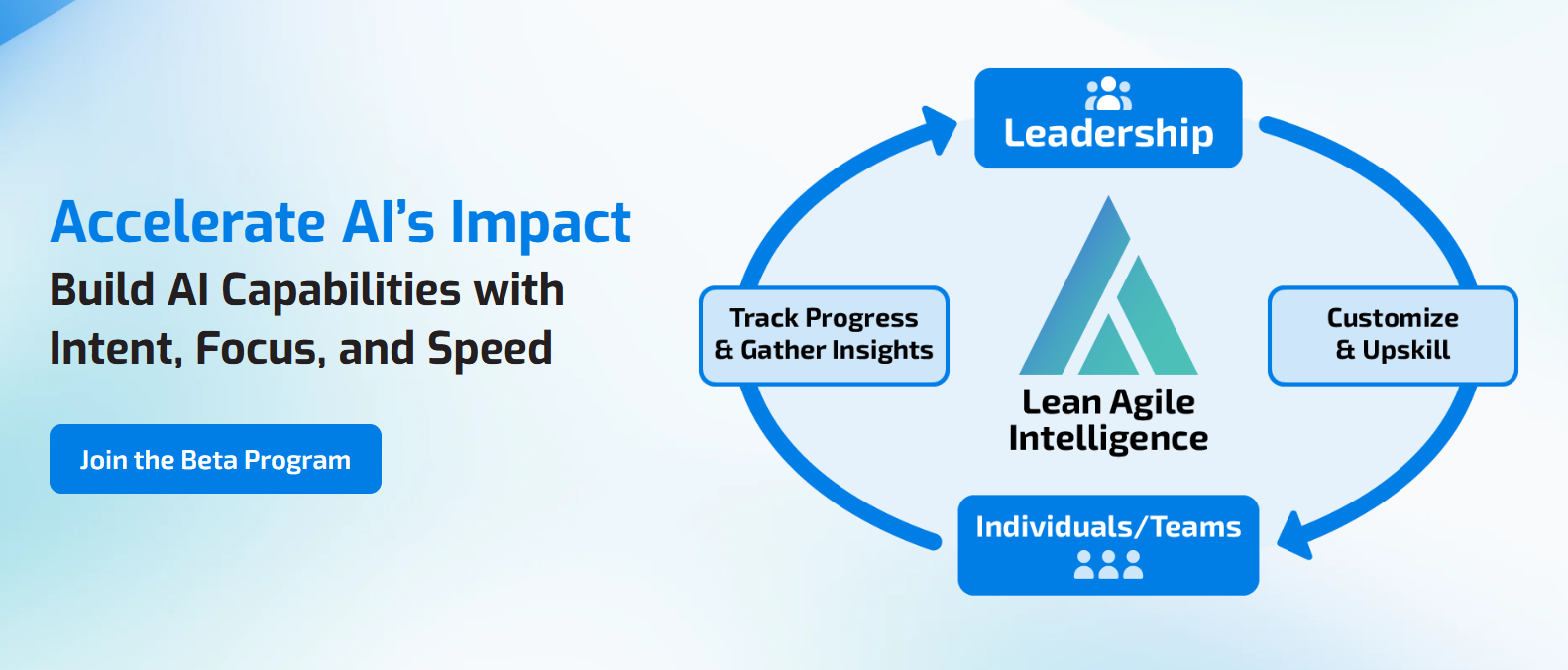
Lean Agile Intelligence helps organizations establish a baseline across AI capabilities and determine whether AI understanding remains dependent on individuals, has developed into shared AI fluency, or consistently influences how employees work.
For AI Understanding, that means looking beyond course completion and evaluating whether employees:
- Share a common understanding of AI
- Recognize AI's strengths and limitations
- Identify appropriate AI use cases
- Provide useful context
- Evaluate AI outputs appropriately
- Apply human judgment where needed
- Continue expanding their understanding as AI evolves