The AI Productivity Paradox: Why Employee Productivity Isn't Translating Into Enterprise ROI
By Team Lean Agile Intelligence
Employees are already seeing the benefits of AI.
Product managers can synthesize information faster. Engineers can accelerate development tasks. Testers can generate scenarios more quickly. Knowledge workers across functions are finding ways to reduce manual effort and complete individual tasks more efficiently.
The research supports what many organizations are experiencing.
Google's 2025 DORA research, based on responses from nearly 5,000 technology professionals, found that 90% use AI at work and more than 80% believe it has increased their productivity.
Yet enterprise leaders are still asking a much harder question:
If AI employee productivity is improving, why isn't that improvement translating more clearly into enterprise ROI?
This disconnect is the AI Productivity Paradox: the growing gap between increased individual productivity and lagging organizational performance, including AI ROI.
The problem is not that AI isn't making people more productive.
The problem is assuming that making individuals faster will automatically make the organization more effective.
What Is the AI Productivity Paradox?
The AI productivity paradox occurs when employees become more productive using AI, but those gains do not translate proportionally into business outcomes.
MIT Project NANDA's preliminary 2025 GenAI Divide research illustrates the challenge from another angle. The research analyzed more than 300 publicly disclosed AI initiatives, interviewed representatives from 52 organizations, and surveyed 153 senior leaders. It found that 95% of organizations in its analysis were seeing no measurable return from GenAI initiatives, while only 5% of integrated AI pilots were generating millions in value.
The report also found that more than 80% of organizations had explored or piloted tools such as ChatGPT and Copilot, and nearly 40% reported deployment. Yet the benefits were primarily showing up in individual productivity rather than P&L performance.
That distinction matters.
An employee may reduce a two-hour task to 30 minutes. That is a real productivity gain.
But enterprise value depends on what happens next.
Does the work move through the organization faster? Does quality improve? Does cost decline? Does throughput increase? Is the freed capacity redirected toward higher-value work?
If not, the productivity gain may remain local.
Individual task productivity does not necessarily equal value delivery or bottom-line impact.
This gap between AI adoption and measurable business value is explored further in Why AI Adoption Isn’t Delivering ROI.

Why AI Employee Productivity Doesn't Automatically Create Enterprise ROI
Organizations do not deliver value through isolated individuals.
Value moves through cross-functional teams, workflows, approvals, dependencies, technology platforms, and handoffs.
As a result, individual productivity gains can easily be absorbed elsewhere in the system.
-
Individual Optimization Doesn't Eliminate System Constraints
-
Imagine an engineer uses AI to complete development work 30% faster. What happens if that work still waits for testing, approval, another team, or a release window?
-
The engineer is faster. The system isn't.
-
This is why local optimization does not necessarily improve overall performance. AI can accelerate one part of a workflow while constraints elsewhere absorb the gain. The underlying principle is simple: delivery is a team sport, and value flows through interconnected workflows and the broader delivery system. That systems perspective becomes even more important when AI is introduced into fragmented teams, workflows, and organizational silos.
-
-
Organizations Speed Up Existing Work Instead of Redesigning It
-
A second problem is using AI to perform the same work faster without questioning whether the workflow itself should change. Teams automate individual tasks while leaving the surrounding process untouched.
-
The bigger opportunity is to ask: If AI changes what is possible, how should this workflow work differently?
-
That could mean eliminating steps, reducing handoffs, changing roles, improving decision-making, or redesigning how teams collaborate.
-
Organizations making greater progress toward AI ROI are not simply adding AI to existing processes. They are building new AI-enabled capabilities and changing how work gets done.
-
-
-
Productivity Gains Don't Have a Destination
-
Suppose AI gives a team 10% more capacity. What happens to it?
-
Without an intentional plan, that capacity can simply turn into more activity: more documents, more work in progress, more scope, or more output flowing into the next bottleneck.
-
Leaders need to connect productivity improvements to an intended outcome:
-
Lower cost
-
Greater throughput
-
Better quality
-
Shorter cycle time
-
Increased innovation capacity
-
Better customer outcomes
-
-
If organizations measure time saved without deciding what they want to do with that time, demonstrating AI ROI becomes much harder.
If you can measure AI usage but still can't clearly see where teams are developing meaningful AI capabilities, LAI's AI assessments can help establish a team-level baseline and identify the gaps and barriers that usage metrics alone may not reveal.

What Organizations Seeing Better AI ROI Do Differently
Closing the AI Productivity Paradox requires organizations to look beyond individual efficiency and focus on how AI changes the broader system of work.
That means moving from isolated AI usage toward shared AI-assisted ways of working across teams. Organizations seeing better AI ROI clarify the capabilities teams should develop, create opportunities to apply AI in real workflows, identify barriers that prevent productivity gains from flowing through the system, and measure whether those changes are improving performance.
In other words, they focus on AI operationalization.
AI adoption gives people access to tools and helps build individual fluency. AI operationalization takes the next step, embedding new capabilities into team workflows, reinforcing them over time, and creating the feedback loops needed for continuous improvement.
For a deeper look at that transition, see AI Adoption vs. AI Operationalization: Why Deploying Tools Isn't Enough, where we explore the structured, intentional, and data-driven approach organizations can use to operationalize AI across teams.
🚀 Want to Accelerate AI Operationalization Across Your Organization?
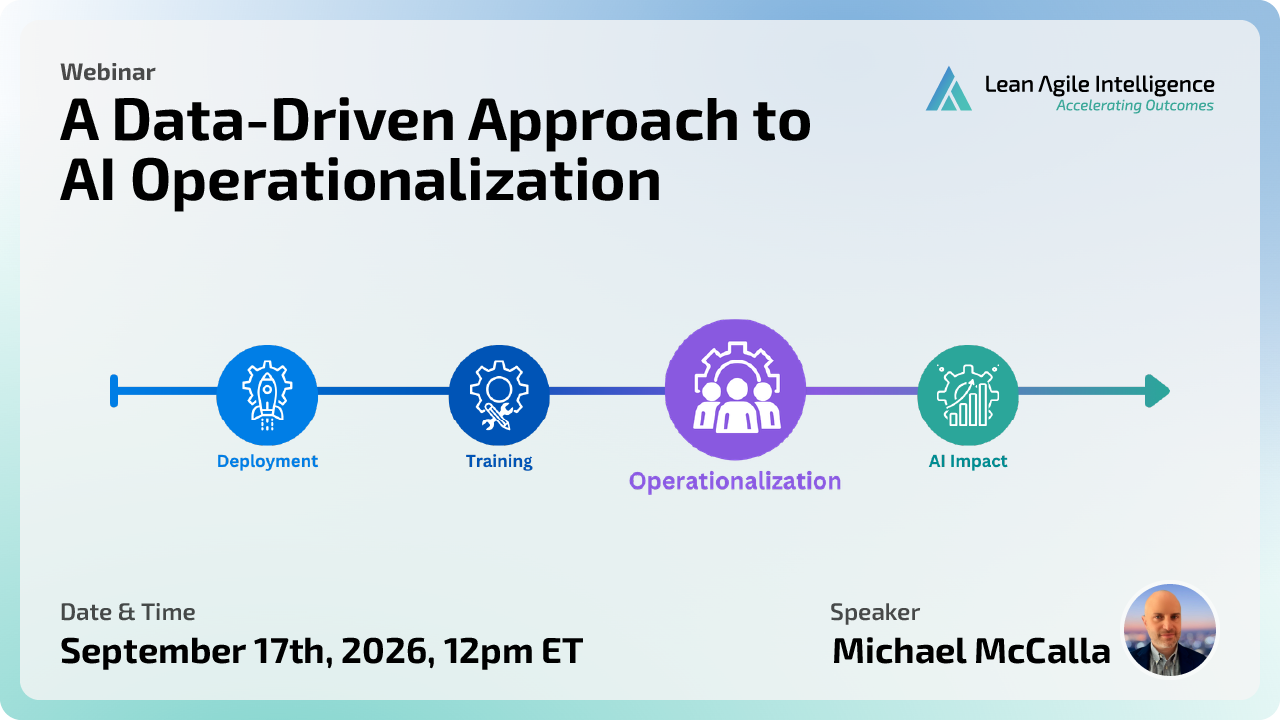
AI deployment is accelerating, but measurable impact isn’t keeping pace.
The next challenge isn’t simply giving people access to AI. It’s operationalizing AI so it can be used effectively, consistently, and at scale.
Join us on September 17 at 12 PM ET for our free webinar:
A Data-Driven Approach to AI Operationalization
Learn how to:
➤ Understand the AI Productivity Paradox and what causes it
➤ Define AI operationalization and how it differs from adoption
➤ View AI operationalization through an organizational change lens
➤ Identify practical ways to accelerate operationalization at the team and organizational levels
Move beyond AI deployment and start building a structured path toward measurable, scalable impact.
👉 Register for the Free Webinar
The AI Productivity Paradox Is a Systems Problem
The rise in AI productivity at the employee level is good news.
It demonstrates that AI can make real work faster and easier.
But individual productivity is only one part of enterprise performance.
The important takeaway is simple:
If productivity improves locally but the system of work does not change, enterprise impact will remain limited.
Workflows, constraints, inconsistent capabilities, and unclear ownership can absorb those gains before they translate into meaningful AI ROI.
The next challenge for enterprise leaders is not simply to increase AI employee productivity.
It is turning individual gains into shared capabilities, better workflows, measurable system improvement, and ultimately better business outcomes.
AI can make people faster.
The bigger opportunity is using it to make the organization better.
Ready to better understand how AI is actually progressing across your teams?
Join Lean Agile Intelligence's AI Assessment Beta Program to understand your teams' current AI capabilities, establish a baseline, identify gaps and barriers, and create a structured, data-driven path toward continuous improvement.
Get Access to LAI's AI Assessment Beta Program