AI Usage Clarity: Turning AI Guidance Into Consistent Use
By Lean Agile Intelligence Product & Research Team
AI usage often expands faster than organizational clarity. Employees gain access to AI tools, experiment with new ways of working, and discover opportunities to reduce effort or improve how work gets done. Without shared AI guidance on when AI should be used, how it should be used, and what responsible usage looks like, those individual experiments quickly become inconsistent.
One manager encourages aggressive experimentation. Another cautions employees to avoid AI altogether. Some teams use AI extensively but quietly. Others remain unsure whether they are even permitted to use it for meaningful work. This is more than a communication problem.
It becomes a barrier to consistent AI adoption and AI operationalization.
Microsoft's 2026 Work Trend Index reported that only 26% of AI users said their leadership was clearly and consistently aligned on AI. The same research highlights clear rules and expectations for how people and AI work together as part of organizational readiness.
Organizations don't simply need more AI usage.
They need AI Usage Clarity.
What Is AI Usage Clarity?
AI Usage Clarity is the organizational capability to create a shared understanding of when, where, and how AI should be used across the organization.
AI Usage Clarity is one capability within LAI's broader AI Maturity Model, which evaluates the capabilities organizations need to move from AI adoption toward operationalization and measurable business outcomes.
That goes beyond:
- Publishing an AI policy
- Approving a set of tools
- Providing AI training
- Telling employees to experiment
Employees need practical answers to questions such as:
- Where is AI encouraged?
- What types of work are appropriate for AI assistance?
- Where is human judgment still critical?
- What expectations exist around reviewing AI-generated work?
- How should AI usage be disclosed when appropriate?
- Which AI use cases are creating value?
- Which tools are approved?
- What information can be used with AI?
- Where should employees go when they need additional AI guidance?
Clarity gives employees enough direction to experiment while establishing consistency around how AI should participate in the work.
That balance matters.
DORA's research has described AI as an amplifier of the organizational system around it: stronger organizational capabilities strengthen the conditions around AI use, while existing weaknesses also remain visible.
The objective is therefore not simply: "Use AI."
It is to progressively establish the: Direction → AI Guidance → Enablement → Workflow Expectations → Feedback Loops
needed to turn individual experimentation into consistent organizational capability.
What Level of AI Usage Clarity Maturity Are You?
Before improving AI usage, identify whether employees primarily rely on individual judgment or whether the organization has established clear expectations that consistently show up in the work.
LAI's AI Usage Clarity Maturity Model uses five levels to describe that progression.
| Level | Where You Are | Primary Focus |
|---|---|---|
| Level 1: Starting | Employees lack a shared understanding of why, when, or how AI should be used, and AI usage depends primarily on individual initiative. | Establish clear organizational direction for appropriate AI use. |
| Level 2: Emerging | Leadership provides clearer direction, experimentation expands, and common expectations begin to form. | Turn early learning and recurring questions into reusable AI guidance. |
| Level 3: Enabling | AI guidance, training, examples, and role-specific resources give employees a defined foundation for applying AI. | Connect guidance directly to roles, tasks, and workflows. |
| Level 4: Operationalizing | AI expectations are consistently reflected in workflows, onboarding, work artifacts, operating procedures, and day-to-day behaviors. | Make appropriate AI usage part of how work is normally performed. |
| Level 5: Optimizing | AI usage and guidance continuously improve based on usage data, employee feedback, workflow performance, business outcomes, and organizational learning. | Continuously improve where and how AI should be applied. |
Choose the level that most closely reflects how AI is actually being used today, not simply what policies or guidance say should happen.
The objective is not to evaluate whether the organization has published AI guidance.
It is to understand whether employees have enough clarity to apply AI consistently and whether that clarity is becoming visible in real work.
The Five Levels of AI Usage Clarity Maturity
LAI's AI Usage Clarity Maturity Model describes how organizations progress from inconsistent individual AI usage toward shared direction, defined guidance, workflow integration, and continuous improvement.
The five levels are:
Starting → Emerging → Enabling → Operationalizing → Optimizing
The progression moves from:
Unclear Expectations → Shared Direction → Defined AI Guidance → Workflow-Embedded Usage → Continuous Improvement
Initially, leadership creates clarity around why and where AI should be used. Organizational learning turns that direction into reusable AI guidance. Role- and workflow-specific enablement helps employees understand how those expectations apply to their work.
Workflow integration makes appropriate AI usage increasingly visible in everyday operating practices.
Measurement and learning then improve both: Where AI is used
and: How AI is used
The objective is not simply: More AI adoption.
It is: More intentional, appropriate, and consistent AI usage.

Level 1: Starting — Expectations Are Unclear
At the Starting level, employees have little shared understanding of how the organization expects them to use AI.
The purpose is unclear. Leadership messages differ. Employees know AI tools exist but remain uncertain about where they should apply them. Some experiment independently. Others wait for explicit permission. Managers create their own interpretations.
As a result, AI usage remains:
- Limited
- Inconsistent
- Fragmented
- Dependent on individual initiative
Observable Evidence
Common signals include:
- Unclear AI purpose
- Conflicting leadership messages
- Ambiguous AI usage expectations
- Limited experimentation
- Employees unsure where AI is appropriate
- Different teams interpreting AI expectations differently
- AI adoption driven primarily by individual initiative
The organization technically has AI available while employees are still asking:
"What exactly are we supposed to do with it?"
How to Progress to Emerging
The first priority is: Clarity, not complexity.
Leadership should establish a consistent answer to three questions:
- Why should we use AI?
- Where should we use AI?
- What expectations govern its use?
Managers need enough direction to reinforce the same core message rather than developing different expectations across teams.
The objective is not to define every possible AI use case upfront.
It is to provide enough AI guidance for employees to begin learning and experimenting intentionally.
Practical Example: Create an AI Usage Charter
Create a simple one- or two-page AI Usage Charter.
Answer five questions:
1. Why Are We Using AI?
What does the organization expect AI to help improve?
Examples include:
- Productivity
- Quality
- Customer experience
- Innovation
- Decision support
2. Where Is AI Encouraged?
Identify appropriate starting areas.
For example:
- Summarizing documents
- Preparing meeting notes
- Researching topics
- Drafting communications
- Analyzing information
3. Where Is Additional Review Required?
Clarify categories of work where greater caution or approval is expected.
4. What Human Review Is Expected?
Establish accountability for evaluating AI-generated work.
5. Where Should Employees Go When They Are Unsure?
Identify the appropriate:
- Manager
- AI enablement team
- Security contact
- Governance group
- Help resource
Then incorporate the same examples into leadership and manager communications.
Employees should hear a consistent message:
Why AI matters → Where it fits → What responsible use looks like
The objective at Starting is not comprehensive governance. It is enough shared direction to begin purposeful AI adoption.

Level 2: Emerging — Direction Begins to Take Shape
At the Emerging level, leadership establishes clearer direction for AI usage and employees have greater permission to experiment.
Leadership communicates more actively about AI. Managers provide greater direction. Governance or steering groups begin forming. Employees see examples of appropriate AI use. Experimentation expands.
The organization shifts from: Ambiguity
toward: Shared direction
Observable Evidence
Observable evidence includes:
- Town halls discussing AI usage
- AI steering groups or councils
- Managers sharing early AI guidance
- Increasing AI experimentation
- Greater leadership consistency
- Early examples of encouraged AI use cases
- Repeated employee questions being surfaced
These are meaningful signals.
But much of the clarity still exists through communication rather than being embedded into how work happens.
Employees understand more about the organization's intentions but still depend heavily on leaders and managers to interpret them.
How to Progress to Enabling
Turn early communications, questions, experiments, and lessons into reusable AI guidance.
Look at what employees are already teaching the organization.
Ask:
- What questions appear repeatedly?
- Which AI experiments are working?
- Where are teams encountering uncertainty?
- Which use cases are becoming common?
- Where are employees interpreting expectations differently?
- Which risks continually surface?
- Which AI usage patterns deserve to become standard?
- Where is existing guidance too vague?
Capture those lessons instead of forcing employees and managers to independently resolve the same questions repeatedly.
The progression becomes: Individual Questions → Shared Learning → Reusable Guidance
Practical Example: Build an AI Usage FAQ and Working Group
Create an AI Usage FAQ based on the questions employees actually ask.
Topics might include:
- Which AI tools are approved?
- Can confidential information be entered?
- When should AI-generated work be reviewed?
- Should AI usage be disclosed?
- Which use cases are encouraged?
- Where is additional approval required?
- What information should not be used?
- Who should employees contact when unsure?
Do not attempt to anticipate every future question. Treat the FAQ as a living resource.
Then establish an AI Council or working group with representation from areas such as:
- Business
- Technology
- Security
- Legal
- HR
- AI enablement
- Transformation
Use that forum to review:
- New use cases
- Employee questions
- Emerging risks
- Repeated friction
- Lessons from experimentation
The result is AI guidance built from actual organizational experience rather than static rules created before meaningful AI adoption begins.

Level 3: Enabling — Clarity Becomes Defined
At the Enabling level, employees have defined AI guidance, training, examples, and resources that help them apply AI appropriately to their work.
Expectations are no longer communicated primarily through leadership messages.
The organization gives employees a repeatable foundation for understanding:
Where AI fits + How AI should be used + What human responsibility remains
This is where clarity becomes tangible.
Observable Evidence
Observable evidence includes:
- AI training programs
- AI usage FAQs
- Role-specific AI guidance
- Workflow-specific AI guidance
- AI use-case examples
- Common AI usage disclosures
- Defined human-review expectations
- Reusable prompts and examples
- Approved-tool guidance
Work artifacts begin reflecting shared patterns rather than every employee or team inventing its own approach.
The organization increasingly has a common answer to: "How should someone in this role use AI for this type of work?"
How to Progress to Operationalizing
Shift the focus from: Explaining AI usage
to: Enabling consistent application
Training should connect directly to real work rather than remaining generic AI education.
AI guidance should show employees:
- Where AI fits in a task
- What AI should do
- What context it needs
- What output is expected
- What human review remains necessary
- What risks matter
Managers should reinforce those expectations through:
- Coaching
- Feedback
- Team practices
- Everyday conversations
The distinction is important: Knowing how AI should be used is not the same as consistently using it that way.
To progress to Operationalizing, employees need to move from: Knowing where AI fits
to: Applying AI consistently where it is appropriate
Practical Example: Create Role-Based AI Usage Guidance
Instead of relying only on an introductory AI course, identify the top 3–5 AI use cases for each major role or function.
For example:
Product Manager
- Summarize customer feedback
- Develop initial hypotheses
- Analyze research
- Draft product communications
HR Business Partner
- Summarize employee feedback
- Prepare meeting materials
- Develop initial communications
- Research policy questions
Sales
- Prepare account research
- Summarize customer interactions
- Develop follow-up communication
- Prepare meeting briefs
For each use case, provide:
- When to Use AI
- What type of work is appropriate?
- Example Approach
- How should the employee begin?
- Expected Output
- What should AI produce?
- Human Review
- What remains the employee's responsibility?
- Risks / Constraints
- What requires additional care?
Then run hands-on sessions using real work rather than hypothetical exercises.
This moves AI guidance closer to the point where employees actually need it.

Level 4: Operationalizing — Clarity Shows Up in the Work
At the Operationalizing level, employees consistently demonstrate the organization's AI expectations in how work gets done.
They no longer simply understand the organization's AI guidance.
AI usage becomes less dependent on individual initiative and increasingly reflected in:
- Workflows
- Roles
- Templates
- Operating procedures
- Onboarding
- Work artifacts
- Team practices
This is the maturity shift from: Knowing what appropriate AI usage looks like
to: Consistently demonstrating it
Observable Evidence
Observable evidence includes:
- Explicit AI steps within workflows
- AI guidance incorporated into onboarding
- Work artifacts demonstrating appropriate AI usage
- Role expectations addressing AI
- Standard operating procedures incorporating AI
- Human-review checkpoints visible in the work
- Increasing appropriate AI utilization
- Less variation in common AI use cases
At Enabling: Employees know how AI should be used.
At Operationalizing: The work itself increasingly reflects those expectations.
The organization can now ask a more meaningful question than: "Are people using AI?"
It can ask: "Are people using AI appropriately and consistently in the work where we expect it to help?"
How to Progress to Optimizing
Embed AI expectations into the systems employees already use.
That includes:
- Workflow steps
- Templates
- Onboarding
- Standard operating procedures
- Role expectations
- Team working agreements
- Coaching practices
- Quality checks
- Review checkpoints
Then evaluate whether those expectations are showing up in actual behavior. Tool access and training completion remain useful activity measures. Operationalized AI usage requires additional evidence.
Examples include:
- Appropriate AI Usage
- Are employees applying AI to the intended workflows?
- Workflow Adoption
- Are defined AI-assisted practices actually being used?
- AI Utilization
- Is meaningful usage increasing where expected?
- Quality
- Does work still meet established standards?
- Cycle Time
- Is the workflow changing in the intended direction?
- Employee Confidence
- Do employees understand how to use AI appropriately?
- Relevant Business Measures
- What is happening to the outcomes the AI-enabled workflow is intended to support?
Do not assume that AI guidance alone caused changes in those outcomes. Use these measures to understand whether the intended AI usage patterns are actually developing.
A useful distinction is:
- Deployment tells you AI is available.
- Operationalization tells you AI is becoming part of the work.
Practical Example: Build AI Usage Into the Workflow
Take a high-value workflow and explicitly define where AI belongs.
Customer Research Workflow
- Collect customer feedback
- Use AI to summarize themes
- Human validates themes
- Use AI to identify potential patterns
- Product team evaluates findings
- Insights inform prioritization
Or:
Executive Communication Workflow
- Gather trusted source information
- Use AI to create the first draft
- Human verifies facts and evidence
- Human adjusts interpretation, tone, and recommendations
- Final approval
Then update:
- Templates
- Standard operating procedures
- Onboarding
- Workflow documentation
- Role guidance
so the AI expectation becomes visible where the work occurs.
At that point:
- AI guidance no longer sits beside the work.
- It becomes part of the work.

Level 5: Optimizing — Clarity Evolves With the Organization
At the Optimizing level, AI usage and guidance continuously improve based on evidence, employee feedback, workflow performance, new use cases, and organizational learning.
AI Usage Clarity is not static. New tools emerge. Employees discover stronger applications. Risks become better understood. Workflows change. AI capabilities evolve. An approach that represented effective AI usage six months ago does not automatically remain the right approach today.
An Optimizing organization uses those lessons to deliberately improve both: Its AI guidance
and: Its ways of working
Observable Evidence
Observable evidence includes:
- Ongoing reviews of AI usage
- Experiments with new ways of applying AI
- AI improvement work items
- Guidance updated based on evidence
- New high-value use cases scaled across teams
- Low-value practices changed or retired
- AI usage patterns reviewed against workflow performance
- Improving utilization where AI is intended to be used
The important distinction is that the organization is not simply monitoring AI usage.
It is: Learning and changing because of what the evidence shows.
How to Sustain and Continuously Improve
Create a continuous feedback loop: Measure → Learn → Improve → Reinforce
Review:
- Usage Data
- Where is AI actually being used?
- Employee Feedback
- Where is guidance unclear or creating unnecessary friction?
- Workflow Performance
- Are intended AI-assisted practices becoming easier and more consistent?
- New Use Cases
- What are employees discovering?
- Low-Value Practices
- What should be changed or retired?
- Guidance Gaps
- Where do employees repeatedly need additional direction?
Then update expectations accordingly.
Optimization means the organization becomes progressively better at answering: Where should we use AI?
and: How should we use it more effectively?
Practical Example: Conduct a Quarterly AI Usage Review
Run a formal quarterly review.
Ask:
- Where is AI being used most?
- Where is usage lower than expected?
- Which use cases show evidence worth investigating further?
- Which use cases create friction or risk?
- What new AI use cases have employees discovered?
- Where is existing AI guidance unclear?
- Which expectations need to change?
- What should be scaled?
- What should be modified?
- What should stop?
Turn the findings into an AI Usage Improvement Backlog.
| Improvement | Reason | Measure |
|---|---|---|
| Improve AI use in customer research | Defined workflow is inconsistently used | Workflow adoption |
| Strengthen prompt guidance | Employees repeatedly ask for support | Employee confidence |
| Test AI-assisted meeting preparation | High recurring manual effort | Preparation time |
| Clarify human-review expectations | Teams interpret requirements differently | Review consistency |
| Retire low-value AI workflow | Usage exists but intended value is not evident | Usage / relevant outcome |
| Add role-specific examples | Generic guidance is difficult to apply | Role adoption |
Then choose: Keep → Clarify → Expand → Embed → Modify → Retire
The objective is not to continuously add:
- More tools
- More training
- More policies
It is to continuously improve:
How clearly and effectively the organization directs AI usage.
Connecting AI Guidance to AI Adoption
AI guidance supports AI adoption by giving employees enough direction to understand where AI fits, what appropriate use looks like, and what responsibilities remain theirs.
AI adoption without sufficient guidance creates several possible patterns: High Usage + Low Clarity
Employees experiment extensively, but practices vary and risk becoming fragmented.
Low Usage + Low Clarity
Employees remain uncertain and avoid meaningful experimentation.
Clear Guidance + Limited Application
Employees understand the expectations but have not yet incorporated AI into their work.
The stronger progression is: Direction → AI Guidance → Enablement → Application → Workflow Adoption → Learning
This is why AI Usage Clarity should not be measured only through:
- Policy publication
- Training completion
- Tool deployment
- License utilization
Those measures show that organizational conditions exist.
The more important questions are:
- Do employees understand where AI belongs?
- Do they understand how to use it appropriately?
- Does that understanding show up in the work?
- Does the organization learn from actual AI usage and improve its guidance?
The objective is not maximum AI adoption.
It is: Intentional AI adoption in the work where the organization expects AI to create value.
Related capabilities: AI Strategy, AI Use Case Prioritization
Key Takeaway
AI Usage Clarity maturity isn't achieved when an organization publishes AI guidance. It is demonstrated when employees understand where and how AI should be used, consistently apply those expectations in their work, and the organization continuously improves its guidance based on evidence and learning.
From AI Adoption to AI Operationalization
AI Usage Clarity provides the direction required to move from individual AI adoption toward consistent AI-enabled ways of working.
Organizations need employees to experiment with AI.
But experimentation without shared direction creates fragmented behavior rather than repeatable organizational capability.
The maturity model progresses from:
Unclear Expectations → Shared Direction → Defined AI Guidance → Workflow-Embedded Usage → Continuous Improvement
Initially, leadership establishes why and where AI belongs. Early experimentation creates learning. Reusable AI guidance translates that learning into shared expectations. Role- and workflow-specific enablement helps people apply those expectations consistently. Workflow integration makes appropriate AI usage visible in everyday work. Measurement and feedback then improve the way AI is used over time.
- That is the progression from: AI adoption
- to: AI operationalization
- The objective is not simply: More AI usage.
- It is: More intentional, appropriate, and effective AI usage within the work where AI belongs.
Evaluate Whether AI Guidance Is Actually Changing How People Work
Publishing AI guidance creates direction. The more important question is whether employees understand that guidance well enough to apply it consistently in their work.
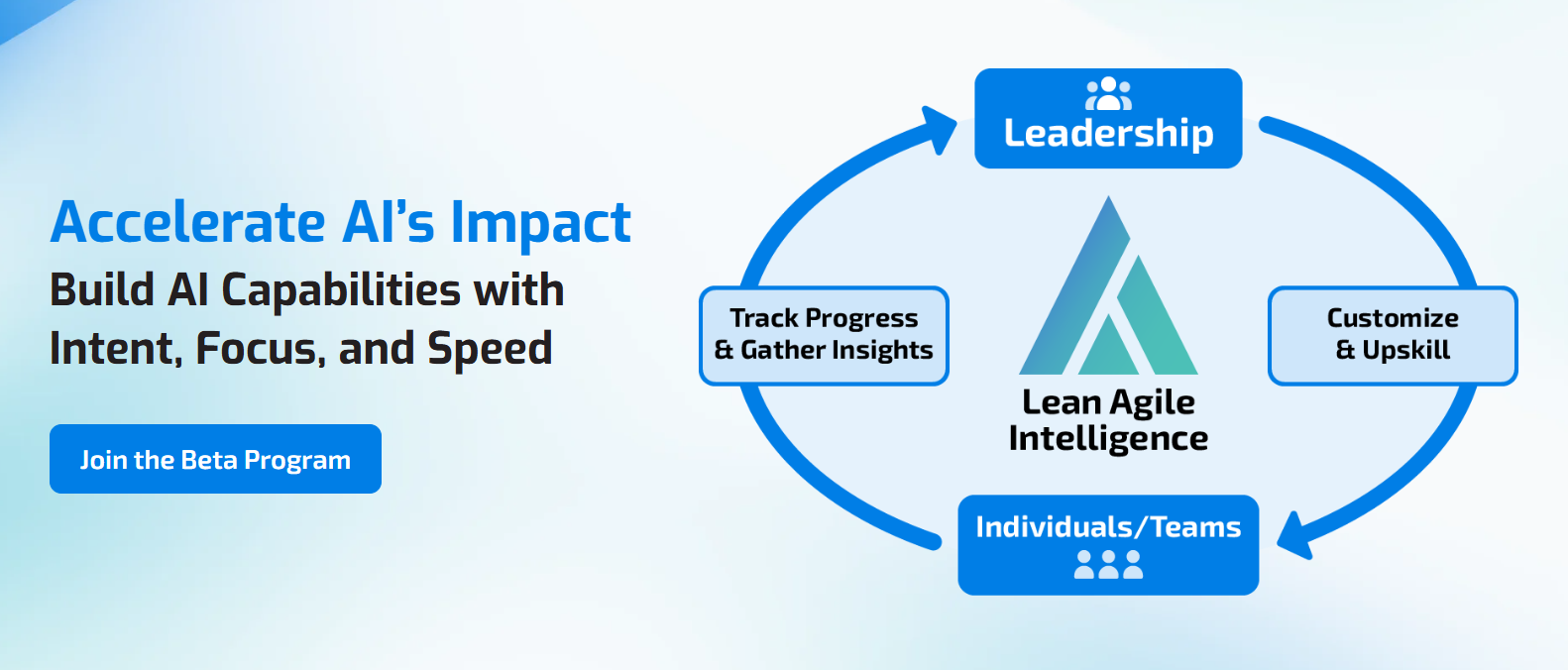
Lean Agile Intelligence helps organizations establish a baseline across AI capabilities and determine whether AI Usage Clarity remains dependent on individual interpretation, has become a shared organizational practice, or is embedded directly into standard workflows.
For AI Usage Clarity, that means evaluating whether the organization:
- Creates clear direction for AI usage
- Defines where AI is encouraged
- Establishes practical human-review expectations
- Provides reusable AI guidance
- Uses role- and workflow-specific examples
- Gives employees somewhere to resolve uncertainty
- Incorporates AI guidance into onboarding
- Embeds expected AI usage into workflows
- Measures actual application rather than training alone
- Learns from employee feedback
- Updates guidance as tools and use cases change
- Retires practices that no longer create value
- Uses evidence to continuously strengthen AI adoption
LAI's AI Enablement & Productivity Assessment establishes a baseline across AI Usage Clarity and the related capabilities teams need to operationalize AI, identifies gaps, and measures progress over time.
Assess Your AI Usage Clarity Capability
Prefer to start with early access? Join the AI Assessment Beta Program.