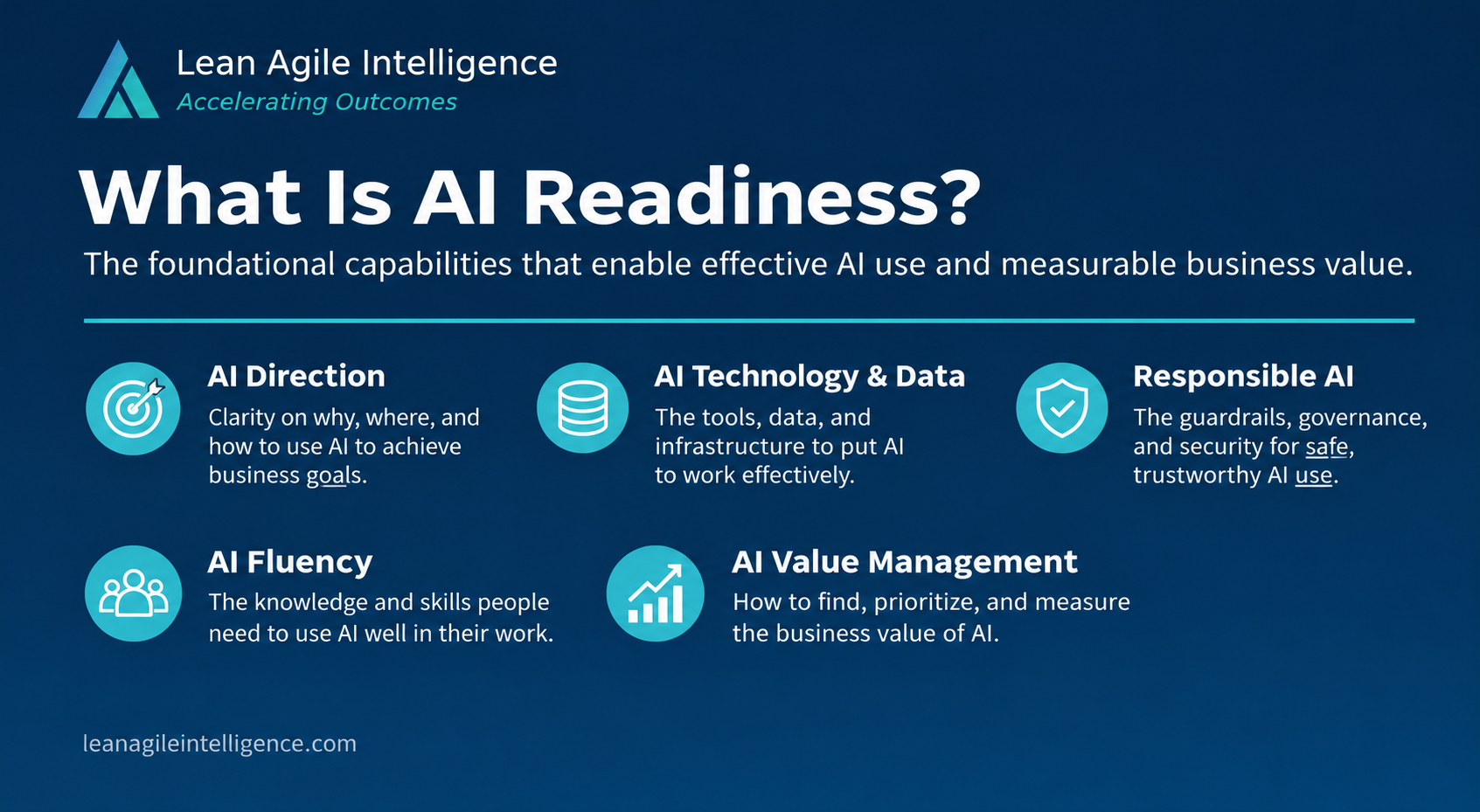
AI readiness is whether an organization has the foundations in place to apply AI effectively and turn it into measurable business outcomes. Most organizations we work with have invested in AI tools and trained their people, but having the tools and the training isn’t the same as being ready.
The Lean Agile Intelligence AI Readiness Model organizes these foundations into five dimensions: AI Direction, AI Technology & Data, Responsible AI, AI Fluency, and AI Value Management. Each dimension contains three capabilities, and because they depend on one another, weaknesses in one can limit the effectiveness of the others.
In our work with customers, we often see organizations focusing their AI readiness efforts on only a few of the five dimensions rather than taking a comprehensive approach across all five.
Why Is AI Readiness Important?
Organizations are investing significant resources in AI and expecting measurable returns. Yet many organizations are finding that deploying AI tools and providing training alone isn't delivering the business outcomes they anticipated.
Research reinforces this challenge. Atlassian's State of Teams 2026 found that while 89% of executives report AI is increasing the speed of work, only 6% are confident they can demonstrate organization-wide AI ROI.
This reinforces the need for a proactive, structured approach to AI readiness that establishes the foundational capabilities required to support effective AI adoption and measurable business outcomes.
What Are the Five Dimensions of an AI Readiness Framework?
Understanding AI readiness starts with identifying the key factors that determine whether an organization is prepared to adopt AI effectively. The Lean Agile Intelligence AI Readiness Model provides a structured framework built around five foundational dimensions, establishing the capabilities required and how they work together.
1. AI Direction
AI Direction gives people clarity on why AI is being used, where it should be applied, and how it supports business goals. Without it, people are left to decide on their own where AI fits and what it’s meant to achieve.
- AI Usage Clarity establishes shared expectations so people understand where AI fits into their work and what effective use looks like.
- AI Strategy defines how the organization plans to achieve its goals through AI. It guides investment decisions and prioritization while keeping initiatives aligned with business outcomes. A good strategy also considers how to realize value early and scale successful approaches.
- AI Roadmap turns that strategy into a coordinated plan. It helps stakeholders understand what's happening, when it's happening, and how initiatives and dependencies fit together.
2. AI Technology & Data
AI Technology & Data gives people the tools, infrastructure, and information they need to put AI to work. The best AI tools deliver little when they don’t fit the work or can’t reach the right data.
- AI Tools & Platforms provides people with the right technology for their work, including tools that integrate with existing systems and workflows.
- AI Data Access ensures relevant information is available and usable for AI applications. That means having appropriate access to standardized, accurate, and up-to-date data in formats AI tools can use safely.
- AI Infrastructure provides the technical environment needed to run AI-powered work reliably and securely. It must also support growing demand as AI use expands across the organization.
3. Responsible AI
Responsible AI sets the principles, boundaries, and safeguards for using AI safely. It mitigates the legal, security, and reputational risks of AI while making clear what people can do, not just what they can’t.
- AI Ethics promotes fairness and transparency while establishing principles that guide responsible decisions about AI.
- AI Governance defines what is allowable, who is accountable, and the boundaries people must operate within when using AI.
- AI Security protects sensitive information and systems through appropriate safeguards and controls.
4. AI Fluency
AI Fluency is the knowledge and skill people need to use AI well in their own work. Training builds awareness, but fluency comes from applying AI to real work.
- AI Understanding reflects how well people understand what AI is, how it works, and what it can and cannot do. It also includes knowing when AI is appropriate for a task.
- AI Prompting is about interacting effectively with AI. People develop techniques for providing clear instructions and relevant context, then refining those interactions to achieve better results.
- AI Output Evaluation establishes expectations for evaluating AI-generated work. People need to know how to check accuracy, assess quality, recognize limitations, and determine whether an output is suitable for its intended purpose.
5. AI Value Management
AI Value Management is how an organization finds, prioritizes, and measures the value of AI. It’s the dimension most often overlooked, and the one that determines whether AI investment pays off.
- AI Use Case Discovery enables organizations to intentionally identify opportunities where AI could solve meaningful problems or improve how work gets done.
- AI Use Case Prioritization provides a structured way to determine which opportunities deserve attention and investment. The goal is to focus execution on work with the greatest potential business value.
- AI Impact Measurement establishes how an organization evaluates the impact of its AI solutions, including whether they are producing the intended business outcomes.
Common AI Readiness Gaps and How to Address Them
Many organizations have the elements of AI readiness in place and still struggle to turn them into effective adoption. The gap is usually between what has been established and what people actually need to succeed.
| Common AI readiness gap | What it looks like | What needs to improve |
|---|---|---|
| Lack of clear AI direction | The organization has an AI strategy, but people don't understand how it connects to their work, which opportunities matter most, or what success looks like. | Connect AI strategy and priorities to everyday work, with clear expectations for where and why AI should be applied. |
| Technology and data limitations | Approved tools are available, but they don't always support specialized work or provide access to relevant, reliable data. | Identify tooling and data gaps, improve integration with existing workflows, and provide secure access to usable information. |
| Unclear AI governance and safeguards | Policies exist, but they're too complex or unclear for people to confidently understand what is allowed. | Establish practical guardrails and clear accountability so people can use AI safely and confidently. |
| Insufficient practical AI fluency | Employees have completed AI training, but lack the hands-on experience and skills to apply AI effectively to their work. | Build fluency through hands-on AI enablement, ongoing feedback, and knowledge sharing. |
| Weak AI value management | Pilots demonstrate potential, but opportunities aren't consistently prioritized or evaluated against measurable business outcomes. | Establish consistent practices for discovering, prioritizing, and measuring AI opportunities based on business value. |
How Do You Measure AI Readiness? A Practical AI Readiness Checklist
Measuring AI readiness requires assessing the maturity of foundational capabilities across the five dimensions to understand where an organization is prepared and where improvements are needed.
An AI readiness assessment tool provides a practical way to establish shared expectations, understand current capabilities, and identify where improvement is needed.
Assessing AI readiness also helps organizations:
- Accelerate AI readiness. Give people and teams a clear understanding of what's required so they can put the necessary foundations in place more effectively.
- Identify capability gaps. Understand where foundational capabilities need improvement across groups and teams.
- Reduce implementation risk. Identify weaknesses that could undermine successful adoption before they become larger problems.
- Prioritize AI investments. Focus resources on the improvements most likely to support successful adoption and deliver value.
- Measure readiness and progress. Establish a consistent baseline, compare readiness across groups and teams, and track improvement over time.
The process involves three steps: defining what readiness looks like, establishing consistent maturity criteria, and assessing capabilities to guide improvement.
1. Define What AI Readiness Looks Like
Start with the five dimensions introduced earlier, identifying the capabilities required for effective AI adoption and establishing clear expectations across the organization. These dimensions provide a practical AI readiness checklist for evaluating whether the foundational capabilities are in place and identifying where additional development is needed.
AI readiness is typically driven at the organizational level, where leadership establishes the foundations needed to support AI adoption. However, organizations often discover further down the road that there's a disconnect between leadership's perception of readiness and the reality across teams. Leadership believes the organization is well prepared, while the teams closest to the work see gaps in the capabilities they depend on to use AI successfully.
Defining readiness helps close that disconnect. Everyone should have a common understanding of what's required, why it matters, and what successful readiness looks like. While readiness establishes the organizational foundations, effective adoption depends on building AI-enabled capabilities and shared practices within teams and groups. This is why teams should be the target of AI enablement.
The five dimensions provide the foundational capabilities needed for AI readiness. However, every organization has unique objectives and requirements that may call for additional capabilities to be intentionally developed. That's why the Lean Agile Intelligence platform allows organizations to configure their readiness model to reflect their specific needs and environment.
2. Establish a Maturity Model
An AI maturity model describes each capability at every maturity level, so people can see where they are today and what the next level requires.
At Lean Agile Intelligence, we use five maturity levels:
- Starting: The capability is not yet in place, or exists only informally.
- Emerging: Practices begin to form, but they're individual, inconsistent, and lack shared guidance.
- Enabling: Effective practices are shared and repeatable across groups and teams.
- Operationalizing: Workflows are redesigned to build those shared practices into how work gets done.
- Optimizing: Practices and workflows are continuously improved based on results and feedback.
These maturity levels describe how well each capability is established and practiced across the organization. For example, an organization might be Operationalizing its AI Governance capability while still Emerging in AI Impact Measurement.
This gives leaders and teams a shared understanding of where capabilities stand, where improvement is needed, and what to work on next.
3. Assess Readiness and Act on Insights
Once capabilities and maturity criteria are defined, organizations can assess readiness across groups and teams. Each capability is evaluated against the maturity criteria, supported by evidence of what's actually in place.
Understanding organizational AI readiness requires visibility across groups and teams. In the Lean Agile Intelligence platform, team results roll up into group and organization-level views, so leaders can spot patterns across the organization and drill into the details. They can see where gaps are systemic and need organization-wide improvement, and where specific groups or teams need targeted support.
While AI readiness assessments evaluate the foundational capabilities needed across the organization, more targeted assessments can examine how AI is being applied within specific teams. For example, the Delivery Team AI Enablement & Productivity Assessment evaluates AI-enabled capabilities across engineering, testing, and product management.
Regular reassessments and feedback loops help organizations monitor progress, learn what is working, and adjust their direction, investments, and support as needs change.
None of this works without trust, which is why the assessment needs a thoughtful change management approach. People should understand why readiness is being assessed and how the results will be used. The goal is honest feedback and development, not rating individual performance.
How AI Readiness, Adoption, Operationalization, Maturity, and Enablement Connect
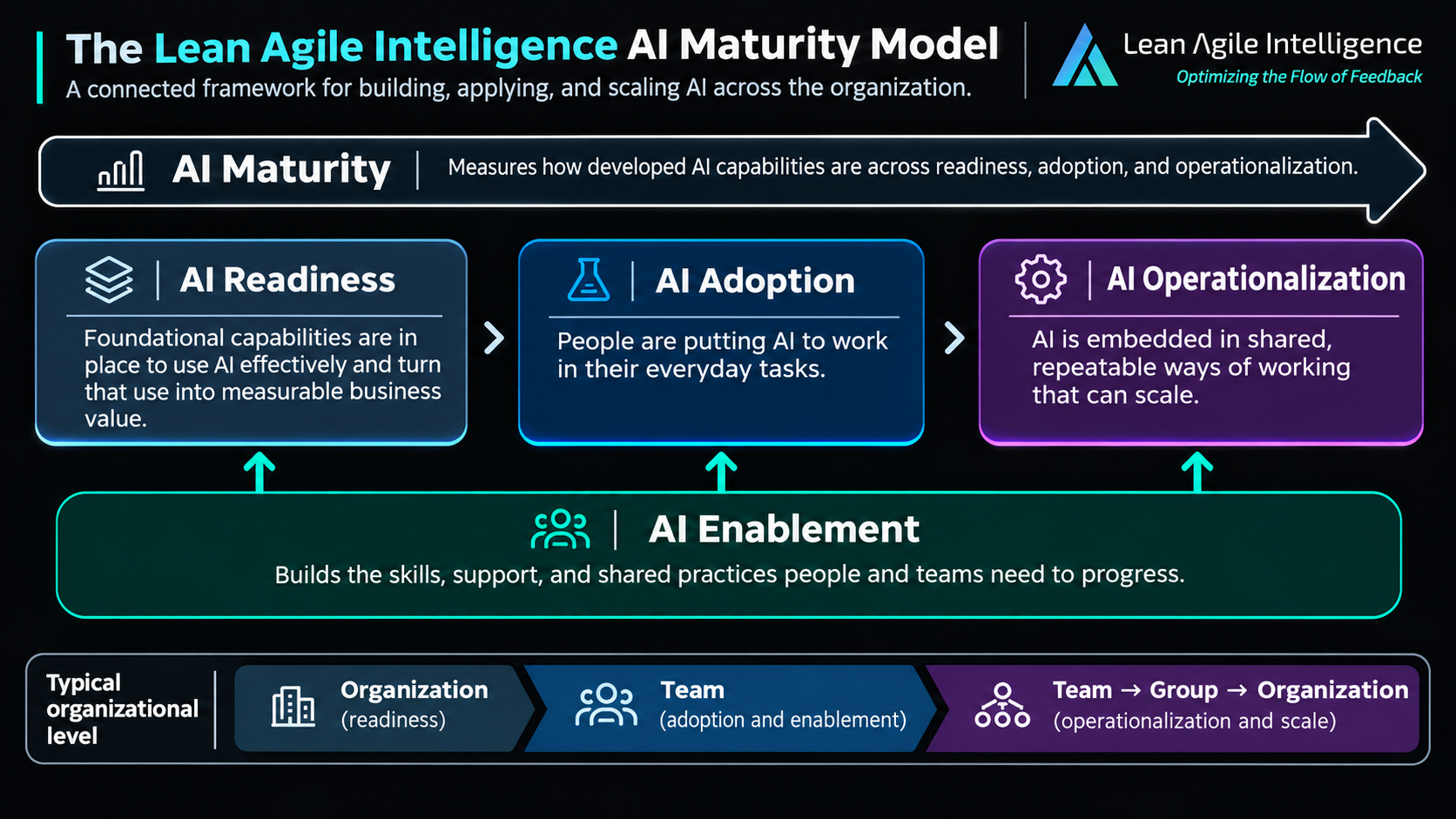
How AI readiness, adoption, operationalization, maturity, and enablement connect.
These terms are often used interchangeably, but they all connect through one idea: capabilities. AI readiness, AI adoption, and AI operationalization represent three interconnected stages of an organization's AI journey.
AI Readiness establishes the organizational foundations needed to apply AI effectively and achieve the intended business outcomes.
AI Adoption develops the AI-enabled capabilities and shared practices that allow people and teams to apply AI effectively to their work.
AI Operationalization embeds AI-enabled capabilities into redesigned, repeatable workflows, including agentic workflows, so organizations can consistently deliver and scale the benefits of AI.
Two additional concepts, AI maturity and AI enablement, apply across the entire journey.
AI Maturity measures how developed these capabilities are using consistent maturity levels, from Starting through Optimizing.
AI Enablement provides the guidance, support, learning, and shared practices needed to develop these capabilities and advance their maturity.
Understand Your Organization’s AI Readiness
Deploying AI tools and tracking usage show that AI is in the building. They don’t show whether the organization is ready to get value from it. Readiness comes down to capabilities: whether the foundations are in place for people and teams to adopt AI effectively and, over time, operationalize it into how work gets done.
Measuring the maturity of those capabilities across groups and teams shows where the foundations are strong, where the gaps are, and where enablement will make the biggest difference.
Is Your Organization Ready for AI?
Understand your AI readiness, identify capability gaps, and discover opportunities to build the foundations for effective AI use.
Start Your Free AI Readiness Assessment →Looking for a More Comprehensive Assessment?
Establish a baseline across your teams, prioritize capability improvements, and measure progress over time with Lean Agile Intelligence.
Explore the Full AI Readiness Assessment →
Frequently Asked Questions About AI Readiness
What makes an organization AI ready?
An organization is AI ready when it has the foundational capabilities required to support its intended AI use. These capabilities span five dimensions: AI Direction, AI Technology & Data, Responsible AI, AI Fluency, and AI Value Management. The level of readiness required depends on the organization’s objectives and should be supported by evidence of what is actually in place.
What’s the difference between AI readiness and AI adoption?
AI readiness is whether the foundational capabilities are in place for AI to be adopted effectively. AI adoption is the development of AI-enabled capabilities and shared practices that allow people and teams to apply AI effectively to their work.
Is AI readiness the same as AI maturity?
No. AI readiness is the set of foundational capabilities an organization needs to use AI effectively. AI maturity describes how developed a capability is, whether it supports readiness, adoption, or operationalization. Maturity is how readiness is measured, not a separate goal.
What is an AI readiness framework?
An AI readiness framework defines the capabilities an organization needs for effective AI use and the criteria for evaluating how developed they are. It gives leaders and teams consistent expectations, a shared view of current readiness, and clear priorities for improvement.
What should an AI readiness checklist include?
An AI readiness checklist should cover the foundational capabilities an organization needs to adopt AI effectively. The Lean Agile Intelligence AI Readiness Model organizes these capabilities into five dimensions: AI Direction, AI Technology & Data, Responsible AI, AI Fluency, and AI Value Management. Organizations should evaluate whether these capabilities are in place, identify gaps, and use a maturity model to prioritize improvements and track progress over time.
How does the Microsoft AI Readiness Assessment differ from the Lean Agile Intelligence AI Readiness Assessment?
The Microsoft AI Readiness Assessment is primarily designed for enterprise leaders to evaluate their organization's preparedness for AI adoption and provides recommendations for leadership actions to improve readiness.
The Lean Agile Intelligence AI Readiness Assessment is designed for both enterprise leaders and practitioners (groups, teams, and individuals), providing actionable guidance, AI-powered recommendations, and ongoing measurement to help leaders improve organizational readiness and teams adopt AI effectively.
How do you assess AI readiness?
Assessing AI readiness starts with defining the capabilities required and establishing clear expectations for what good looks like. A maturity model provides the criteria for evaluating each capability across groups and teams, with team results rolling up into group and organization-level views. Regular reassessments help identify gaps, guide improvements, and measure progress over time.
How does AI readiness relate to NIST AI RMF or ISO/IEC 42001?
They address different questions. The NIST AI Risk Management Framework and ISO/IEC 42001 guide how organizations manage AI risk and run an AI management system. An AI readiness assessment looks more broadly at whether people and teams have the capabilities to use AI effectively and achieve measurable outcomes. Work done under NIST or ISO/IEC 42001 directly strengthens the Responsible AI dimension.