AI Adoption Strategy: 7 Steps for Moving Beyond Experimentation
By Lean Agile Intelligence Product & Research Team
For most organizations, AI adoption is no longer the problem.
Employees have access to ChatGPT, Copilot, Gemini, and a growing number of specialized AI tools. Training programs are underway. Experiments and pilots are everywhere. Individuals are finding ways to work faster.
Yet many organizations are still struggling to answer a much more important question:
Is AI actually improving business performance?
That disconnect is at the heart of what we call the AI Productivity Paradox: individuals report meaningful productivity gains from AI, but those gains do not necessarily translate into measurable enterprise-level value.
The data increasingly supports this conclusion. Atlassian’s State of Teams 2026 found that 89% of executives say AI has increased the speed of work, yet only 6% are confident they can point to clear organization-wide AI ROI.
Google’s 2025 DORA research tells a similar story. Ninety percent of technology professionals surveyed were using AI at work, and more than 80% believed it had increased their productivity. But DORA’s broader conclusion was more important: AI acts as an amplifier of the organizational system around it. Strong workflows, teams, platforms, and feedback loops can magnify AI’s value. Weaknesses in those systems can be magnified as well.
That means the next stage of enterprise AI adoption cannot simply be about deploying more tools.
Organizations need an AI adoption strategy designed to move from access and experimentation to repeatable, measurable, AI-assisted ways of working.
What Is an AI Adoption Strategy?
An AI adoption strategy is a structured approach for turning AI access and experimentation into repeatable, measurable ways of working across an organization.
An effective AI adoption strategy connects:
- Business outcomes
- AI-assisted capabilities
- Employee and team behaviors
- Workflows and processes
- Governance and organizational support
- Enablement and coaching
- Measurement and continuous improvement
The goal is not simply to increase AI usage.
The goal is to change how work gets done in ways that produce measurable business value.
A strong enterprise AI adoption strategy should answer four questions:
- What business outcomes are we trying to improve?
- What AI-assisted capabilities and ways of working do our teams need?
- What barriers are preventing teams from applying AI effectively?
- How will we know whether AI is improving business performance?
The 7 Steps of an Effective AI Adoption Strategy
A practical AI adoption framework includes seven steps:
- Start with business outcomes, not AI tools.
- Treat AI adoption as an organizational change.
- Define the AI-assisted ways of working you want to build.
- Establish a team-level baseline.
- Turn AI knowledge into ability through intentional practice.
- Redesign workflows, not just individual tasks.
- Measure, reinforce, learn, and scale.
Together, these steps help organizations move from isolated AI experimentation toward AI operationalization.
1. Start With Business Outcomes, Not AI Tools
An effective AI adoption strategy starts with the business outcome the organization wants to improve, not with the AI technology it purchased.
AI investments generally need to contribute to one or both of two broad outcomes:
- Productivity: How can AI help us perform existing work cheaper, faster, or better?
- Innovation: How can AI help us create new products, services, customer experiences, or revenue opportunities?
The mistake is beginning with the technology:
“We bought Copilot. How do we get everyone to use it?”
That makes usage the objective.
Instead, start with the business problem:
- Where are we losing time?
- Where is work getting stuck?
- Where is quality suffering?
- Where are there opportunities to increase capacity?
- Which customer or employee problems could AI help us solve differently?
- What measurable outcome would tell us AI is creating value?
This distinction matters because AI tool utilization and AI value realization are not the same thing.
Deployment creates access.
Adoption creates usage.
Neither automatically creates impact.
AI transformation ultimately has to be judged by measurable AI impact—not by deployment activity alone.
An effective AI adoption framework connects the capabilities and behaviors enabled by AI to measurable improvements in business performance.
2. Treat AI Adoption as an Organizational Change
Enterprise AI adoption is a change-management challenge as much as it is a technology challenge.
One reason AI initiatives stall is that organizations often manage them like technology deployments rather than large-scale organizational changes. A useful way to understand this is through the Prosci ADKAR Model, which describes five outcomes required for successful change:
Awareness → Desire → Knowledge → Ability → Reinforcement
Learn more about the Prosci ADKAR Model
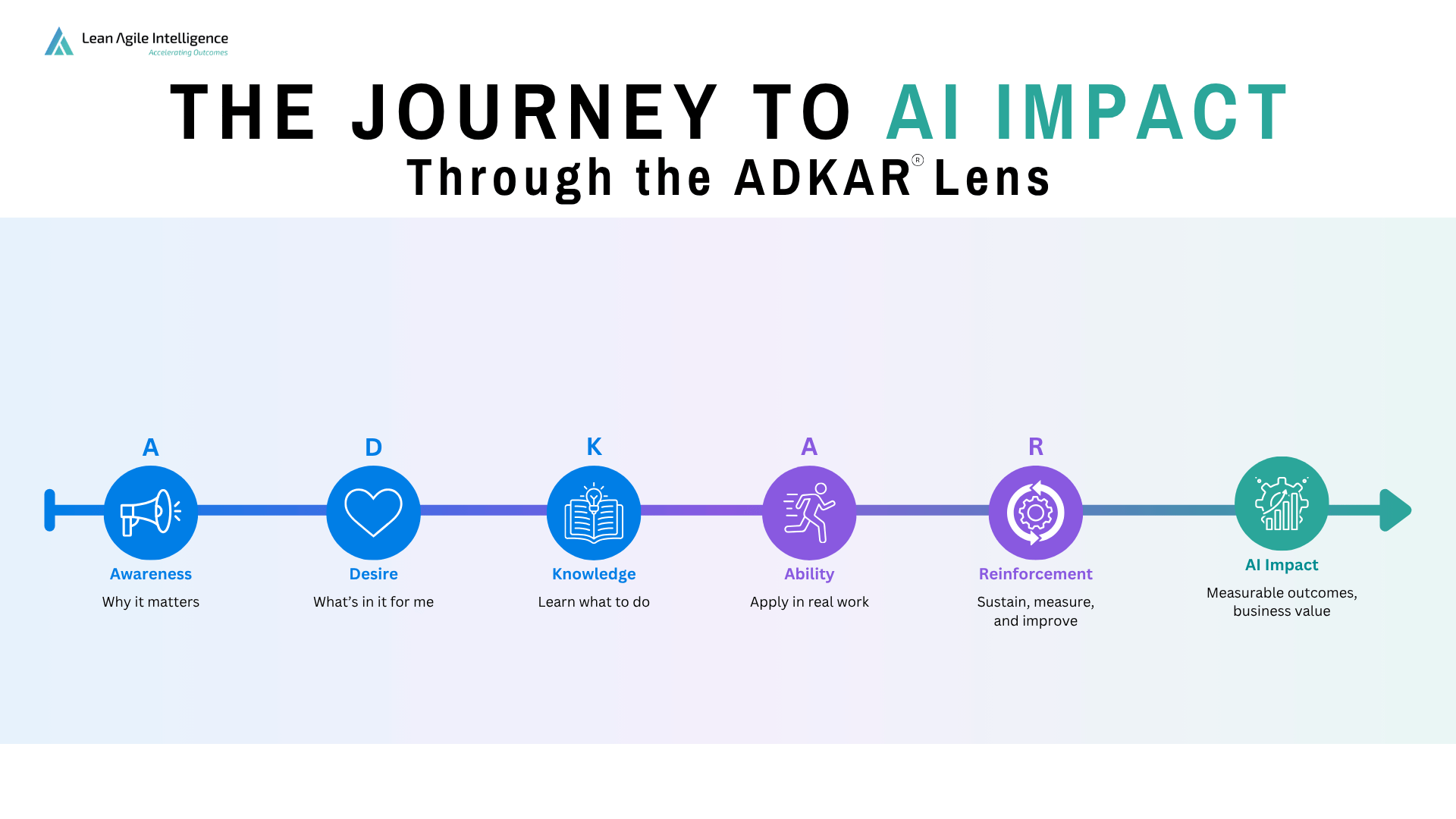
Most enterprise AI adoption programs invest heavily in the first three.
Organizations communicate why AI matters. They provide licenses. Leaders encourage experimentation. Employees attend training sessions, learn prompting techniques, and build AI fluency.
Those activities are important. But they primarily activate the change.
The harder work happens with the final two stages: Ability and Reinforcement.
Ability asks:
Can teams consistently apply what they learned to real work?
Reinforcement asks:
Can the organization sustain, measure, adapt, and improve those new behaviors over time?
Prosci distinguishes knowledge from ability for an important reason: knowing how to perform a new behavior does not mean someone can consistently perform it in practice.
This is where many organizations develop what we call the AI Operationalization Gap.
What Is the AI Operationalization Gap?
The AI Operationalization Gap is the distance between introducing and adopting AI and deeply embedding it into day-to-day work in a way that produces measurable value.
Organizations can have high AI awareness, strong training participation, and significant tool usage while still struggling to change how work actually gets done.
A more effective AI adoption strategy must therefore extend beyond rollout and training into the systems required to operationalize the change.
3. Define the AI-Assisted Ways of Working You Want to Build
Teams need a clear understanding of what effective AI-assisted work looks like. Telling employees to “use AI more” is not a strategy.
Organizations should define the capabilities and ways of working teams need to develop.
Depending on the organization, those capabilities might include:
- Responsible AI and governance
- AI fluency
- Prompting and output evaluation
- AI value management
- Use-case discovery and prioritization
- AI-assisted product management
- AI-assisted engineering and coding
- AI-assisted testing
- Workflow automation
- Agentic ways of working
The objective is not to prescribe exactly how every team must work.
It is to create enough structure that teams understand what good looks like, while maintaining enough autonomy for teams to determine how those capabilities should be applied within their context.
That creates a common language across the organization.
Without it, enterprise AI adoption can quickly become hundreds of unrelated experiments. One team becomes highly sophisticated while another barely gets started. Practices develop independently. Lessons are difficult to share. Leaders have little visibility into where meaningful adoption is occurring.
Structure gives the organization a common destination without requiring every team to take exactly the same route.
Make Sure the Environment Supports AI Adoption
Team capability alone is not enough. Enterprise AI adoption also depends on organizational conditions that allow those capabilities to develop.
These may include:
- Access to approved AI tools
- Appropriate access to data
- Clear security and responsible AI policies
- Governance that enables rather than unnecessarily blocks experimentation
- Defined ownership and accountability
- Leadership support
- Time and capacity for teams to learn
- Technical platforms capable of supporting AI-enabled workflows
The goal is not to perfect every organizational foundation before teams begin using AI.
The goal is to understand which conditions are enabling adoption and which are creating barriers to it.
Do you know where your teams actually are in their AI journey?
LAI AI Assessments help organizations define the capabilities required for AI-enabled ways of working, establish a baseline across teams, identify gaps, and provide actionable next steps for improvement.
4. Establish a Team-Level Baseline
Organizations cannot improve AI adoption systematically if they do not understand their current capabilities, behaviors, and barriers.
This is one of the most important and most frequently overlooked, parts of an AI adoption strategy.
Organizations often rely on activity metrics:
- Number of AI licenses assigned
- Number of active users
- Prompt volume
- Training completion
- AI tool usage
Those metrics can tell you whether people have access to and are interacting with AI.
They cannot necessarily tell you whether new capabilities and ways of working are developing.
Instead, establish a baseline at the team and team-of-teams level. A strong AI maturity model can extend that baseline beyond readiness and usage by examining how AI is showing up in real work, what capabilities are developing, and whether greater AI effectiveness is contributing to measurable outcomes.
An AI assessment can help teams examine questions such as:
- Are AI tools and appropriate data accessible?
- Do teams understand responsible AI expectations?
- Can team members effectively evaluate AI-generated output?
- Are teams identifying and prioritizing meaningful AI use cases?
- Is AI incorporated into shared workflows or primarily used by individuals?
- Are teams measuring whether AI is improving outcomes?
- What organizational barriers are preventing further progress?
Importantly, these assessments should not be treated as audits, grades, or employee evaluations.
They should create conversations.
The goal is to understand whether the environment, workflows, support systems, and capabilities created by the AI initiative are actually enabling teams to succeed.
That data can then be aggregated across teams, products, portfolios, or business units to create enterprise visibility.
Instead of asking:
“How do we think our AI transformation is going?”
Leaders can begin asking:
“What does the data tell us?”
5. Turn AI Knowledge Into Ability Through Intentional Practice
AI training creates knowledge. AI adoption requires people to turn that knowledge into repeatable ability.
Employees can understand prompting, attend AI workshops, and watch demonstrations without ever changing how their teams actually deliver work.
Organizations therefore need to deliberately create the conditions for teams to learn by doing.
That includes:
- Targeted coaching and enablement
- Time to experiment
- Opportunities to practice
- Resources tied to specific capability gaps
- Clear expectations
- Recommended next steps
- Support for removing barriers
One of the biggest mistakes organizations make is expecting people to transform how they work on top of 100% existing capacity.
If developing AI-assisted ways of working matters, organizations may need to deliberately allocate time for it in capacity planning.
In some cases, teams need to slow down temporarily so they can go significantly faster later.
AI itself can also make this model more scalable.
Instead of relying exclusively on centralized transformation or enablement teams, AI can provide contextual recommendations, coaching, examples, and next-step guidance based on the specific capabilities a team needs to improve.
This changes enablement from a primarily push-based model to a much more targeted, demand-driven one.
6. Redesign the Workflow—Not Just the Individual Task
The greatest enterprise value from AI often comes from redesigning workflows, not simply making individual tasks faster.
This may be the most important evolution in enterprise AI adoption.
Individual productivity does not necessarily equal value delivery.
Organizations do not deliver value through isolated individuals. Value flows through interconnected workflows, cross-functional teams, and systems of delivery. That is also why the team should become a primary unit of AI enablement: it is where individual knowledge can become shared practices, workflows can change, and local productivity gains can begin translating into better delivery.
Suppose AI allows one person to complete a task 40% faster. That sounds valuable.
But what happens if:
- The work immediately sits in a queue for two days?
- Somebody downstream spends additional time reviewing AI-generated output?
- Another department becomes the new bottleneck?
- The person simply produces more work than the system can absorb?
The individual productivity improvement is real, but the business impact may be negligible. There is another risk: optimizing AI within individual roles or functions can inadvertently recreate functional silos, improving one part of the system while leaving the end-to-end flow of value unchanged.
DORA’s research reinforces this system-level view, concluding that the greatest returns from AI come not simply from the tools themselves but from the surrounding workflows, organizational capabilities, platforms, and cultural environment.
Google Cloud's work on measuring AI business value makes a similar distinction between engineering speed and sustainable financial impact.
So instead of asking:
“How can this person perform this task faster with AI?”
Start asking:
“How should this workflow operate differently now that AI exists?”
That changes the unit of improvement. The focus shifts from individual AI usage toward shared AI-assisted ways of working.
It also requires clear ownership. Someone must be accountable not simply for AI adoption, but for improving how AI contributes to measurable outcomes.
7. Measure, Reinforce, Learn, and Scale
AI adoption should operate as a continuous improvement system rather than a one-time transformation program.
This is where the data-driven component of the strategy becomes critical.
Teams should periodically reassess their capabilities, review progress, identify barriers, select improvement actions, and measure what happens next.
The cycle is straightforward:
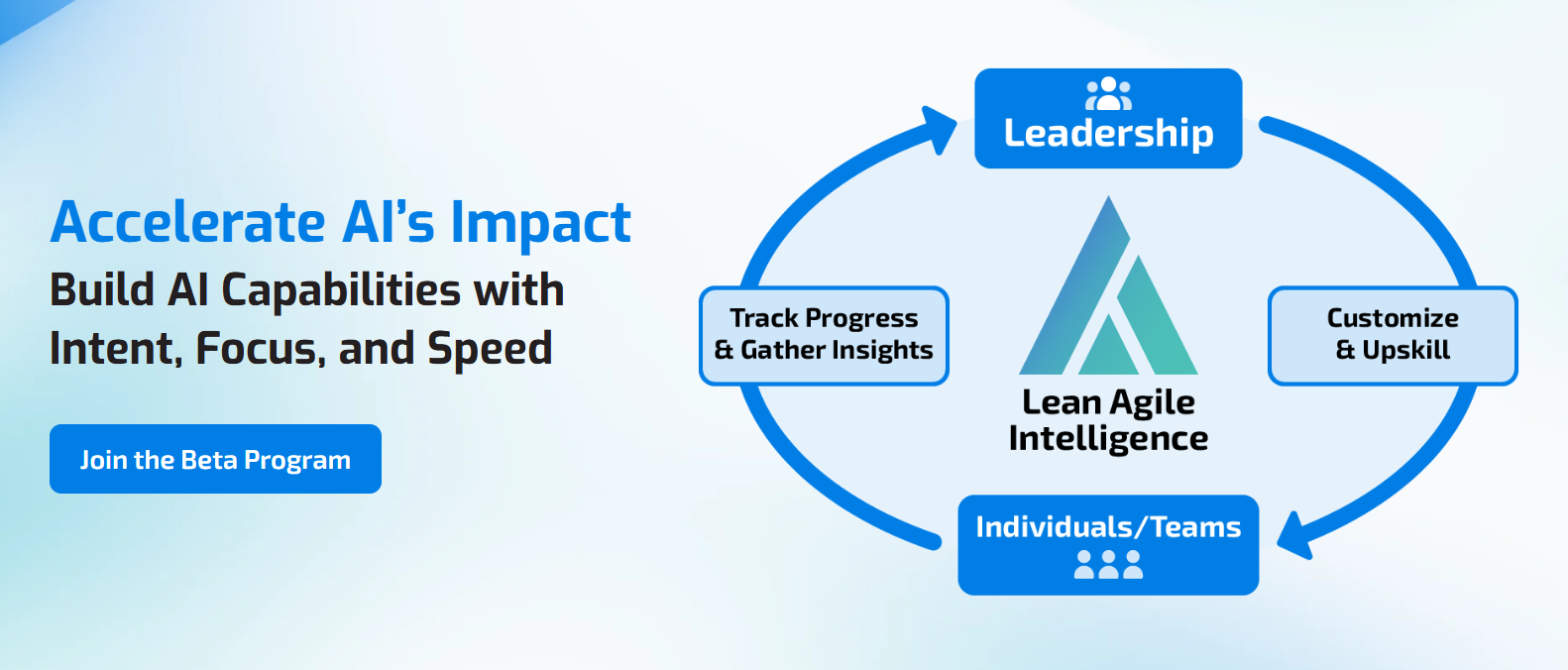
Define capabilities → establish a baseline → identify gaps → take improvement actions → measure progress → learn → repeat.
The objective should not be to obsess over an isolated assessment score.
Look for patterns and trends.
Ask:
- Which capabilities are improving?
- Where are teams consistently getting stuck?
- Are certain organizational policies creating barriers?
- Which teams have developed practices others could learn from?
- Are improvements in AI capabilities corresponding with improvements in business or delivery metrics?
- Where should enablement resources be deployed?
- Which experiments should be scaled?
- Which should be stopped?
This creates something many enterprise AI programs currently lack:
A feedback loop between strategy and execution.
Team-level insights can roll up into team-of-teams, portfolios, business units, and eventually enterprise-level views.
Leaders gain visibility without dictating every team's actions. Teams maintain autonomy while the organization develops more consistent capabilities.
And AI adoption becomes empirical.
Instead of rolling out a transformation plan and hoping it works, organizations can continuously inspect what is happening, learn from the data, and adapt.
Ready to move your AI strategy from experimentation to operationalization?
Join the LAI AI Assessment Beta Program to establish a baseline with your teams, identify the capabilities and barriers affecting AI adoption, and help shape the next generation of LAI's AI assessment and coaching capabilities.
A Better AI Adoption Framework: Structured, Intentional, and Data-Driven
A scalable AI adoption framework should be structured, intentional, and data-driven.
Taken together, the seven steps point to a different way of thinking about AI transformation.
- Structured: Define the AI-assisted capabilities and expectations teams need to develop so people understand what good looks like.
- Intentional: Give teams the coaching, resources, practice time, capacity, and support needed to deliberately develop those capabilities.
- Data-Driven: Establish baselines, measure progress, identify systemic barriers, create feedback loops, and use evidence to decide where to invest.
In simple terms:
- Structured: What capabilities do we need?
- Intentional: How will we help teams build them?
- Data-driven: How will we know whether we are improving?
This is fundamentally different from simply buying AI tools and encouraging employees to experiment. And the distinction is becoming increasingly important.
Atlassian's research found that many AI strategies continue to focus disproportionately on individuals despite the fact that much of the work that creates value happens at the team level.
The implication for leaders is significant:
The next competitive advantage will not come from who gives employees access to AI first.
Access is rapidly becoming ubiquitous.
The advantage will come from which organizations learn how to systematically incorporate AI into the way work gets done—and continuously improve those ways of working.
Turning Your AI Adoption Strategy Into AI Operationalization
AI adoption gets people using AI. AI operationalization embeds AI into the way the organization works and connects that change to measurable outcomes. The distinction between AI adoption and AI operationalization is critical.
AI adoption remains important. People need access, awareness, motivation, knowledge, and fluency. But adoption is the beginning of the journey, not the destination.
The larger opportunity is AI operationalization: embedding AI into shared ways of working, building the capabilities necessary to use it effectively, measuring the results, removing barriers, and continuously adapting the operating model.
That is how organizations begin closing the gap between individual productivity and enterprise value.
And that is how an AI adoption strategy evolves from a collection of experiments into a scalable system for change.
The question organizations should be asking is no longer:
“Are our people using AI?”
It is:
“Are we changing how work gets done—and is that change producing measurable value?”
Move Beyond AI Experimentation
Giving teams AI tools is only the starting point. LAI's AI Assessments help organizations understand where teams are today, identify the capabilities required to improve, uncover barriers to AI adoption, and create a measurable path toward AI operationalization.